

Evaluation of Newly Introduced Durum Wheat Genotypes for Performance and Resilience in Algerian Semi-Arid Climate
 AMAR ROUABHI
Published 2026-06-29
Keywords
- wheat,
- yield components,
- Genotype x Environment Interaction,
- stability,
- semi-arid
- Algeria ...More
How to Cite
Copyright (c) 2026 AMAR ROUABHI, ABDELALI DJELLOUL, ABDELHAMID MEKHLOUF

This work is licensed under a Creative Commons Attribution 4.0 International License.




Abstract
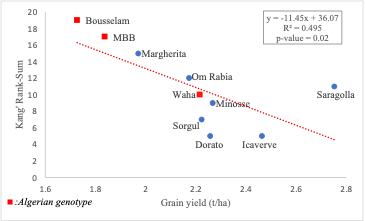
This research investigates the performance of ten durum wheat genotypes under the rainfed conditions of a semi-arid environment in Algeria over three growing seasons (2020-2023). The experimented genotypes, included three Algerian landraces, used as check plant material, along with Italian, Turkish, Tunisian and ICARDA genotypes. The experiment was part of the international PRIMA project "IMPRESA", aimed to improve resilience to abiotic stresses in durum wheat. Results underlined the significative effect of season variability over all yield components, a genotypic variability between landraces and introduced genotype and an effect of heading earliness stage. Meanwhile, interesting Interactions have been shown between season-genotype and season-heading earliness stage. Introduced genotypes showed highest grain yield over seasons, with 2.75t ha-1 for G5. However, G1 and G8 showed high stability over seasons. In contrast, introduced genotype (G4) recorded highest instability over seasons with 15 and 42 for Kang's rank-sum and Wricke's ecovalence indices respectively. Also, results showed that Algerian landraces are balanced performers compared to the introduced genotypes, this finding allows to draw future screening scheme from the experimented plant material.
References
- Araus, J. L., & Kefauver, S. C. (2018). Breeding to adapt agriculture to climate change: Affordable phenotyping solutions. Current Opinion in Plant Biology, 45, 237–247. https://doi.org/10.1016/j.pbi.2018.05.003
- Asseng, S., Ewert, F., Martre, P., Rötter, R. P., Lobell, D. B., Cammarano, D., ... & Zhu, Y. (2015). Rising temperatures reduce global wheat production. Nature climate change, 5(2), 143-147.
- Asseng, S., Foster, I., & Turner, N. C. (2011). The impact of temperature variability on wheat yields. Global Change Biology, 17(2), 997–1012. https://doi.org/10.1111/j.1365-2486.2010.02262.x
- Becker, H. C., & Léon, J. (1988). Stability Analysis in Plant Breeding. Plant Breeding, 101(1), 1–23. https://doi.org/10.1111/j.1439-0523.1988.tb00261.x
- Blasius, J., & Thiessen, V. (2012). Assessing the quality of survey data. https://www.torrossa.com/gs/resourceProxy?an=4912249&publisher=FZ7200
- Bouchafaa, B., Kherchi-Medjden, H., & Rouaski, K. (2023). Is Wheat Self-Sufficiency in Algeria, a Myth? SocioEconomic Challenges, 7(1), 52–58. https://doi.org/10.21272/sec.7(1).52-58.2023
- Djermoun, A. (2009). La production céréalière en Algérie: Les principales caractéristiques. Revue Nature et Technologie, 1, 45–53.
- FAO. (2024). GIEWS Country Brief. https://www.fao.org/giews/countrybrief/country/DZA/pdf_archive/DZA_Archive.pdf
- Fellahi, Z., Hannachi, A., Guendouz, A., Bouzerzour, H., & Boutekrabt, A. (2013). Study of interrelationships among yield and yield related attributes by using various statistical methods in bread wheat (Triticum aestivum L. em Thell.). Electronic Journal of Plant Breeding, 1161–1166.
- Ferrante, A., Cartelle, J., Savin, R., & Slafer, G. A. (2017). Yield determination, interplay between major components and yield stability in a traditional and a contemporary wheat across a wide range of environments. Field Crops Research, 203, 114–127. https://doi.org/10.1016/j.fcr.2016.12.028
- Fischer, R. A. (2011). Wheat physiology: A review of recent developments. Crop and Pasture Science, 62(2), 95–114.
- Flohr, B. M., Hunt, J. R., Kirkegaard, J. A., & Evans, J. R. (2017). Water and temperature stress define the optimal flowering period for wheat in south-eastern Australia. Field Crops Research, 209, 108–119. https://doi.org/10.1016/j.fcr.2017.04.012
- Foulkes, M. J., Slafer, G. A., Davies, W. J., Berry, P. M., Sylvester-Bradley, R., Martre, P., Calderini, D. F., Griffiths, S., & Reynolds, M. P. (2011). Raising yield potential of wheat. III. Optimizing partitioning to grain while maintaining lodging resistance. Journal of Experimental Botany, 62(2), 469–486. https://doi.org/10.1093/jxb/erq300
- Garoui, S., & Aissani, R. (2024). The reality of agricultural investment in algeria and its role in achieving food security: An analytical study of the wheat market in Algeria (2016-2022). Brazilian Journal of Business, 6(3), e72685. https://doi.org/10.34140/bjbv6n3-026
- Haro, E. S., & Allan, R. E. (1997). Effects of Heading Date on Agronomic Performance of Winter Wheat Isolines. Crop Science, 37(2), 346–351. https://doi.org/10.2135/cropsci1997.0011183X003700020006x
- Kaplan, D. (2004). The SAGE Handbook of Quantitative Methodology for the Social Sciences. SAGE Publications.
- Kiliç, H., Akçura, M., & Aktaş, H. (2010). Assessment of Parametric and Non-parametric Methods for Selecting Stable and Adapted Durum Wheat Genotypes in Multi-Environments. Notulae Botanicae Horti Agrobotanici Cluj-Napoca, 38(3), 271–279. https://doi.org/10.15835/nbha3834742
- Kouri, D. (2017). Algeria dependency on imported food. Recherches Économiques, 16, 8–23.
- Linting, M., Meulman, J. J., Groenen, P. J. F., & Van Der Koojj, A. J. (2007). Nonlinear principal components analysis: Introduction and application. Psychological Methods, 12(3), 336–358. https://doi.org/10.1037/1082-989X.12.3.336
- Liu, Z., Qin, J., Tian, X., Xu, S., Wang, Y., Li, H., Wang, X., Peng, H., Yao, Y., Hu, Z., Ni, Z., Xin, M., & Sun, Q. (2018). Global profiling of alternative splicing landscape responsive to drought, heat and their combination in wheat (Triticum aestivum L.). Plant Biotechnology Journal, 16(3), 714–726. https://doi.org/10.1111/pbi.12822
- Lobell, D. B., Ortiz-Monasterio, J. I., & Falcon, W. P. (2007). Yield uncertainty at the field scale evaluated with multi-year satellite data. Agricultural Systems, 92(1–3), 76–90. https://doi.org/10.1016/j.agsy.2006.02.010
- Martínez-Peña, R., Rezzouk, F. Z., Díez-Fraile, M. D. C., Nieto-Taladriz, M. T., Araus, J. L., Aparicio, N., & Vicente, R. (2023). Genotype-by-environment interaction for grain yield and quality traits in durum wheat: Identification of ideotypes adapted to the Spanish region of Castile and León. European Journal of Agronomy, 151, 126951. https://doi.org/10.1016/j.eja.2023.126951
- Mondal, S., Singh, R. P., Crossa, J., Huerta-Espino, J., Sharma, I., Chatrath, R., Singh, G. P., Sohu, V. S., Mavi, G. S., Sukuru, V. S. P., Kalappanavar, I. K., Mishra, V. K., Hussain, M., Gautam, N. R., Uddin, J., Barma, N. C. D., Hakim, A., & Joshi, A. K. (2013). Earliness in wheat: A key to adaptation under terminal and continual high temperature stress in South Asia. Field Crops Research, 151, 19–26. https://doi.org/10.1016/j.fcr.2013.06.015
- Porter, J. R., & Gawith, M. (1999). Temperatures and the growth and development of wheat: A review. European Journal of Agronomy, 10(1), 23–36. https://doi.org/10.1016/S1161-0301(98)00047-1
- Pourtabrizi, S., Mohamadi-Nejad, G., Khajoei-Nejad, G., & Abdolshahi, R. (2022). Pleiotropic effect of Ppd-D1a on earliness, yield and yield components of bread wheat under well-watered and rain-fed conditions. In Review. https://doi.org/10.21203/rs.3.rs-2276346/v1
- Rebetzke, G. J., Chenu, K., Biddulph, B., Moeller, C., Deery, D. M., Rattey, A. R., Bennett, D., Barrett-Lennard, E. G., & Mayer, J. E. (2013). A multisite managed environment facility for targeted trait and germplasm phenotyping. Functional Plant Biology, 40(1), 1. https://doi.org/10.1071/FP12180
- Reynolds, M. P., & Trethowan, R. M. (2007). Physiological interventions in breeding for adaptation to abiotic stress. In Scale and complexity in plant systems research (pp. 129-146). Springer, Dordrecht.
- Reynolds, M., & Langridge, P. (2016). Physiological breeding. Current Opinion in Plant Biology, 31, 162–171. https://doi.org/10.1016/j.pbi.2016.04.005
- Reynolds, M. P., Quilligan, E., Aggarwal, P. K., Bansal, K. C., Cavalieri, A. J., Chapman, S. C., Chapotin, S. M., Datta, S. K., Duveiller, E., Gill, K. S., Jagadish, K. S. V., Joshi, A. K., Koehler, A.-K., Kosina, P., Krishnan, S., Lafitte, R., Mahala, R. S., Muthurajan, R., Paterson, A. H., … Yadav, O. P. (2016). An integrated approach to maintaining cereal productivity under climate change. Global Food Security, 8, 9–18. https://doi.org/10.1016/j.gfs.2016.02.002
- Rockström, J., Karlberg, L., Wani, S. P., Barron, J., Hatibu, N., Oweis, T., Bruggeman, A., Farahani, J., & Qiang, Z. (2010). Managing water in rainfed agriculture—The need for a paradigm shift. Agricultural Water Management, 97(4), 543–550. https://doi.org/10.1016/j.agwat.2009.09.009
- Sabaghnia, N., Dehghani, H., & Sabaghpour, S. H. (2006). Nonparametric Methods for Interpreting Genotype × Environment Interaction of Lentil Genotypes. Crop Science, 46(3), 1100–1106. https://doi.org/10.2135/cropsci2005.06-0122
- Sadras, V. O., & Slafer, G. A. (2012). Environmental modulation of yield components in cereals: Heritabilities reveal a hierarchy of phenotypic plasticities. Field Crops Research, 127, 215–224. https://doi.org/10.1016/j.fcr.2011.11.014
- Sahnoune, F., Belhamel, M., Zelmat, M., & Kerbachi, R. (2013). Climate Change in Algeria: Vulnerability and Strategy of Mitigation and Adaptation. Energy Procedia, 36, 1286–1294. https://doi.org/10.1016/j.egypro.2013.07.145
- Semenov, M. A., & Porter, J. R. (1995). Climatic variability and the modelling of crop yields. Agricultural and Forest Meteorology, 73(3–4), 265–283. https://doi.org/10.1016/0168-1923(94)05078-K
- Semenov, M. A., Stratonovitch, P., Alghabari, F., & Gooding, M. J. (2014). Adapting wheat in Europe for climate change. Journal of Cereal Science, 59(3), 245–256. https://doi.org/10.1016/j.jcs.2014.01.006
- Shavrukov, Y., Kurishbayev, A., Jatayev, S., Shvidchenko, V., Zotova, L., Koekemoer, F., De Groot, S., Soole, K., & Langridge, P. (2017). Early Flowering as a Drought Escape Mechanism in Plants: How Can It Aid Wheat Production? Frontiers in Plant Science, 8, 1950. https://doi.org/10.3389/fpls.2017.01950
- Slafer, G. A. (2003). Genetic basis of yield as viewed from a crop physiologist’s perspective. Annals of Applied Biology, 142(2), 117–128. https://doi.org/10.1111/j.1744-7348.2003.tb00237.x
- Slafer, G. A., Araus, J. L., Royo, C., & Moral, L. F. G. (2005). Promising eco-physiological traits for genetic improvement of cereal yields in Mediterranean environments. Annals of Applied Biology, 146(1), 61–70. https://doi.org/10.1111/j.1744-7348.2005.04048.x
- Tsenov, N., Gubatov, T., & Yanchev, I. (2023). Effect of genotype-environment interaction on some important quality parameters of common wheat (Triticum aestivum L.). Agricultural Science and Technology, 15(2), 3–16. https://doi.org/10.15547/ast.2023.02.011
- USDA. (2025). Grain and Feed Update (Grain and Feed Nos. AG2025-0001; p. 15). https://apps.fas.usda.gov/newgainapi/api/Report/DownloadReportByFileName?fileName=Grain+and+Feed+Update_Algiers_Algeria_AG2025-0001.pdf