

Impact of Soil and Water Conservation Measures on Wheat Productivity and Farmers’ Income: Evidence from Tigray, Northern Ethiopia
Published 2026-06-29
Keywords
- Soil degradation,
- Soil water conservation,
- Wheat productivity,
- Impact assessment,
- Switching regression
- Northern Ethiopia ...More
How to Cite
Copyright (c) 2026 Tsegay Assefa, Mitiku Haile, Melaku Behre

This work is licensed under a Creative Commons Attribution 4.0 International License.




Abstract
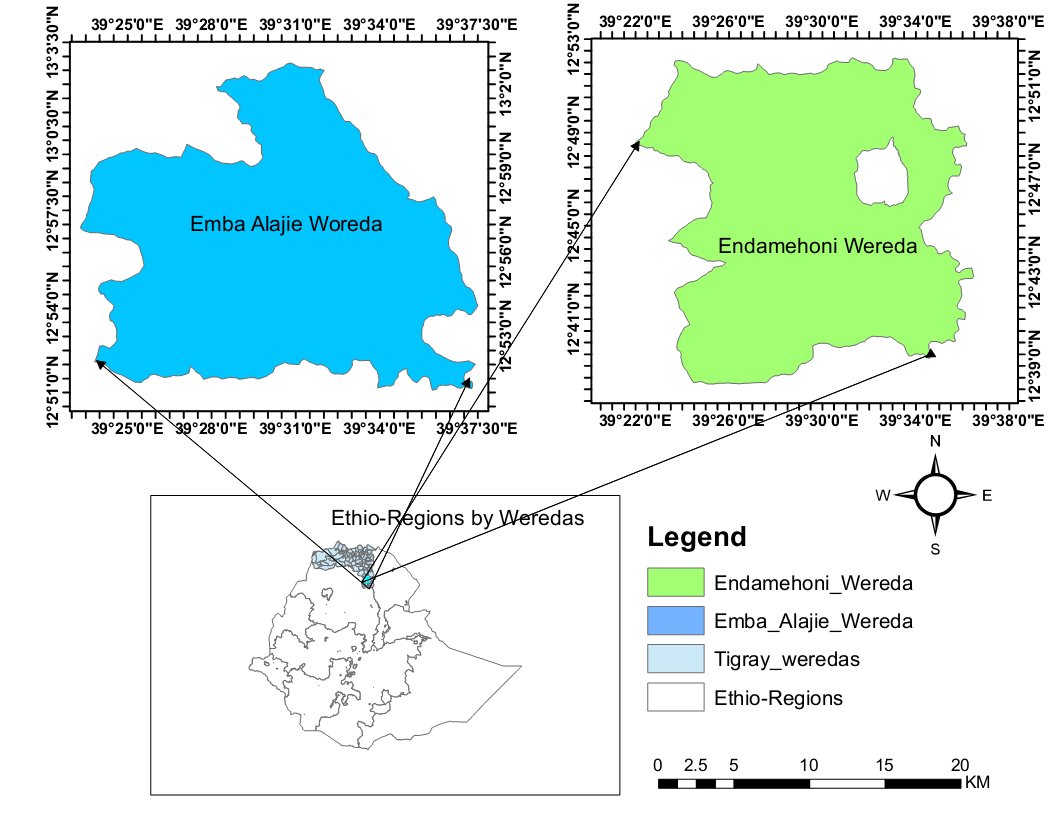
Soil and water conservation (SWC) practices are considered vital for improving agricultural productivity and farmer income in areas vulnerable to soil erosion and climate variability. Nevertheless, the impact of SWC practices on wheat productivity and income remains unclear because of the presence of selection bias in adoption decisions. Data were gathered randomly from 335 wheat farmer household heads from purposively selected Woredas of Emba Alaje and Endamehoni and Tabias of Atsela, Sesat, and Mekhan via a multistage sampling technique. This study examines the impact of SWC practices on wheat yield and farmer income in Tigray, northern Ethiopia. It utilizes the endogenous switching regression (ESR) model, which addresses potential endogeneity in the adoption process. The ESR model indicates that, compared with nonadopter farmers, farmers who adopt SWC practices significantly (p < 0.01) experience increases in wheat yield and income of 18.9% and 25.6%, respectively. The findings of this study show that both wheat yield and income were more significant when farmers adopted SWC measures on their croplands. However, among the characteristics that impact SWC adoption, family size and asset values had favourable effects on nonadopters’ wheat productivity and income, whereas the sex of the farmer household head, education level, total annual income, and participation in farmer cooperatives had negative effects. For adopters, total annual income and the number of plots negatively impact wheat income, whereas asset values have a positive effect. Addressing these challenges can increase wheat productivity and income while also ensuring the efficiency of SWC practices in increasing farming productivity and economic resilience. This study highlights the benefits of SWC in boosting farming productivity and economic resilience. The findings offer valuable insights for policymakers promoting sustainable land management practices for sustainable farming yields in the face of environmental challenges in semiarid regions.
References
- AbdelRahman, M. A. E. (2023). An overview of land degradation, desertification, and sustainable land management using GIS and remote sensing applications. Rendiconti Lincei. Scienze Fisiche e Naturali, 34(3), 767–808. https://doi.org/10.1007/s12210-023-01155-3
- Abdulai, A., & Huffman, W. (2014). The adoption and impact of soil and water conservation technology: An endogenous switching regression application. Land Economics, 90(1), 26–43. https://doi.org/10.3368/le.90.1.26
- Abebe, Y., & Bekele, A. (2014). The Impact of Soil and Water Conservation Program on the Income and Productivity of Farm Households in Adama District, Ethiopia. Science, Technology and Arts Research Journal, 3(3). https://doi.org/10.4314/star.v3i3.32
- Abegaz, A., Abera, W., Jaquet, S., & Tamene, L. (2024). Climate Risk Management Adoption of climate-smart agricultural practices (CSAPs) in Ethiopia. Climate Risk Management, 45, 100628. https://doi.org/10.1016/j.crm.2024.100628
- Addis, H. K., Abera, A., & Abebaw, L. (2019). Economic benefits of soil and water conservation measures at the subcatchment scale in the northern Highlands of Ethiopia. Progress in Physical Geography: Earth and Environment, 44(2), 251–266. https://doi.org/10.1177/0309133319878118
- Admasu, A., Kiros, M., & Abdulkadir, M. (2011). Baseline survey of Endamehoni woreda of Tigray Region. 1–37.
- Ahmed, M. H., Geleta, K. M., Tazeze, A., & Andualem, E. (2017). The impact of improved maize varieties on farm productivity and wellbeing: Evidence from the east Hararghe zone of Ethiopia. Development Studies Research, 4(1), 9–21. https://doi.org/10.1080/21665095.2017.1400393
- Alam, A. (2014). Soil Degradation: A Challenge to Sustainable Agriculture. International Journal of Scientific Research in Agricultural Sciences, 1, 50–55. https://doi.org/10.12983/ijsras-2014-p0050-0055
- Alemayehu, S., Olago, D., Opere, A., Zeleke, T. T., & Dejene, S. W. (2024). Evaluating Wheat Cultivation Potential in Ethiopia Under the Current and Future Climate Change Scenarios. Land, 13(11). https://doi.org/10.3390/land13111915
- Alemayehu, T., & Fisseha, G. (2018). Effects of soil and water conservation practices on selected soil physico-chemical properties in Debre-Yakob Micro-Watershed, Northwest Ethiopia. Ethiopian Journal of Science and Technology, 11(1), 29. https://doi.org/10.4314/ejst.v11i1.3
- Aleminew, A., & Alemayehu, M. (2020). Soil Fertility Depletion and Its Management Options under Crop Production Perspectives in Ethiopia : A Review. Agricultural Reviews, 41(2), 91–105. https://doi.org/10.18805/ag.r-136
- Andualem, Z., Meshesha, D., & Esa, E. (2025). The impacts of watershed management practices on crop yield potential in Yezat Watershed, North West, Ethiopia. Environmental Science and Pollution Research, 32, 16395–16412. https://doi.org/10.1007/s11356-025-36619-6
- Anteneh, A., & Asrat, D. (2020). Wheat production and marketing in Ethiopia : Review study Wheat production and marketing in Ethiopia : Review study. Cogent Food & Agriculture, 6(1). https://doi.org/10.1080/23311932.2020.1778893
- Asfaw, D., & Neka, M. (2017). Factors affecting adoption of soil and water conservation practices: The case of Wereillu Woreda (District), South Wollo Zone, Amhara Region, Ethiopia. International Soil and Water Conservation Research, 5(4), 273–279. https://doi.org/10.1016/j.iswcr.2017.10.002
- Asfew, M., Bakala, F., & Fite, Y. (2023). Adoption of soil and water conservation measures and smallholder farmers’ perception in the Bench-Sheko Zone of Southwest Ethiopia. Journal of Agriculture and Food Research, 11, 100512. https://doi.org/10.1016/j.jafr.2023.100512
- Asnake, B. (2024). Land degradation and possible mitigation measures in Ethiopia : A review. Journal of Agricultural Extension and Rural Development, 16(1), 23–29. https://doi.org/10.5897/JAERD2019.1049
- Assefa, B. T., Chamberlin, J., Van Ittersum, M. K., & Reidsma, P. (2021). Usage and impacts of technologies and management practices in Ethiopian smallholder maize production. Agriculture, 11(10), 938. https://doi.org/10.3390/agriculture11100938
- Baiyegunhi, L. J. S., Akinbosoye, F., & Bello, L. O. (2022). Welfare impact of improved maize varieties adoption and crop diversification practices among smallholder maize farmers in Ogun State, Nigeria. Heliyon, 8(5). https://doi.org/10.1016/j.heliyon.2022.e09338
- Bassa, A., & Senapathy, M. (2022). Adoption of Soil and Water Conservation Practices in Southern Ethiopia. https://doi.org/10.36074/aosawcpise-monograph.2022
- Bati, B., & Esmael, Y. (2023). Impact of Soil and Water Conservation on Household Income in East Shoa Zone of Oromia. Journal of Food Industry, 6(1), 32. https://doi.org/10.5296/jfi.v6i1.20668
- Belachew, A., Mekuria, W., & Nachimuthu, K. (2020). Factors influencing adoption of soil and water conservation practices in the northwest Ethiopian highlands. International Soil and Water Conservation Research, 8(1), 80–89. https://doi.org/10.1016/j.iswcr.2020.01.005
- Belay, M., Bekele, G., & Ibrahim, M. (2022). Measuring the poverty reduction effects of adopting agricultural technologies in rural Ethiopia: findings from an endogenous switching regression approach. Heliyon, 8, e09495. https://doi.org/10.1016/j.heliyon.2022.e09495
- Betela, B., & Wolka, K. (2021). Evaluating soil erosion and factors determining farmers’ adoption and management of physical soil and water conservation measures in Bachire watershed, southwest Ethiopia. Environmental Challenges, 5, 100348. https://doi.org/10.1016/j.envc.2021.100348
- Bezu, A., & Tezera, K. (2019). Impacts of soil and water conservation on crop yield, soil properties, water resources, and carbon sequestration: A review. Journal of Soil Science and Environmental Management, 10(5), 103–113. https://doi.org/10.5897/JSSEM2018.0723
- Biru, W. D., Zeller, M., & Loos, T. K. (2020). The Impact of Agricultural Technologies on Poverty and Vulnerability of Smallholders in Ethiopia : A Panel Data Analysis. Social Indicators Research, 147(2), 517–544. https://doi.org/10.1007/s11205-019-02166-0
- Debie, E. (2021). Smallholder farmers’ decisions to the combined use of soil conservation practices in Tiwa watershed, Northwest highlands of Ethiopia. Heliyon, 7(1), e05958. https://doi.org/10.1016/j.heliyon.2021.e05958
- Derpsch, R., Kassam, A., Reicosky, D., Friedrich, T., Calegari, A., Basch, G., Gonzalez-sanchez, E., & Rheinheimer, D. (2024). Nature ’ s laws of declining soil productivity and Conservation Agriculture. Soil Security, 14(January), 100127. https://doi.org/10.1016/j.soisec.2024.100127
- Dessie, A. B., Mekie, T. M., Abate, T. M., Belgu, A. S., Zeleke, M. A., Eshete, D. G., B Atinkut, H., & Takele, M. T. (2023). Measuring integrated smallholder soil fertility management practices in Megech watershed, Tana subbasin, Ethiopia. Heliyon, 9(5), e16256. https://doi.org/10.1016/j.heliyon.2023.e16256
- Ejegue, K. T., Eirgete, M. T., & Awuliya, T. (2021). Factors Affecting Adoption of Introduced Physical Soil and Water Conservation Measures on Cultivated Land in Bahirdar Zuria Woreda, Amhara, Ethiopia. Journal of Environment and Earth Science, 11(5), 26–36. https://doi.org/10.7176/jees/11-5-03
- Erkossa, T., Williams, T. O., & Laekemariam, F. (2018). Integrated soil, water and agronomic management effects on crop productivity and selected soil properties in Western Ethiopia. International Soil and Water Conservation Research, 6(4), 305–316. https://doi.org/10.1016/j.iswcr.2018.06.001
- Etsay, H., Oniki, S., Berhe, M., & Negash, T. (2024). The intensity of conservation practices installed on croplands and its determinant factors in Tigray region of northern. Environment, Development and Sustainability. https://doi.org/10.1007/s10668-024-04565-x
- Fantahun, A., Lemma, T. M., Tesfay, F., & Getahun, Y. S. (2024). Impact of Soil and Water Conservation Measures on Soil Physicochemical Characteristics and Crop Productivity: Evidence From Korekore Watershed in the Central Highlands of Ethiopia. The Scientific World Journal. https://doi.org/10.1155/tswj/2679180
- Feyissa, A., & Worku, W. (2023). Ethiopia ’ s wheat production pathways to self-sufficiency through land area expansion , irrigation advance , and yield gap closure. Heliyon, 9(10), e20720. https://doi.org/10.1016/j.heliyon.2023.e20720
- Gatbel, C., Awdenegest, M., & Amanuel, S. (2019). Impacts of soil and water conservation practices on livelihood: The case of watershed in Gambela region, Ethiopia. African Journal of Environmental Science and Technology, 13(6), 241–252. https://doi.org/10.5897/ajest2018.2643
- Gebre, G. G., Mawia, H., Makumbi, D., & Rahut, D. B. (2021). The impact of adopting stress‐tolerant maize on maize yield, maize income, and food security in Tanzania. Food and Energy Security, 10(4), e313. https://doi.org/10.1002/fes3.313
- Gebremeskel, G., Gebremicael, T. G., & Girmay, A. (2018). Economic and environmental rehabilitation through soil and water conservation, the case of Tigray in northern Ethiopia. Journal of Arid Environments, 151, 113–124. https://doi.org/10.1016/j.jaridenv.2017.12.002
- Gebreselassie, S., Kirui, O., & Mirzabaev, A. (2016). Economics of Land Degradation and Improvement in Ethiopia (pp. 401–430). https://doi.org/10.1007/978-3-319-19168-3_14
- Geffersa, A. G., Agbola, F. W., & Mahmood, A. (2022). Improved maize adoption and impacts on farm household welfare: Evidence from rural Ethiopia. Australian Journal of Agricultural and Resource Economics, 66(4), 860–886. https://doi.org/10.1111/1467-8489.12489
- Greene, W. H. (2003). Econometric analysis. Pretence Hall.
- Gupta, G. S. (2019). Land Degradation and Challenges of Food Security. Review of European Studies, 11(1), 63. https://doi.org/10.5539/res.v11n1p63
- Hamidou Traoré, Albert Barro, Djibril Yonli, Z. S. and V. P. (2020). Water Conservation Methods and Cropping Systems for Increased Productivity and Economic Resilience in Burkina Faso. Water, 12(976), 1–13. doi:10.3390/w12040976
- Htwe, T. N., Brinkmann, K., & Buerkert, A. (2015). Spatiotemporal assessment of soil erosion risk in different agricultural zones of the Inle Lake region, southern Shan State, Myanmar. Environmental Monitoring and Assessment, 187(10), 617. https://doi.org/10.1007/s10661-015-4819-5
- Jaleta, M., Kassie, M., Marenya, P., Yirga, C., & Erenstein, O. (2018). Impact of improved maize adoption on household food security of maize producing smallholder farmers in Ethiopia. Food Security, 10, 81–93. https://doi.org/10.1007/s12571-017-0759-y
- Janeth, C., Saina, E., Kebeney, S., & Chepng, W. (2019). Socio-Economic Factors Influencing Participation by Farm Households in Soil Erosion Management in Chepareria Ward, West Pokot County, Kenya. Journal of Agriculture and Environmental Sciences, 8(2), 75–85. https://doi.org/10.15640/jaes.v8n2a10
- Jelde, A., Husen, D., Ambomsa, A., & Shelemew, Z. (2024). Evaluation of Land Surface Management on Moisture Conservation, Yield and Yield Components of Maize (Zea Mays L.) in East Shewa Zone of Oromia, Ethiopia. International Journal of Natural Resource Ecology and Management, 9(4), 116–128. https://doi.org/10.11648/j.ijnrem.20240904.13
- Jiru, E. B., & Wegari, H. T. (2022). Soil and water conservation practice effects on soil physicochemical properties and crop yield in Ethiopia : review and synthesis. Ecological Processes, 11(21), 1–16. https://doi.org/10.1186/s13717-022-00364-2
- Karanja, S., Ogutu, S. O., Akinyi, D., & Mockshell, J. (2025). Comparative profitability of agroecological practices in Ethiopian wheat farming. Frontiers in Agronomy, 1–14. https://doi.org/10.3389/fagro.2024.1502786
- Ketema, M., Kibret, K., Hundessa, F., & Bezu, T. (2021). Adoption of improved maize varieties as a sustainable agricultural intensification in Eastern Ethiopia: Implications for Food and Nutrition Security. Turkish Journal of Agriculture-Food Science and Technology, 9(6), 998–1007. https://doi.org/10.24925/turjaf.v9i6.998-1007.3937
- Kihara, J., Manda, J., Kimaro, A., Swai, E., Mutungi, C., Kinyua, M., Okori, P., Fischer, G., Kizito, F., & Bekunda, M. (2022). Contributions of integrated soil fertility management (ISFM) to various sustainable intensification impact domains in Tanzania. Agricultural Systems, 203, 103496. https://doi.org/10.1016/j.agsy.2022.103496
- Kumar, S., Singh, D. R., Jha, G. K., Mondal, B., & Biswas, H. (2021). Key determinants of adoption of soil and water conservation measures: A review. Indian Journal of Agricultural Sciences, 91(1), 8–15. https://doi.org/10.56093/ijas.v91i1.110897
- Leta, A., & Megersa, T. (2021). Factors Influencing Soil Erosion Management Practices in Ejersa Lafo District, West Showa Zone, Oromia, Regional State, Ethiopia. Journal of Applied Sciences and Environmental Management, 25(1), 79–85. https://doi.org/10.4314/jasem.v25i1.11
- Lokshin, M., & Sajaia, Z. (2004). Maximum likelihood estimation of endogenous switching regression models. The Stata Journal, 4(3), 282–289.
- Marenya, P. P., Gebremariam, G., & Jaleta, M. (2020). Sustainable intensification among smallholder maize farmers in Ethiopia: adoption and impacts under rainfall and unobserved heterogeneity. Food Policy, 95, 101941. https://doi.org/10.1016/j.foodpol.2020.101941
- Masha, M., & Bojago, E. (2023). Evaluating soil erosion and determinants of farmers ’ adoption of soil and water conservation measures in the Offa district, southern Ethiopia. Journal of Agriculture and Food Research, 14. https://doi.org/10.1016/j.jafr.2023.100866
- Masha, M., Bojago, E., & Belayneh, M. (2023). Assessing the impacts of soil and water conservation practices on soil physicochemical properties in contrasting slope landscapes of Southern Ethiopia. Journal of Agriculture and Food Research, 14, 100876. https://doi.org/10.1016/j.jafr.2023.100876
- Masha, M., Yirgu, T., & Debele, M. (2021). Impacts of Soil and Water Management Measures on Crop Production and Farm Income of Rural Households in the Damota Area Districts, Southern Ethiopia. International Journal of Agronomy, 1–13. https://doi.org/10.1155/2021/5526713
- Meena, N. K., Gautam, R., Tiwari, P., & Sharma, P. (2017). Nutrient losses in soil due to erosion. Journal of Pharmacognosy and Phytochemistry, 6(6S), 1009–1011.
- Mengistu, D., Bewket, W., & Lal, R. (2016). Conservation Effects on Soil Quality and Climate Change Adaptability of Ethiopian Watersheds. Land Degradation and Development, 27(6), 1603–1621. https://doi.org/10.1002/ldr.2376
- Mengistu, T. W., Gupta, S., & Birner, R. (2018). Analysis of maize biomass use in Ethiopia and its implications for food security and the bioeconomy. Food Security, 10, 1631–1648. https://doi.org/10.1007/s12571-018-0865-5
- Merga, G., Sileshi, M., & Zeleke, F. (2023). Welfare impact of improved maize varieties adoption among smallholder farmers in Amuru district of Horo Guduru Wollega, Ethiopia. Cogent Economics & Finance, 11(1), 2207923. https://doi.org/10.1080/23322039.2023.2207923
- Meseret, D., & Amsalu, A. (2017). Determinants of farmers ’ perception to invest in soil and water conservation technologies in the North-Western Highlands of Ethiopia ☆. International Soil and Water Conservation Research, 5(1), 56–61. https://doi.org/10.1016/j.iswcr.2017.02.003
- Moges, A. S., & Wondimagegn, S. A. (2025). Impact of soil and water conservation intervention on soil physico-chemical properties in Awash Basin , Ethiopia. Soil Security, 19, 100189. https://doi.org/10.1016/j.soisec.2025.100189
- Mohammed, M., Takele, G., & Kibret, K. (2020). Effects of physical soil and water conservation structures and slope gradients on soil physicochemical properties in West Oromia, Ethiopia. International Journal of Soil Science, 15(1), 1–7. https://doi.org/10.3923/ijss.2020.1.7
- More, Y. H., & Madolo, M. C. (2020). Effects of Soil and Water Conservation Structures on Crop Yield, Lemo District, Southern Ethiopia. International Jounal of Food Science and Agriculture, 4(4), 519–527. https://doi.org/10.26855/ijfsa.2020.12.021
- Ojo, T. O., Baiyegunhi, L. J. S., Adetoro, A. A., & Ogundeji, A. A. (2021). Adoption of soil and water conservation technology and its effect on the productivity of smallholder rice farmers in Southwest Nigeria. Heliyon, 7, e06433. https://doi.org/10.1016/j.heliyon.2021.e06433
- Ren, Z., Han, X., Feng, H., Wang, L., Ma, G., & Li, J. (2024). Long-term conservation tillage improves soil stoichiometry balance and crop productivity based on a 17-year experiment in a semiarid area of northern China. Science of the Total Environment, 908, 168283. https://doi.org/10.1016/j.scitotenv.2023.168283
- Sarvade, S., Upadhyay, V. B., Kumar, M., & Imran Khan, M. (2019). Soil and Water Conservation Techniques for Sustainable Agriculture BT-Sustainable Agriculture, Forest and Environmental Management (pp. 133–188). https://doi.org/10.1007/978-981-13-6830-1_5
- Shiferaw, B., Kassie, M., Jaleta, M., & Yirga, C. (2014). Adoption of improved wheat varieties and impacts on household food security in Ethiopia. Food Policy, 44, 272–284. https://doi.org/10.1016/j.foodpol.2013.09.012
- Sileshi, M., Kadigi, R., Mutabazi, K., & Sieber, S. (2019). Determinants for adoption of physical soil and water conservation measures by smallholder farmers in Ethiopia. International Soil and Water Conservation Research, 7(4), 354–361. https://doi.org/10.1016/j.iswcr.2019.08.002
- Tadesse, T. (2023). Returns of sustainable land management interventions: Evidence from Southern Ethiopia. Sustainable Environment, 9(1). https://doi.org/10.1080/27658511.2023.2280315
- Tanto, T., & Laekemariam, F. (2019). Impacts of soil and water conservation practices on soil property and wheat productivity in Southern Ethiopia. Environmental Systems Research, 8(1). https://doi.org/10.1186/s40068-019-0142-4
- Tariq, A., Kumar, A., Mufti, S., & Davies, S. (2024). Soil fertility in mixed crop-livestock farming systems of Punjab , Pakistan : The role of institutional factors and sustainable land management practices. Agricultural Systems, 218, 103964. https://doi.org/10.1016/j.agsy.2024.103964
- Tebeje, A. K., Desta, G., Hussein, M. A., Assefa, T., Tsegaw, Y. L., Zimale, F. A., & Ahmed, A. (2024). Multi-Scale analysis of the impacts of soil and water conservation practices and landscape on grain yield and return on investment in the subhumid Ethiopian highlands. Heliyon, 10(18), e37786. https://doi.org/10.1016/j.heliyon.2024.e37786
- Tesfa, A., & Mekuriaw, S. (2014). The Effect of Land Degradation on Farm Size Dynamics and Crop-Livestock Farming System in Ethiopia : A Review. Open Journal of Soil Science, 4(1), 1–5. https://doi.org/10.4236/ojss.2014.41001
- Tesfay, G., Gebresamuel, G., Gebretsadik, A., Gebrelibanos, A., Yemane, G. &, & Hagos, T. (2014). Participatory rural appraisal report: Raya-Alamata woreda, Tigray region. CASCAPE working paper 2.6.4.
- Tesfay, M. G. (2020). Does fertilizer adoption enhance smallholders’ commercialization ? An endogenous switching regression model from northern Ethiopia. Agriculture & Food Security, 9(3), 1–18. https://doi.org/10.1186/s40066-020-0256-y
- Tesfay, M. G. (2023). Welfare effect of improved wheat adoption in Tigrai , Ethiopia : A panel data evidence. Cogent Food & Agriculture, 9(1), 1–26. https://doi.org/10.1080/23311932.2023.2184121
- Tesfayohannes, S., Kassa, G., & Mulat, Y. (2022). Impact of soil and water conservation practices on crop income in tembaro district, southern Ethiopia. Heliyon, 8(8). https://doi.org/10.1016/j.heliyon.2022.e10126
- Tilahun, A., & Belay, F. (2019). Conservation and production impacts of soil and water conservation practices under different socioeconomic and biophysical setting : a review. Journal of Degraded and Mining Lands Management, 6(2), 1653–1666. https://doi.org/10.15243/jdmlm.
- Tilahun, K., & Gizaw, D. and. (2021). Impact of Physical Soil and Water Conservation Measures on Soil Erosion Reduction and Associated Constraints in the Highland of Ethiopia. Journal of Soil and Water Science, 5(1), 171–183. https://doi.org/10.36959/624/442
- Wolka, K., Biazin, B., Martinsen, V., & Mulder, J. (2021). Soil and water conservation management on hill slopes in southwest Ethiopia: Modelling effects of soil bunds on surface runoff and maize yield using AquaCrop. Journal of Environmental Management, 296, 113187. https://doi.org/10.1016/j.jenvman.2021.113187
- Wooldridge, J. M. (2015). Control function methods in applied econometrics. Journal of Human Resources, 50(2), 420–445.
- Wordofa, M. G., Okoyo, E. N., & Erkalo, E. (2020). Factors influencing adoption of improved structural soil and water conservation measures in Eastern Ethiopia. Environmental Systems Research, 9(1), 1–11. https://doi.org/10.1186/s40068-020-00175-4
- Yifru, G. S., & Miheretu, B. A. (2022). Farmers’ adoption of soil and water conservation practices: The case of Lege-Lafto Watershed, Dessie Zuria District, South Wollo, Ethiopia. PLoS ONE, 17, 1–20. https://doi.org/10.1371/journal.pone.0265071
- Yigezu, T., El-Shater, A. (2021). Socioeconomic impacts of zero and reduced tillage in wheat fields of the Moroccan drylands. Agricultural Economics, 52, 645–663. https://doi.org/10.1111/agec.12640
- Zegeye, Mesele Belay, Fikire, Abebaw Hailu & Meshesha, G. B. (2022). Determinants of Multiple Agricultural Technology Adoption : Evidence from Determinants of multiple agricultural technology adoption : evidence from rural Amhara region , Ethiopia. Cogent Economics & Finance, 10(1), 2058189. https://doi.org/10.1080/23322039.2022.2058189
- Zenbaba, O. S., Ketema, M., Jaleta, M., & Jemal, K. (2025). Impact of wheat production technology packages adoption on smallholder farmers ’ food security and income in Horo Guduru Wollega. Journal of Innovation and Entrepreneurship. https://doi.org/10.1186/s13731-025-00495-8
- Zenebe, A., Gebresamuel, G., & Atkilt, G. (2015). Characterization of Agricultural Soils in Cascape Intervention Woredas in Southern Tigray , Ethiopia.
- Ziadat, F. M., Zdruli, P., Christiansen, S., Caon, L., Monem, M. A., & Fetsi, T. (2022). An overview of land degradation and sustainable land management in the near East and North Africa. Sustainable Agriculture Research, 11(1), 11–24. https://doi.org/10.5539/sar.v11n1p11