

Cost–Benefit and Profitability Assessment of Land Use Transition from Agriculture to Plantation Forest in Bolosso Sore and Hadero Tunto Districts, Southern Ethiopia
Published 2026-06-29
Keywords
- Cost–Benefit analysis,
- Crop profitability,
- Ethiopia,
- Eucalyptus plantation,
- Land use conversion
- Net Present Value,
- Smallholder economy ...More
How to Cite
Copyright (c) 2026 Deginet Berhanu, Gemedo Furo, Gezahegn Seyoum

This work is licensed under a Creative Commons Attribution 4.0 International License.




Abstract
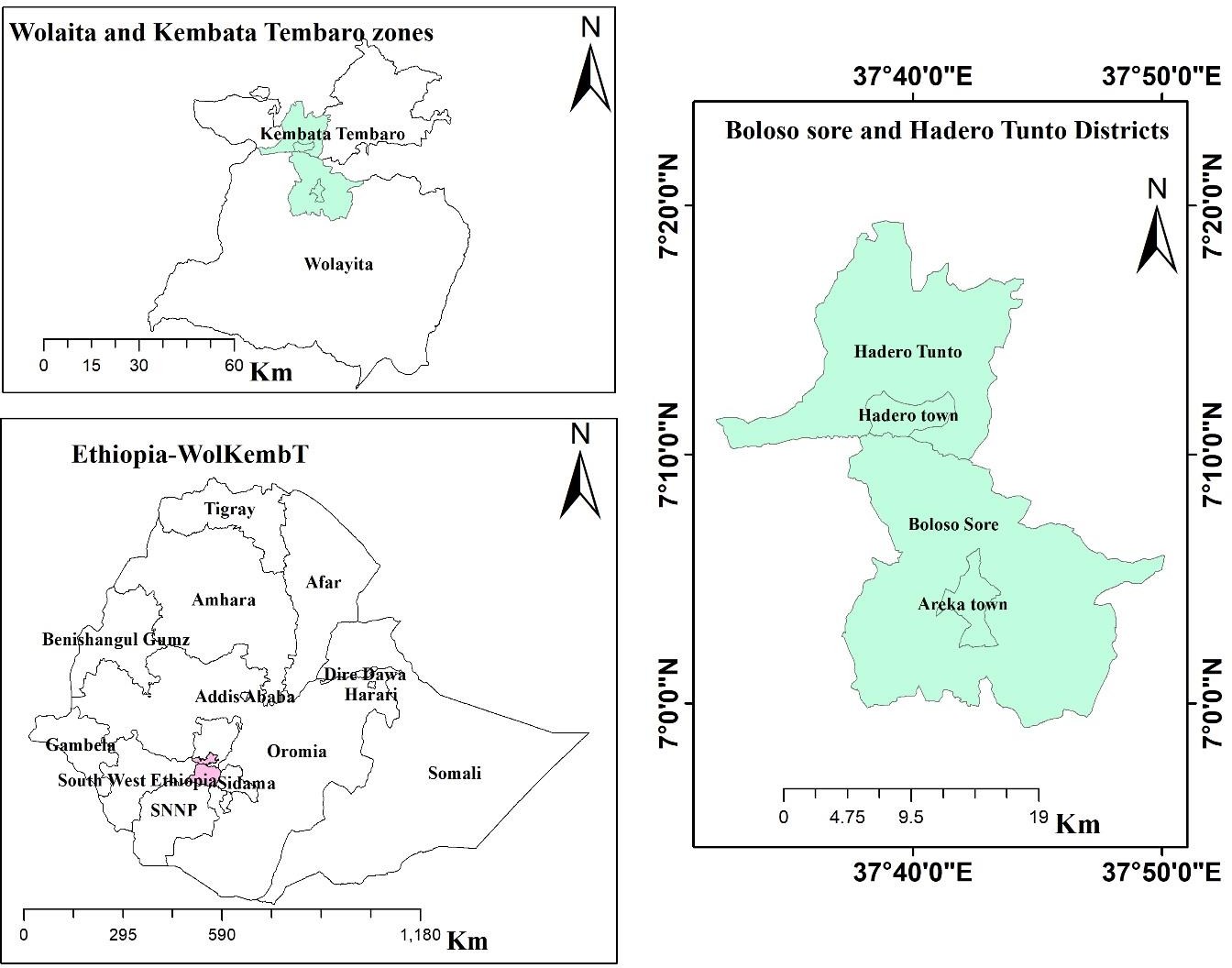
Rapid land-use transitions from crop farming to plantation forestry are reshaping rural economies in Ethiopia, driven by declining agricultural productivity, rising demand for wood products, and farmers’ preference for low-risk income alternatives. Eucalyptus dominates due to fast growth and high market value. This study assesses the economic viability of converting cropland to eucalyptus in Boloso Sore and Hadero Tunto by comparing tree- and crop-based systems. Data from 240 households were collected via surveys, interviews, focus groups, and field observations (multistage sampling). Cost–benefit analysis used NPV, BCR, and IRR at an 8% discount rate. Eucalyptus plantations yield higher long-term profits with lower labor: NPV 458,577.05 ETB, BCR 16.25, and IRR 66%. Crops provide short-term food and cash: NPV 388,319.97 ETB, BCR 16.36, IRR 203%. Sensitivity tests show plantation forestry is more robust across price, cost, yield, and discount-rate changes. As discount rates rise from 8% to 14%, NPVs fall for both, but plantations remain higher, converging only around 14.5%–15%, beyond which crops may gain advantage under very high capital costs. Under broader sensitivity scenarios including variations in price, production cost, and yield the plantation system demonstrates greater resilience due to its large periodic revenues, which buffer moderate market and productivity fluctuations. In contrast, crop-based agriculture is more vulnerable to input cost increment and short-term yield instability, although it is relatively less sensitive to extreme discount rate increases. Overall, within realistic ranges (8–14%), eucalyptus plantations remain economically superior despite food-security and ecological trade-offs.
References
- Abebe M., Tadesse W. (2006): Eucalyptus in Ethiopia: Risk or opportunity? Ethiopian Institute of Agricultural Research.
- Alemayehu B., Suarez-Minguez J., Rosette J. (2024): The implications of plantation forest-driven land use/land cover changes for ecosystem service values in the northwestern highlands of Ethiopia. Remote Sensing, 16(22): 4159.
- Allen D., McKenney D.W., Yemshanov D., Fraleigh S. (2013): The economic attractiveness of short rotation coppice biomass plantations for bioenergy in Northern Ontario. The Forestry Chronicle, 89(1): 66–78. https://doi.org/10.5558/tfc2013-013
- Ayana A.N., Lejissa L.T. (2018): Comparative economic analysis of three competing land use types in southern Ethiopia: Tools for informed decision-making on land use choices. Journal of Economics and Sustainable Development, 9(1): 37–45.
- Baum S., Weih M., Busch G., Kroiher F., Bolte A. (2009): The impact of short rotation coppice plantations on phytodiversity. Landbauforschung vTI Agriculture and Forestry Research, 3: 163–170.
- Bayle G.K. (2019): Ecological and social impacts of Eucalyptus tree plantation on the environment. Journal of Biodiversity Conservation and Bioresource Management, 5(1): 98–109. https://doi.org/10.3329/jbcbm.v5i1.42125
- Belay F., Mulugeta M., Makonnen T. (2025): Eucalyptus-based livelihoods: Enhancing household food security and resilience in Northwest Ethiopia. Frontiers in Sustainable Food Systems, 9: 1496756.
- Beshir S., Moges A., Dananto M. (2023): Trend analysis, past dynamics and future prediction of land use and land cover change in upper Wabe-Shebele River Basin. Heliyon, 9(9).
- Birru Y., Anteneh A., Tadele A. (2013): Expansion of eucalyptus woodlots in the fertile soils of the highlands of Ethiopia: Could it be a threat on future cropland use? Journal of Agricultural Science, 8: 97–107.
- Carte L., Hofflinger A., Polk M.H. (2021): Expanding exotic forest plantations and declining rural populations in La Araucanía, Chile. Land, 10(3): 283. https://doi.org/10.3390/land10030283
- Chipeta M., Emana B., Chanyalew D. (2015): Ethiopia’s agriculture sector policy and investment framework (2010–2020): External mid-term review. Management Institute and Strategy Management Department, ESSEC, Nepal, 84 pp.
- Christopher Frey H., Patil S.R. (2002): Identification and review of sensitivity analysis methods. Risk Analysis, 22(3): 553–578.
- Evison D. (2008): A method for comparing investment returns from major rural land uses including forestry. New Zealand Journal of Forestry, 53(3): 27–32.
- FAO (2014): State of the world’s forests: Enhancing the socioeconomic benefits from forests. Food and Agriculture Organization of the United Nations, Rome.
- FAO (n.d.): Eucalyptus in East Africa: The socio-economic and environmental issues. Food and Agriculture Organization of the United Nations. https://www.fao.org/3/aq401e/aq401e.pdf
- Forrester D.I., Bauhus J., Khanna P.K. (2004): Growth dynamics in a mixed-species plantation of Eucalyptus globulus and Acacia mearnsii. Forest Ecology and Management, 193(1–2): 81–95.
- Forstmaier A., Shekhar A., Chen J. (2020): Mapping of Eucalyptus in Natura 2000 areas using Sentinel-2 imagery and artificial neural networks. Remote Sensing, 12(14): 2176. https://doi.org/10.3390/rs12142176
- Harvey C. (1995): Proportional discounting of future costs and benefits. Mathematics of Operations Research, 20(2): 381–399.
- Hurni H., Tato K., Zeleke G. (2005): The implications of changes in population, land use, and land management for surface runoff in the Upper Nile Basin area of Ethiopia. Mountain Research and Development, 25(2): 147–154. https://doi.org/10.1659/0276-4741(2005)025[0147:IOCIPL]2.0.CO;2
- Jagger P., Pender J. (2003): The role of trees for sustainable management of less-favored lands: The case of Eucalyptus in Ethiopia. Forest Policy and Economics, 5(1): 83–95. https://doi.org/10.1016/S1389-9341(01)00078-X
- Lambin E.F., Meyfroidt P. (2011): Global land use change, economic globalization, and the looming land scarcity. Proceedings of the National Academy of Sciences, 108(9): 3465–3472.
- Lamers P., Junginger M., Hamelinck C., Faaij A. (2012): Developments in international solid biofuel trade: An analysis of volumes, policies, and market factors. Renewable and Sustainable Energy Reviews, 16(5): 3176–3199. https://doi.org/10.1016/j.rser.2012.02.042
- Lubowski R., et al. (2006): [Incomplete reference: full title and publication details required].
- Lopez A.J. (2015): Predicting invasive range of Eucalyptus globulus in California (Master’s thesis). California Polytechnic State University.
- Mekonnen A.B. (2024): Adoption of climate-smart agricultural practices among smallholder farmers and implications for climate change adaptation in Southern Ethiopia (Doctoral dissertation). University of Nairobi.
- Mengistu B., Amayu F., Bekele W., Zerihun D. (2020): Effects of Eucalyptus species plantations and cropland on selected soil properties. Geology, Ecology and Landscapes, 4(1): 1–9. https://doi.org/10.1080/24749508.2019.1575714
- Minotta G., Nervo G., Facciotto G., Bergante S., Liesebach M. (2025): The world of fast-growing trees. In: Innovative practices in the sustainable management of fast-growing trees: Lessons learned from poplars and willows and other experiences worldwide, 19.
- Molla G., Addisie M.B., Ayele G.T. (2023): Expansion of eucalyptus plantation on fertile cultivated lands in the north-western highlands of Ethiopia. Remote Sensing, 15(3): 661.
- Msofe N.K., Sheng L., Lyimo J. (2019): Land use change trends and their driving forces in the Kilombero Valley floodplain, southeastern Tanzania. Sustainability, 11(2): 505. https://doi.org/10.3390/su11020505
- Naderifar M., Goli H., Ghaljaie F. (2017): Snowball sampling: A purposeful method of sampling in qualitative research. Strides in Development of Medical Education, 14(3): 1–6.
- Pahwa M., Cavanagh A., Vanstone M. (2023): Key informants in applied qualitative health research. Qualitative Health Research, 33(14): 1251–1261.
- Planting for the Future (n.d.): How demand for wood products could be friendly to tropical forests. https://www.researchgate.net/publication/266616339
- Ronald S., Zalesny J., Mitchell R. (2008): Biofuels, bioenergy, and bioproducts from sustainable agricultural and forest crops: Proceedings of the short rotation crops international conference. Gen. Tech. Rep. NRS-P-31. Newtown Square, PA, USDA Forest Service, Northern Research Station, 76 pp.
- Saltelli A. (1999): Sensitivity analysis: Could better methods be used? Journal of Geophysical Research: Atmospheres, 104(D3): 3789–3793.
- Sasikumar K., Vijayalakshmi C., Parthiban K.T. (2002): Allelopathic effects of Eucalyptus on black gram (Phaseolus mungo L.). Allelopathy Journal, 9: 205–214.
- Tadesse M., Ambaw G., Mungai C., Kuma S., Radeny M.A., Tamene L.D., Solomon D. (2022): Climate-smart crop–small ruminant value chain: A rapid assessment of gender gaps and opportunities in Doyogena, SNNPR, Ethiopia.
- Teketay D. (2000): Facts and experience on Eucalypts in Ethiopia and elsewhere: Ground for making wise and informed decisions. Walia, 21: 25–46.
- Tesfaye Y., Bekele M., Kebede H., Tefera F., Kassa H. (2015): Enhancing the role of forestry in building climate resilient green economy in Ethiopia. Center for International Forestry Research, 75 pp.
- Tortorelli D.A., Michaleris P. (1994): Design sensitivity analysis: Overview and review. Inverse Problems in Engineering, 1(1): 71–105.
- Vance E.D., Loehle C., Wigley T.B., Weatherford P. (2014): Scientific basis for sustainable management of Eucalyptus and Populus as short-rotation woody crops in the U.S. Forests, 5(4): 901–918. https://doi.org/10.3390/f5040901
- World Bank (2022): Ethiopia economic update: Navigating multiple shocks and sustaining reform momentum. World Bank Publications.
- Zerga B., Warkineh B., Teketay D., Woldetsadik M. (2021): The sustainability of reforesting landscapes with exotic species: A case study of eucalypts in Ethiopia. Sustainable Earth, 4(1): 5.
- Zeleke G., Kassawmar T., Tadesse M., Teferi E., Girma A., Anteneh Y., O’Donnell’s G. (2024): Dynamics in smallholder-based land use systems: Drivers and outcomes of cropland–eucalyptus field–cropland conversions in north-west Ethiopia. Frontiers in Sustainable Food Systems, 8: 1393863.