

Published 2026-06-29
Keywords
- Banana canopy,
- Microclimate,
- Mushroom cultivation,
- Pleurotus spp,
- Seasonal variation
- Sustainable farming ...More
How to Cite
Copyright (c) 2026 Gladwel Chepng'etich Ng'eno, Mary Goretti Kariaga, Asenath Jerotich Sigot, Job Sirengo Lusweti, Evelyne Mmbone Muleke

This work is licensed under a Creative Commons Attribution 4.0 International License.




Abstract
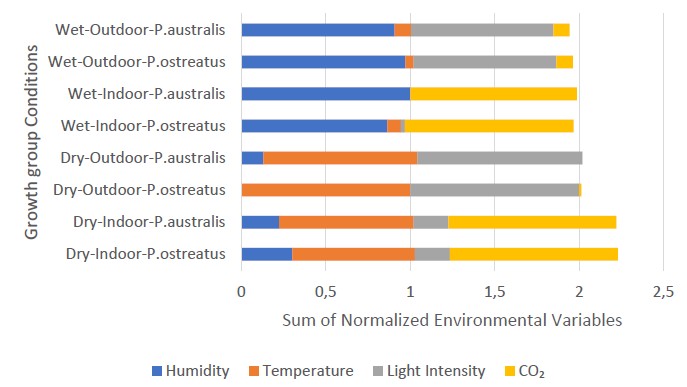
Mushroom cultivation is highly sensitive to microclimatic conditions, which determine colonization, fruiting, and quality. In tropical regions, seasonal variability in temperature, humidity, light, and carbon dioxide often constrains production, particularly for smallholder farmers who lack the resources to maintain controlled environments. Banana (Musa spp.) plantations provide natural shade and buffering effects that may serve as low-cost alternatives to indoor cultivation, yet empirical evaluations remain limited. This study investigated the influence of season (wet and dry), cultivation environment (indoor vs. outdoor under banana canopy), and species (Pleurotus ostreatus and Pleurotus australis) on microclimate dynamics at Masinde Muliro University farm, Kakamega County, Kenya. A split–split plot design with three replicates was used, and air temperature, relative humidity, light intensity, and carbon dioxide concentration were monitored at mushroom canopy height. Data were analyzed using ANOVA, with treatment means separated by Tukey’s HSD at P ≤ 0.05. Results showed significant seasonal variation in all parameters. During the dry season, indoor conditions maintained higher humidity and lower temperatures than outdoors. However, in the wet season, humidity and temperature did not differ significantly between indoor and outdoor setups, demonstrating the buffering effect of the banana canopy. Outdoor environments consistently recorded higher light intensity and lower CO₂ levels compared to indoor systems. These findings highlight banana canopies as effective natural microclimate regulators, offering a sustainable and low-input alternative to controlled indoor cultivation in tropical smallholder systems.
References
- Adebayo, E., & Martinez-Carrera, D. (2015). Oyster mushrooms (Pleurotus) are useful for utilizing lignocellulosic biomass. African Journal of Biotechnology, 14(1), 52–67. DOI 10.5897/AJB2014.14249
- Almeida, D., Cardoso, R. V., Pereira, C., Alves, M. J., Ferreira, I. C., Zied, D. C., Junior, W. G. V., Caitano, C. E., Fernandes, Â., & Barros, L. (2022). Biochemical approaches on commercial strains of Agaricus subrufescens growing under two environmental cultivation conditions. Journal of Fungi, 8(6), 616. DOI: 10.3390/jof8060616
- Blazy, J.-M., Dorel, M., Salmon, F., Ozier-Lafontaine, H., Wery, J., & Tixier, P. (2009). Model-based assessment of technological innovation in banana cropping systems contextualized by farm types in Guadeloupe. European Journal of Agronomy, 31(1), 10–19. https://doi.org/10.1016/j.eja.2009.02.001
- Blomme, G., Ntamwira, J., Kearsley, E., Bahati, L., Amini, D., Safari, N., & Ocimati, W. (2020). Sensitivity and tolerance of different annual crops to different levels of banana shade and dry season weather. Frontiers in Sustainable Food Systems, 4, 545926. https://doi.org/10.3389/fsufs.2020.545926
- Blomme, G., Ocimati, W., Groot, J., Ntamwira, J., Bahati, L., & Kantungeko, D. (n.d.). Agroecological integration strategies for optimal exploitation of available land spaces under banana. Sustainability of Banana-Based Agroecosystems Affected by Xanthomonas Wilt Disease of Banana,181.https://doi.org/10.17660/ActaHortic.2018.1196.5
- Bringye, B., Fekete-Farkas, M., & Vinogradov, S. (2021). An analysis of mushroom consumption in Hungary in the international context. Agriculture, 11(7), 677. https://doi.org/10.3390/agriculture11070677
- De Bonis, M., Locatelli, S., Sambo, P., Zanin, G., Pecchia, J. A., & Nicoletto, C. (2024). Effect of different led light wavelengths on production and quality of Pleurotus ostreatus grown on different commercial substrates. Horticulturae, 10(4), 349. DOI 10.3390/horticulturae10040349
- De Cianni, R. (2025). Developing a mushroom supply chain for food purposes in the European perspective: Companies’ competitiveness and consumer behaviour. https://hdl.handle.net/20.500.14242/218333
- Devi, K. B., Malakar, R., Kumar, A., Sarma, N., & Jha, D. K. (2023). Ecofriendly utilization of lignocellulosic wastes: Mushroom cultivation and value addition. In Value-addition in agri-food industry waste through enzyme technology (pp. 237–254). Elsevier. https://doi.org/10.1016/B978-0-323-89928-4.00016-X
- Gunko, S., Trynchuk, O., Naumenko, O., Podpriatov, H., Khomichak, L., Bober, A., Zavhorodnii, V., Voitsekhivskyi, V., Zavadska, O., & Bondareva, L. (2021). The effect of carbon dioxide on the quality of the mushrooms. Slovak Journal of Food Sciences, 15. https://doi.org/10.5219/1634
- Kamaliah, N., Salim, S., Abdullah, S., Nobilly, F., Mat, S., Norhisham, A. R., Tohiran, K. A., Zulkifli, R., Lechner, A. M., & Azhar, B. (2022). Evaluating the experimental cultivation of edible mushroom, Volvariella volvacea underneath tree canopy in tropical agroforestry systems. Agroforestry Systems, 96(1), 35–47. https://doi.org/10.1007/s10457-021-00685-9
- Kashangura, C. (2012). Optimisation of the growth conditions and genetic characterisation of Pleurotus species.
- MEDANY, G. M. (2014). Cultivation possibility of golden oyster mushroom (Pleurotus citrinopileatus) under the Egyptian conditions. Egyptian Journal of Agricultural Research, 92(2), 749–762. https://doi.org/10.21608/ejar.2014.155474
- Pathmashini, L., Arulnandhy, V., & Wijeratnam, R. (2008). Cultivation of oyster (Pleurotus ostreatus) mushroom on sawdust with different types of spawns. DOI: 10.4038/cjsbs.v37i2.505
- Patil, S., Chonde, S., & Pathade, G. (2024). Production of mushrooms: A short Review. Ecology, Environment and Conservation, 30, 296–304.
- Raman, J., Jang, K.-Y., Oh, Y.-L., Oh, M., Im, J.-H., Lakshmanan, H., & Sabaratnam, V. (2021). Cultivation and nutritional value of prominent Pleurotus spp.: An overview. Mycobiology, 49(1), 1–14. DOI: 10.1080/12298093.2020.1835142
- Tanny, J. (2013). Microclimate and evapotranspiration of crops covered by agricultural screens: A review.Biosystems Engineering, 114(1), 26–43. DOI: 10.1016/j.biosystemseng.2012.10.008
- Valladares, F., Laanisto, L., Niinemets, Ü., & Zavala, M. A. (2016). Shedding light on shade: Ecological perspectives of understorey plant life. Plant Ecology & Diversity, 9(3), 237–251. DOI: 10.1080/17550874.2016.1210262