

Published 2026-06-29
Keywords
- Agriculture,
- Bibliometrix,
- Biological control,
- Research collaboration,
- Scientific production
- Sustainability,
- VOSviewer ...More
How to Cite
Copyright (c) 2026 Rachid Azenzem, Imane Mrabti, Hassan Grijja, Kaoutar El Issaoui, Mohamed Afechtal, Jalal Kassout

This work is licensed under a Creative Commons Attribution 4.0 International License.




Abstract
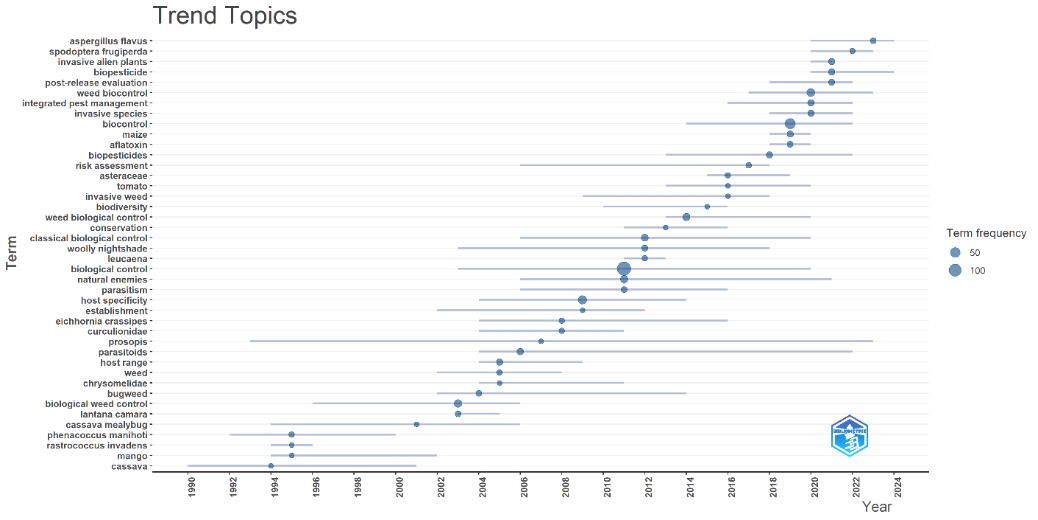
The rapid growth of the global population raises concerns about the ability of production systems to meet food security challenges. In addition to climate uncertainties, pests and diseases are exerting increasing pressure on agricultural yields and the quality of harvests. To address these biological threats, biopesticides have gained increasing attention in recent decades as sustainable and promising alternatives to synthetic pesticides. However, there are notable disparities between countries or regions in terms of research and the adoption of these products. Therefore, this study uses a bibliometric approach to examine scientific literature and provide insights into the current landscape and future trends of biopesticides research in Africa from 1929 to 2024. The results indicated a steady increase in scientific production over the last three decades (1990-2024), with an annual growth rate of 4.92%. The most significant surge occurred between 2015 and 2024, with an average growth rate of 18.35%. South Africa stands out as the most active country in biopesticide research publications, followed by significant contributions from Kenya, Egypt, Nigeria, and Benin. The presence of non-African countries such as the United States, Australia, and the United Kingdom among the key contributors highlights collaborative efforts in this field. The temporal analysis indicated that research focus has shifted to emerging pest control, biopesticide commercialization, and risk assessment of biocontrol agents. While the prospects for biopesticide research in Africa are promising, further efforts are needed to strengthen local capacities, foster partnerships, and promote research initiatives across the continent.
References
- Agboyi, L. K., Goergen, G., Beseh, P., Mensah, S. A., Clottey, V. A., Glikpo, R. et al., 2020. Parasitoid complex of fall armyworm, Spodoptera frugiperda, in Ghana and Benin. Insects 11(2), 68. https://doi.org/10.3390/insects11020068
- Akutse, K. S., Subramanian, S., Maniania, N. K., Dubois, T., Ekesi, S., 2020. Biopesticide research and product development in Africa for sustainable agriculture and food security–Experiences from the International Centre of Insect Physiology and Ecology (icipe). Front. sustain. food syst. 4, 563016. https://doi.org/10.3389/fsufs.2020.563016
- Aria, M., Cuccurullo, C., 2017. bibliometrix: An R-tool for comprehensive science mapping analysis. J. Informetr. 11(4), 959–975. https://doi.org/10.1016/j.joi.2017.08.007
- Azenzem, R., Koussa, T., Alfeddy, M. N., 2024. Biocontrol potential of essential oils from six Moroccan plants against the causal agent of verticillium wilt of olives. Journal of Natural Pesticide Research, 9, 100085. https://doi.org/10.1016/j.napere.2024.100085
- Bandyopadhyay, R., Ortega-Beltran, A., Akande, A., Mutegi, C., Atehnkeng, J., Kaptoge, L., et al., 2016. Biological control of aflatoxins in Africa: current status and potential challenges in the face of climate change. World Mycotoxin J. 9 (5), 771–790.
- Bateman, M. L., Day, R. K., Luke, B., Edgington, S., Kuhlmann, U., Cock, M. J., 2018. Assessment of potential biopesticide options for managing fall armyworm (Spodoptera frugiperda) in Africa. J. Appl. Entomol. 142 (9), 805–819. https://doi.org/10.1111/jen.12565
- Chakraborty, N., Mitra, R., Pal, S., Ganguly, R., Acharya, K., Minkina, et al., 2023. Biopesticide consumption in India: insights into the current trends. Agriculture 13(3), 557. https://doi.org/10.3390/agriculture13030557
- Chio, E. H., Li, Q. X. (2022). Pesticide research and development: general discussion and spinosad case. Journal of agricultural and food chemistry, 70(29), 8913-8919.
- Coetzee, J. A., Hill, M. P., Byrne, M. J., Bownes, A., 2011. A review of the biological control programmes on Eichhornia crassipes (C. mart.) solms (Pontederiaceae), Salvinia molesta DS Mitch.(Salviniaceae), Pistia stratiotes L.(Araceae), Myriophyllum aquaticum (vell.) verdc.(Haloragaceae) and Azolla filiculoides Lam.(Azollaceae) in South Africa. Afr. Entomol. 19(1), 451–468. https://hdl.handle.net/10520/EJC32900
- Damalas, C. A., Koutroubas, S. D., 2018. Current status and recent developments in biopesticide use. Agriculture 8(1), 13. https://doi.org/10.3390/agriculture8010013
- Daraban, G. M., Hlihor, R. M., Suteu, D., 2023. Pesticides vs. biopesticides: From pest management to toxicity and impacts on the environment and human health. Toxics 11(12), 983. https://doi.org/10.3390/toxics11120983
- De Lange, W. J., van Wilgen, B. W., 2010. An economic assessment of the contribution of biological control to the management of invasive alien plants and to the protection of ecosystem services in South Africa. Biol. Invasions 12 (12), 4113–4124. https://doi.org/10.1007/s10530-010-9811-y
- Effendi, D. N., Anggraini, W., Jatmiko, A., Rahmayanti, H., Ichsan, I. Z., Rahman, M. M., 2021. Bibliometric analysis of scientific literacy using VOS viewer: Analysis of science education. In J. Phys.: Conf. Ser. 1796 (1) 012096). https://doi.org/10.1088/1742-6596/1796/1/012096
- Fan, J., Wu, P., Tian, T., Ren, Q., Haseeb, M., Zhang, R., 2020. Potential distribution and niche differentiation of Spodoptera frugiperda in Africa. Insects 11(6), 383. https://doi.org/10.3390/insects11060383
- FAO, 2024. Pesticides use and trade – 1990–2022. FAOSTAT Analytical Briefs, No. 89. Rome. https://doi.org/10.4060/cd1486en
- Frederiks, C., & Wesseler, J. H. (2019). A comparison of the EU and US regulatory frameworks for the active substance registration of microbial biological control agents. Pest management science, 75(1), 87-103. https://doi.org/10.1002/ps.5133
- Hatting, J. L., Moore, S. D., Malan, A. P., 2019. Microbial control of phytophagous invertebrate pests in South Africa: Current status and future prospects. J. Invertebr. Pathol. 165, 54–66. https://doi.org/10.1016/j.jip.2018.02.004
- Hernandez-Tenorio, F., Miranda, A. M., Rodríguez, C. A., Giraldo-Estrada, C., Sáez, A. A., 2022. Potential strategies in the biopesticide formulations: a bibliometric analysis. Agronomy 12(11), 2665. https://doi.org/10.3390/agronomy12112665
- Herren, H. R., Neuenschwander, P., 1991. Biological control of cassava pests in Africa. Annu. Rev. Entomol. 36, 257–283.
- Hoffmann, J. H., Moran, V. C.,1998. The population dynamics of an introduced tree, Sesbania punicea, in South Africa, in response to long-term damage caused by different combinations of three species of biological control agents. Oecologia, 114, 343–348. https://doi.org/10.1007/s004420050456
- Idris, H. A., Labuschagne, N., Korsten, L., 2007. Screening rhizobacteria for biological control of Fusarium root and crown rot of sorghum in Ethiopia. Biol. control 40 (1), 97–106. https://doi.org/10.1016/j.biocontrol.2006.07.017
- Ikhwani, I., Rahayuningsih, S., Yuniarti, E., Kusuma, H. S., Darmokoesomo, H., & Putra, N. R., 2024. Mapping the trend of evolution: a bibliometric analysis of biopesticides in fruit crop protection. J. Plant Dis. Prot. 131 (3), 645–664. https://doi.org/10.1007/s41348-024-00879-0
- James, S., Collins, F. H., Welkhoff, P. A., Emerson, C., Godfray, H. C. J., Gottlieb, M., et al., 2018. Pathway to deployment of gene drive mosquitoes as a potential biocontrol tool for elimination of malaria in sub-Saharan Africa: recommendations of a scientific working group. Am J Trop Med Hyg. 98 (6), 1. https://doi.org/10.4269/ajtmh.18-0083
- Kenis, M., Du Plessis, H., Van den Berg, J., Ba, M. N., Goergen, G., Kwadjo, K. E., et al., 2019. Telenomus remus, a candidate parasitoid for the biological control of Spodoptera frugiperda in Africa, is already present on the continent. Insects 10(4), 92. http://dx.doi.org/10.1017/S0007485300009330
- Krismawati, A., Yustisia, Y., Arifin, Z., Purbiati, T., Rachmawati, D., Latifah, E. et al., 2024. A bibliometric analysis of biopesticides in corn pest management: Current trends and future prospects. Heliyon 10 (22) e40196.
- Kubiak, A., Wolna-Maruwka, A., Niewiadomska, A., Pilarska, A. A., 2022. The problem of weed infestation of agricultural plantations vs. the assumptions of the European biodiversity strategy. Agronomy 12(8), 1808. https://doi.org/10.3390/agronomy12081808
- Kumar, J., Ramlal, A., Mallick, D., Mishra, V., 2021. An overview of some biopesticides and their importance in plant protection for commercial acceptance. Plants 10(6), 1185. https://doi.org/10.3390/plants10061185
- Lemessa, F., Zeller, W., 2007. Screening rhizobacteria for biological control of Ralstonia solanacearum in Ethiopia. Biol. control 42(3), 336–344. https://doi.org/10.1016/j.biocontrol.2007.05.014
- Mahmood, I., Imadi, S. R., Shazadi, K., Gul, A., Hakeem, K. R., 2016. Effects of pesticides on environment. Plant, soil and microbes: volume 1: implications in crop science, 253–269. https://doi.org/10.1007/978-3-319-27455-3_13
- Malan, A. P., Knoetze, R., Moore, S. D., 2011. Isolation and identification of entomopathogenic nematodes from citrus orchards in South Africa and their biocontrol potential against false codling moth. J. Invertebr. Pathol. 108 (2), 115–125. https://doi.org/10.1016/j.jip.2011.07.006
- Malek, R., Wyckhuys, K., Haddaway, N., Bateman, M., Babendreier, D., Gu, B., ... & Savilaakso, S. (2026). Global Opportunities and Challenges to the Uptake of Biopesticides: An Evidence Map. Juno Reports, 3(1), 0001. https://doi.org/10.1079/junoreports.2026.0001
- Marrone, P. G., 2024. Status of the biopesticide market and prospects for new bioherbicides. Pest Manag. Sci. 80(1), 81–86. https://doi.org/10.1002/ps.7403.
- Narandžić, T., Šarac, V., Rodić, V., Vukelić, N., Lukač-Bulatović, M., Bijelić, S., Ljubojević, M., 2025. Exploring the Known and Mapping Future Directions in Biopesticides Research: A Bibliometric Analysis. Horticulturae 11(1), 97. https://doi.org/10.3390/horticulturae11010097
- Ndolo, D., Njuguna, E., Adetunji, C. O., Harbor, C., Rowe, A., Den Breeyen, A. et al., 2019. Research and development of biopesticides: Challenges and prospects. Outlooks Pest Manag. 30(6), 267–276. https://doi.org/10.1564/v30_dec_08
- Oguh, C. E., Okpaka, C. O., Ubani, C. S., Okekeaji, U., Joseph, P. S., & Amadi, E. U. (2019). Natural pesticides (biopesticides) and uses in pest management-a critical review. Asian Journal of Biotechnology and Genetic Engineering, 2(3), 1-18.
- Olson, S., 2015. An analysis of the biopesticide market now and where it is going. Outlooks Pest Manag. 26(5), 203–206. https://doi.org/10.1564/v26_oct_04
- Ragasruthi, M., Balakrishnan, N., Murugan, M., Swarnakumari, N., Harish, S., Sharmila, D. J. S., 2024. Bacillus thuringiensis (Bt)-based biopesticide: Navigating success, challenges, and future horizons in sustainable pest control. Sci. Total Environ. 176594. https://doi.org/10.1016/j.scitotenv.2024.176594
- Silva, G., 2018. Feeding the world in 2050 and beyond–Part 1: Productivity challenges. Michigan State University Extension, 3. https://www.canr.msu.edu/news/feeding-the-world-in-2050-and-beyond-part-1
- Soyel, S. A., Ruidas, S., Roy, P., Mondal, S., Bhattacharyya, S., Hazra, D. K., 2022. Biopesticides as eco-friendly substitutes to synthetic pesticides: An insight of present status and future prospects with improved bio-effectiveness, self-lives, and climate resilience. IJESP 2(2), 1–12. https://doi.org/10.35745/ijesp2022v02.02.0001
- Spradbery, J. P., Kirk, A. A., 1978. Aspects of the ecology of siricid woodwasps (Hymenoptera: Siricidae) in Europe, North Africa and Turkey with special reference to the biological control of Sirex noctilio F. in Australia. Bull. Entomol. Res. 68(3), 341–359.
- Stevenson, P. C., Isman, M. B., Belmain, S. R., 2017. Pesticidal plants in Africa: A global vision of new biological control products from local uses. Ind. Crop. Prod. 110, 2–9. https://doi.org/10.1016/j.indcrop.2017.08.034
- Šunjka, D., Mechora, Š. 2022. An alternative source of biopesticides and improvement in their formulation—recent advances. Plants 11(22), 3172. https://doi.org/10.3390/plants11223172
- Umetsu, N., Shirai, Y., 2020. Development of novel pesticides in the 21st century. J Pestic Sci. 45(2), 54–74. https://doi.org/10.1584/jpestics.D20-201
- United Nations, 2013. World Population Prospects: The 2015 Revision, Key Findings and Advance Tables; Working Paper No ESA/P/WP; United Nations Department of Economic and Social Affairs: New York, NY, USA. https://desapublications.un.org/file/546/download
- Van Eck, N., Waltman, L., 2010. Software survey: VOSviewer, a computer program for bibliometric mapping. scientometrics 84(2), 523–538. https://doi.org/10.1007/s11192-009-0146-3
- Van Wilgen, B. W., De Wit, M. P., Anderson, H. J., Le Maitre, D. C., Kotze, I. M., Ndala, S., et al., 2004. Costs and benefits of biological control of invasive alien plants: case studies from South Africa: working for water. S. Afr. J. Sci. 100 (1), 113–122.
- Wu, F., Khlangwiset, P., 2010. Health economic impacts and cost-effectiveness of aflatoxin-reduction strategies in Africa: case studies in biocontrol and post-harvest interventions. Food Addit. Contam. 27 (4), 496–509. https://doi.org/10.1080/19440040903437865