

Enhancement of Compost Quality and Nutrient Retention Through Co-composting with Bamboo-derived Biochar
Published 2025-12-30
Keywords
- Bamboo biochar,
- Co-composting,
- Nutrient retention,
- Physico-chemical properties,
- Soil amendment
How to Cite
Copyright (c) 2025 Pavithira Rishitharan, Somasundaram Sutharsan, Thayamini H. Seran

This work is licensed under a Creative Commons Attribution 4.0 International License.




Abstract
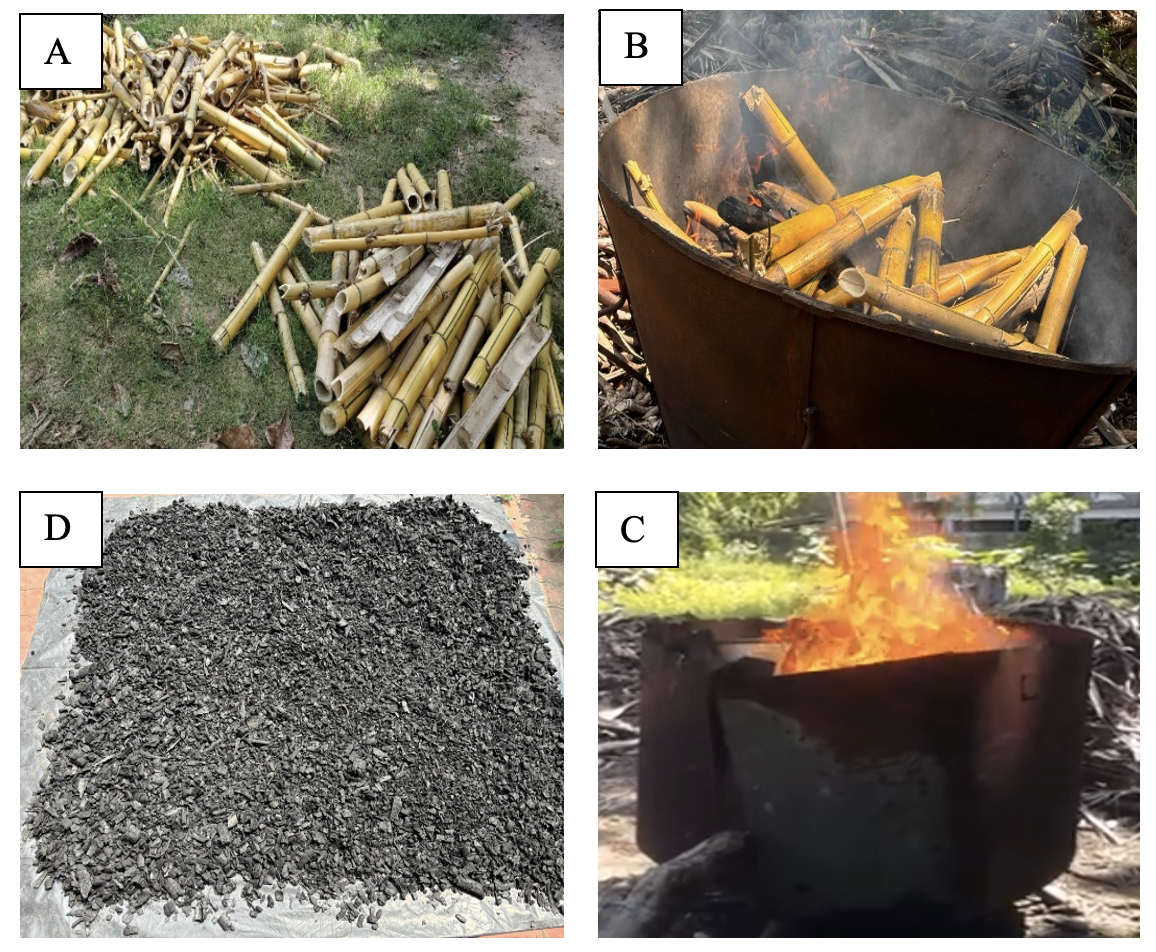
This research evaluates the efficacy of bamboo-derived biochar (BB) as a pivotal amendment for optimizing compost quality and nutrient retention. The study utilized BB produced via a Kon-Tiki kiln, a method selected to preserve the feedstock's biogenic integrity. Scanning Electron Microscopy (SEM) analysis confirmed that the resulting biochar possesses a highly developed micro and mesoporous network, a structural attribute critical for augmenting water retention, cation exchange capacity, and microbial habitat stability. When integrated into the composting matrix, the Bamboo Biochar enriched Compost (BBC) demonstrated superior physicochemical balance, characterized by a near-neutral pH (7.14) and an electrical conductivity of 3.79 dS/m. Crucially, the co-composting process yielded a robust nutrient profile that significantly exceeds typical values for conventional compost, with elevated concentrations of Nitrogen (1.09%), Phosphate (0.79%), and Potassium (1.18%), alongside secondary nutrients such as Calcium (4.31%) and Magnesium (1.27%). The analysis also highlighted substantial micronutrient retention, including Zinc (379.73 mg/kg), Manganese (543.17 mg/kg), Iron (1.73%), and Copper (55.6 mg/kg). While raw BB serves as a stable carbon sink (86.7% organic carbon), the BBC formulation achieved a functional equilibrium with a moderate organic carbon content (28.6%) and an optimized C:N ratio of 26.2, thereby fostering efficient microbial activity and compost maturity. Ultimately, these findings confirm that the synergy between the porous structure of bamboo biochar and the nutrient density of compost fosters a circular waste valorization approach, delivering a sustainable, high-quality soil amendment
References
- Alfei, S. and Pandoli, O.G. (2024). Bamboo-Based Biochar: A Still Too Little-Studied Black Gold and Its Current Applications. Journal of Xenobiotics, 14(1), 416-451. doi: 10.3390/jox14010026. PMID: 38535501; PMCID: PMC10971603. DOI: https://doi.org/10.3390/jox14010026
- Algethami, J., Irshad, M.K., Javed, W., Alhamami, M. and Ibrahim, M. (2023). Iron-modified biochar improves plant physiology, soil nutritional status and mitigates Pb and Cd-hazard in wheat (Triticum aestivum L.). Frontiers in Plant Science, 14. 10.3389/fpls.2023.1221434. DOI: https://doi.org/10.3389/fpls.2023.1221434
- Ali, A., Guo, D., Zhang, Y., Sun, X., Jiang, S, Guo, Z., Huang, H., Liang, W., Li, R., Zhang, Z. (2017). Using bamboo biochar with compost for the stabilization and phytotoxicity reduction of heavy metals in mine-contaminated soils of China. Scientific Reports, 7(1), 2690. doi: 10.1038/s41598-017-03045-9. PMID: 28578402; PMCID: PMC5457455. DOI: https://doi.org/10.1038/s41598-017-03045-9
- Amunugoda, P. (2019). Bamboo species for specific uses, invasiveness, plantation cultivation, raw material supply chain [PowerPoint Presentation]. Stake Holder Workshop on Bamboo Sector Road Map/ Country Action/ Strategic Plan Development. Colombo: Industrial Technology Institute (ITI).
- Andrey, V., Tatiana, M., Saglara, S., Leonid, V., Gerhard, S., Inna, V., Vishnu, D., Svetlana, N., Dinesh, M. and Jun, Y. (2020). The mechanisms of biochar interactions with microorganisms in soil. Environmental Geochemistry and Health, 42, 2495–2518. DOI: https://doi.org/10.1007/s10653-019-00412-5
- Antonangelo, A., Sun, X., and Zhang, H. (2021). The roles of co-composted biochar (COMBI) in improving soil quality, crop productivity, and toxic metal amelioration. Journal of Environmental Management, 277, 111443. doi:10.1016/j.jenvman.2020.111443. DOI: https://doi.org/10.1016/j.jenvman.2020.111443
- AU Synergy, (2025). Bamboo Biochar and Vinegar, AU synergy Carbonization Centre, Kelantan. viewed 9th November 2024. https://ausynergy.com/bamboo-biochar.
- Awasthi, M.K., Duan, Y., Awasthi, S., Liu, T. and Zhang, Z. (2020). Influence of bamboo biochar on mitigating greenhouse gas emissions and nitrogen loss during poultry manure composting. Bioresource Technology, 303. 122952. 10.1016/j.biortech.2020.122952. DOI: https://doi.org/10.1016/j.biortech.2020.122952
- Bazrafshan, E., Zarei, A., Mostafapour, F. K., Poormollae, N., Mahmoodi, S., and Zazouli, M. A. (2016). Maturity and stability evaluation of composted municipal solid wastes. Health Scope, 5 (1). doi:10.17795/jhealthscope-33202. DOI: https://doi.org/10.17795/jhealthscope-33202
- Biekre, A.H.T., Tie, B.T. and Dogbo, D.O. (2018). Physico-chemical characteristics of composts based on by-products of Songon farms in Côte d'Ivoire. International Journal of Biological and Chemical Sciences, 12, 596−609. DOI: https://doi.org/10.4314/ijbcs.v12i1.45
- Buss, W., Graham, M.C., Shepherd, J.G. and Mašek O. (2016). Suitability of marginal biomass-derived biochars for soil amendment. Science of the Total Environment, 547, 314–322. https ://doi.org/10.1016/j.scito tenv.2015.11.148. DOI: https://doi.org/10.1016/j.scitotenv.2015.11.148
- Cahyana, A., Marzuki, A. and Cari. (2014). Analisa SEM (Scanning Electron Microscope) pada kaca TZN yang dikristalkan sebagian. Prosiding Mathematics and Sciences Forum. UNS.
- Castaño, M.I.L., Jannoura1, R. and Joergensen, R.G. (2019). Coffee mucilage impact on young coffee seedlings and soil microorganisms. Journal of Plant Nutrition and Soil Science, 182, 782–790. DOI: https://doi.org/10.1002/jpln.201900139
- Chaturvedi, K., Singhwane, A., Dhangar, M., Mili, M., Gorhae, N., Naik, A., Prashant, N., Srivastava, A.K. and Verma, S. (2024). Bamboo for producing charcoal and biochar for versatile applications. Biomass Conversion and Biorefinery, 13, 1-27. doi: 10.1007/s13399-022-03715-3. Epub ahead of print. PMID: 36817514; PMCID: PMC9924895.
- CharGrow. (2023). Harnessing the Power of Biochar in Compost: A Sustainable Soil Amendment, viewed 29 October 2023. https://char-grow.com/harnessing-the-power-of-biochar-in-compost-a-sustainable-soil-amendment.
- Cheng, J., Lee, X., Gao, W., Chen, Y., Pan, W. and Tang, Y. (2017). Effect of biochar on the bioavailability of difenoconazole and microbial community composition in a pesticide-contaminated soil. Applied Soil Ecology, 121, 185-192. 10.1016/j.apsoil.2017.10.009. DOI: https://doi.org/10.1016/j.apsoil.2017.10.009
- Collin, B., Doelsch, E., Keller, C., Panfili, F. and Meunier, J. D. (2013). Effects of silicon and copper on bamboo grown hydroponically. Environmental Science and Pollution Research, 20(9), 6482–6495. DOI: https://doi.org/10.1007/s11356-013-1703-0
- De, A.J.C. and De, A.M.F. (2006). Análise química de resíduos sólidos para monitoramento e estudos agroambientais. In: De AJC, De AMF, editors. [Chemical analysis of solid waste for monitoring and agri-environmental studies]. 1st ed, 177. Campinas - SP: IAC. Portuguese.
- Elsayed. K. (2012). Chemical and Physical Properties of Compost. Misr Journal of Agricultural Engineering. 29, 1567 - 1582. 10.21608/mjae.2012.101382. DOI: https://doi.org/10.21608/mjae.2012.101382
- Fischer, D. and Glaser, B. (2012). Synergisms between compost and biochar for sustainable soil amelioration. In Biochar for Environmental Management, 193–212. Routledge. DOI: https://doi.org/10.5772/31200
- Gabhane, J., William, S.P., Bidyadhar, R., Bhilawe, P., Anand, D., Vaidya, A.N. and Wate, S.R. (2012). Additives aided composting of green waste: effects on organic matter degradation, compost maturity, and quality of the finished compost. Bioresource Technology, 114, 382-8. doi: 10.1016/j.biortech.2012.02.040. Epub 2012 Feb 25. PMID: 22444633. DOI: https://doi.org/10.1016/j.biortech.2012.02.040
- Gao, S., Hofman-Krull, K., Bidwell, A.L. and DeLuca, T.H. (2016). Locally produced wood biochar increases nutrient retention and availability in agricultural soils of the San Juan Islands, USA. Agriculture, Ecosystems and Environment, 233, 43–54. https://doi.org/10.1016/j.agee.2016.08.028. DOI: https://doi.org/10.1016/j.agee.2016.08.028
- Gao, Y., Fang, Z., Van Zwieten, L., Bolan, N., Dong, D., Quin, B., Meng, J., Li, F., Wu, F., Wang, H. and Chen, W. (2022). A critical review of biochar-based nitrogen fertilizers and their effects on crop production and the environment. Biochar, 4. 10.1007/s42773-022-00160-3. DOI: https://doi.org/10.1007/s42773-022-00160-3
- Gaskin, J., Steiner, C., Harris, K., Das, K. and Bibens, B. (2008). Effect of low-temperature pyrolysis conditions on biochar for agricultural use. Trans ASABE. 51(6), 2061–2069. doi:10.13031/2013.25409. DOI: https://doi.org/10.13031/2013.25409
- Ghassemi, F., Jakeman, A. J. and Nix, H. (1995). Salinization of Land and Water Resources: Human causes management and case studies. Center for Resources and Environmental Studies, ANU, Canberra.
- Godlewska, P., Schmidt, H.P., Ok, Y.S. and Oleszczuk, P. (2017). Biochar for composting improvement and contaminants reduction. A review. Bioresource Technology, doi: http://dx.doi.org/ 10.1016/j.biortech.2017.07.095. DOI: https://doi.org/10.1016/j.biortech.2017.07.095
- Guo, X. X., Liu, H. T., and Zhang, J. (2020). The role of biochar in organic waste composting and soil improvement: A review. Waste Management, 102, 884-899. DOI: https://doi.org/10.1016/j.wasman.2019.12.003
- Hernández-Hernández, M. (2015). Carbón vegetal como mejorador de un acrisol cultivado con caña de azúcar. Tesis de maestría. Instituto de enseñanza e investigación en ciencias agrícolas. Colegio de postgraduados. Heroica Cárdenas, Tab., México. 61 p.
- Hien, T., Tsubota, T., Taniguchi, T. and Shinogi, Y. (2020). Enhancing soil water holding capacity and provision of a potassium source via optimization of the pyrolysis of bamboo biochar. Biochar, 3, 1-11. 10.1007/s42773-020-00071-1. DOI: https://doi.org/10.1007/s42773-020-00071-1
- Hien, T., Shinogi, Y., Mishra, A. and Dang, V. (2017). The Effect of Bamboo Biochar on Crop’s Productivity and Quality in The Field Condition. Journal of the Faculty of Agriculture, Kyushu University. 62, 477-482. 10.5109/1854023. DOI: https://doi.org/10.5109/1854023
- Hua, L., Wu, W., Liu, Y., McBride, M. B. and Chen, Y. (2009). Reduction of nitrogen loss and Cu and Zn mobility during sludge Composting with a bamboo charcoal amendment. Environmental Science and Pollution Research, 16, 1–9. DOI: https://doi.org/10.1007/s11356-008-0041-0
- Inyang, M., Gao, B., Pullammanappallil, P., Ding, W., Zimmerman, A.R. (2010). Biochar from anaerobically digested sugarcane bagasse. Bioresource Technology, 101, 8868–8872. DOI: https://doi.org/10.1016/j.biortech.2010.06.088
- Inyang, M., Gao, B., Yao, Y., Xue, Y., Zimmerman, A., Pullammanappallil, P. and Cao, X. (2016). A review of biochar as a low-cost adsorbent for aqueous heavy metal removal. Critical Reviews in Environmental Science and Technology, 46(4), 406-433. DOI: https://doi.org/10.1080/10643389.2015.1096880
- Jeffery, S., Verheijen, F.G.A., van der Velde, M. and Bastos, A.C. (2011). A quantitative review of the effects of biochar application to soils on crop productivity using meta-analysis. Agriculture, Ecosystems and Environment, 144, 175–187. https://doi.org/10.1016/j.agee.2011.08.015. DOI: https://doi.org/10.1016/j.agee.2011.08.015
- Jia, M., Wang, F., Bian, Y., Jin, X., Song, Y., Kengara, F.O., Xu, R. and Jiang, X. (2013). Effects of pH and metal ions on oxytetracycline sorption to maize-straw-derived biochar. Bioresource Technology, 136:87-93. doi: 10.1016/j.biortech.2013.02.098. Epub 2013 Mar 4. PMID: 23567668. DOI: https://doi.org/10.1016/j.biortech.2013.02.098
- Jørgensen, K. and Jensen, L. S. (2009). Chemical and biochemical variation in animal manure solids separated using different commercial separation technologies. Bioresource Technology, 100(12), 3088–3096. https://doi.org/10.1016/j.biortech.2009.01.065. DOI: https://doi.org/10.1016/j.biortech.2009.01.065
- Khodadad, C.L.M., Zimmerman, A.R., Green, S.J., Uthandi, S. and Foster J.S. (2010). Taxa-specific changes in soil microbial community composition induced by pyrogenic carbon amendments. Soil Biology and Biochemistry, 43(2), 385–392. doi: 10.1016/j.soilbio.2010.11.005. DOI: https://doi.org/10.1016/j.soilbio.2010.11.005
- Kim, K.H., Kim, J., Cho, T. and Choi, J.W. (2012). Influence of pyrolysis temperature on physicochemical properties of biochar obtained from the fast pyrolysis of pitch pine (Pinusrigida). Bioresource Technology, 118, 158–62 doi: 10.1016/j.biortech. 2012.04.094. DOI: https://doi.org/10.1016/j.biortech.2012.04.094
- Lathwal, M., Rani, M., Indira, A. and Chongtham, N. (2023). Bamboo: A Sustainable Alternative for Biochar Production. In: Palombini, F.L., Nogueira, F.M. (eds) Bamboo Science and Technology. Environmental Footprints and Eco-design of Products and Processes. Springer, Singapore. https://doi.org/10.1007/978-981-99-0015-2_10. DOI: https://doi.org/10.1007/978-981-99-0015-2_10
- Lehmann, J. and Stephen, J. (2009). Biochar for Environmental Management, Science and Technology. Earthscan Publishers Ltd. doi: 10.4324/9781003297673-1. DOI: https://doi.org/10.4324/9781003297673-1
- Lehmann, J., Rillig, M. C., Thies, J., Masiello, C. A., Hockaday, W. C. and Crowley, D. (2011). Biochar effects on soil biota-A review. Soil Biology and Biochemistry, 43(9), 1812–1836. https://doi.org/10.1016/j.soilbio.2011.04.022. DOI: https://doi.org/10.1016/j.soilbio.2011.04.022
- Leksikowati, S.S. and Rachmawati, D. (2024). Distribution of silicon in different organ of bamboo (Gigantochloa apus (Schult. & Schult.) Kubz ex Munro). BIO Web of Conferences, 94. 06006. 10.1051/bioconf/20249406006. DOI: https://doi.org/10.1051/bioconf/20249406006
- Liao, P., Yuan, S., Xie, W., Zhang, W., Tong, M. and Wang, K. (2013). Adsorption of nitrogen-heterocyclic compounds on bamboo charcoal: kinetics, thermodynamics, and microwave regeneration. Journal of Colloid and Interface Science, 390(1), 189–195. doi: 10.1016/j.jcis.2012.09.037. DOI: https://doi.org/10.1016/j.jcis.2012.09.037
- Liang, B., Lehmann, J., Solomon, D., Kinyangi, J., Grossman, J., O’Neill, B., Skjemstad, J.O., Thies, J.E., Luizao, F.J., Petersen, J. and Neves, E.G. (2006). Black carbon increases cation exchange capacity in soils, Soil Science Society of America Journal. 70, 1719–1730. DOI: https://doi.org/10.2136/sssaj2005.0383
- Liu, Z., Dugan, B., Masiello, C. A. and Gonnermann, H. (2017). Biochar particle size, shape, and porosity act together to influence soil water properties. PLOS ONE, 12(6), e0179079. DOI: https://doi.org/10.1371/journal.pone.0179079
- Masó, M. A. and Blasi, A. B. (2008). Evaluation of composting as a strategy for managing organic wastes from a municipal market in Nicaragua. Bioresource Technology, 99, 5120−24. DOI: https://doi.org/10.1016/j.biortech.2007.09.083
- Meena, A. L., Karwal, M. and Dutta, D. (2021). Composting: Phases and Factors Responsible for Efficient and Improved Composting. Refinement of Horticulture Based Farming Systems for Food and Nutritional Security, View Project Consortium Research Platform on Conservation Agriculture View project. Doi: 10.13140/RG.2.2.13546.95689.
- Mulbah, R., Flomo, M., Yana, T. and Zimba, E. (2023). Composting Unearthed: A Comprehensive Review of Challenges, Historical Evolution, Prospects, Applications, And Processes. International Journal of Creative Research Thoughts, 11(12), 842-852. ISSN: 2320-2882.
- Okoli, F.A., Chukwura, E.I. and Mbachu, A.E. (2024). Agro wastes compost quality parameters and effect on the growth of Amaranthus amaranthus. Technology in Agronomy, 4. e012 https://doi.org/10.48130/tia-0024-0010. DOI: https://doi.org/10.48130/tia-0024-0010
- Orozco Gutiérrez, G., Medina Telez, L., Elvira Espinosa, A. and Cervantes Preciado, J. F. (2021). Biocarbón de bambú como mejorador de la fertilidad del suelo en caña de azúcar, Revista Mexicana de Ciencias Forestales. México, ME, 12(65). doi: 10.29298/rmcf.v12i65.780. DOI: https://doi.org/10.29298/rmcf.v12i65.780
- Pace, M.G., Miller, B. E. and Farrell-Poe. K.L. (1995). The Composting Process. Ag. Systems Tech. & Ed. Dept. Utah State University. viewed 30 October 2024. https://extension.usu.edu/agwastemanagement/files/The_Composting_Process.pdf.
- Prapagdee, S. and Tawinteung, N. (2017). Effects of biochar on enhanced nutrient use efficiency of green bean Vigna radiata L. Environmental Science and Pollution Research International, 24, 9460–9467. https ://doi.org/10.1007/s1135 6-017-8633-1. DOI: https://doi.org/10.1007/s11356-017-8633-1
- Purakayastha, T., Kumari, S. and Pathak, H. (2015). Characterization, stability, and microbial effects of four biochar’s produced from crop residues. Geoderma, 239, 293–303. DOI: https://doi.org/10.1016/j.geoderma.2014.11.009
- Rasse, D., Weldon, S., Joner, E., Joseph, S., Kammann, C., Liu, X., O'Toole, A., Pan, G. and Kocatürk Schumacher, P. (2022). Enhancing plant N uptake with biochar-based fertilizers: limitation of sorption and prospects. Plant and Soil, 10.1007/s11104-022-05365-w. DOI: https://doi.org/10.1007/s11104-022-05365-w
- Rynk, R. (1992). On-farm composting handbook. Ithaca, NY: Northeast Regional Agricultural Engineering Service, Cooperative Extension.
- Sahoo, S., Vijay, V., Chandra, R. and Kumar, H. (2021). Production and characterization of biochar produced from slow pyrolysis of pigeon pea stalk and bamboo. Cleaner Engineering and Technology, 3. 100101. 10.1016/j.clet.2021.100101. DOI: https://doi.org/10.1016/j.clet.2021.100101
- Sánchez-García, M., Alburquerque, J.A., Sánchez-Monedero, M.A., Roig, A., Cayuela M.L. (2015). Biochar accelerates organic matter degradation and enhances N mineralization during composting of poultry manure without a relevant impact on gas emissions. Bioresource Technology, 192:272-9. doi: 10.1016/j.biortech.2015.05.003. PMID: 26038333. DOI: https://doi.org/10.1016/j.biortech.2015.05.003
- Sánchez-Monedero, M., Cayuela, M.L., Roig, A., Jindo, K., Mondini, C. and Bolan, N. (2017). Role of biochar as an additive in organic waste composting. Bioresource Technology. 247. 10.1016/j.biortech.2017.09.193. DOI: https://doi.org/10.1016/j.biortech.2017.09.193
- Scott, H.L., Ponsonby, D. and Atkinson, C.J. (2014). Biochar: an improver of nutrient and soil water availability-what is the evidence?. CAB Reviews, 9(019), 1–19. DOI: https://doi.org/10.1079/PAVSNNR20149019
- Steiner, C., Das, K. C., Melear, N. and Lakly, D. (2010). Reducing Nitrogen Loss during Poultry Litter Composting using Biochar. Journal of Environmental Quality, 39(4):1236-42. doi: 10.2134/jeq2009.0337. PMID: 20830911. DOI: https://doi.org/10.2134/jeq2009.0337
- Steiner, C., Melear, N., Harris, K. and Das, K.C. (2011). Biochar as bulking agent for poultry litter composting, Carbon Management, 2(3), 227-230. DOI: https://doi.org/10.4155/cmt.11.15
- Suthar, R. G., Wang, C., Nunes, M. C. N., Chen, J., Sargent, S. A., Bucklin, R. A. and Gao, B. (2018). Bamboo Biochar Pyrolyzed at Low Temperature Improves Tomato Plant Growth and Fruit Quality. Agriculture, 8(10), 153. https://doi.org/10.3390/agriculture8100153. DOI: https://doi.org/10.3390/agriculture8100153
- Tan, X.F., Liu, S.B., Liu, Y.G., Gu, Y.L., Zeng, G.M., Hu, X.J., Wang, X., Liu, S.H. and Jiang, L.H. (2016). Biochar as potential sustainable precursors for activated carbon production: Multiple applications in environmental protection and energy storage. Bioresource Technology, 227:359-372. doi: 10.1016/j.biortech.2016.12.083. Epub 2016 Dec 24. PMID: 28063759. DOI: https://doi.org/10.1016/j.biortech.2016.12.083
- Taskin, E., de Castro, B.C., Allegretta, I., Terzano, R., Rosa, A.H. and Loffredo, E. (2019). Multianalytical characterization of biochar and hydro-char produced from waste biomasses for environmental and agricultural applications. Chemosphere, 233, 422–430. DOI: https://doi.org/10.1016/j.chemosphere.2019.05.204
- Thidar, K., Suu, W. and Nyo, W. (2021). Physical and Chemical Properties of Compost Made from Agricultural Wastes. International Journal of Environmental and Rural Development, 10, 61-66. 10.32115/ijerd.10.2_61.
- Thies, J. E., and Rillig, M.C. (2009). Characteristics of biochar: Biological properties. In: Biochar for Environmental Management: Science and Technology. J. Lehmann, and S. Joseph (eds.). Earthscan, United Kingdom, pp. 85Y10.
- Umemura, M. and Takenaka. C. (2014). Biological cycle of silicon in Moso bamboo (Phyllostachys pubescens) forests in central Japan. Ecological Research, 29, 501-510. DOI: https://doi.org/10.1007/s11284-014-1150-5
- UNIDO, (2016). GEF project to boost bamboo processing. viewed 26 April 2024. https://archives1.dailynews.lk/2016/03/10/business/unido-gef-project-boost-bamboo-processing?page=3608.
- Wang, Y., Xiao, X. and Chen, B. (2018). Biochar Impacts on Soil Silicon Dissolution Kinetics and their Interaction Mechanisms. Scientific Reports, 8, 8040. https://doi.org/10.1038/s41598-018-26396-3. DOI: https://doi.org/10.1038/s41598-018-26396-3
- Xu, J. and Xiong, Z. (2025). Biochar amendments mitigate trace gas emissions in organic waste composting: a meta-analysis. Nitrogen Cycling 1: e005 doi: 10.48130/nc-0025-0003 DOI: https://doi.org/10.48130/nc-0025-0003
- Yadav, V., Khare P., Deshmukh, Y., Shanker, K., Nigam, N., Karak, T. (2018). Performance of biochar derived from Cymbopogon winterianus waste at two temperatures on soil properties and growth of Bacopa monneri. Communications in Soil Science and Plant Analysis, 49, 2741–2764. https ://doi.org/10.1080/00103 624.2018.15383 71. DOI: https://doi.org/10.1080/00103624.2018.1538371
- Yao, Y., Gao, B., Chen, J. and Yang, L. (2013). Engineered biochar reclaiming phosphate from aqueous solutions: mechanisms and potential application as a slow-release fertilizer. Environmental Science and Technology, 47(15):8700-8. doi: 10.1021/es4012977. Epub 2013 Jul 25. PMID: 23848524. DOI: https://doi.org/10.1021/es4012977
- Zhang, B., Fan, B., Hassan, I., Peng, Y., Ma, R., Guan, C.Y., Chen, S., Cui, S. and Li, G. (2021). Effects of bamboo biochar on nitrogen conservation during co-composting of layer manure and spent mushroom substrate. Environmental Technology. doi: 10.1080/09593330.2021.1936201. Epub ahead of print. PMID: 34044755. DOI: https://doi.org/10.1080/09593330.2021.1936201
- Zheng, H., Zhenyu, W., Deng, X., Herbert, S. and Xing, B. (2013). Impacts of adding biochar on nitrogen retention and bioavailability in agricultural soil. Geoderma, 206, 32–39. 10.1016/j.geoderma.2013.04.018. DOI: https://doi.org/10.1016/j.geoderma.2013.04.018