

Spatial variation of climate change-induced heat stress risk for dairy cows in Botswana : Mapping the risk of heat stress for dairy cows
Published 2025-12-30
Keywords
- Climate Projections,
- SSP 5-8.5,
- Temperature humidity index,
- Spatial Variation,
- Adaptation strategies
How to Cite
Copyright (c) 2025 Jonas Kwedibana, Nnyaladzi Batisani

This work is licensed under a Creative Commons Attribution 4.0 International License.




Abstract
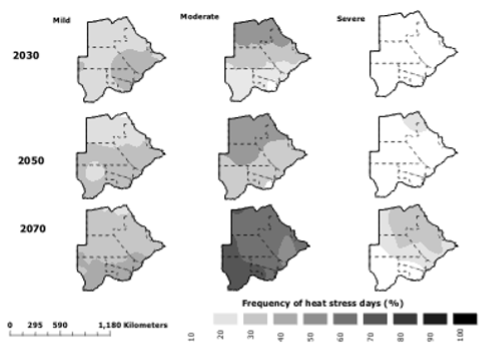
The southern African region is considered a “climate change hotspot” due to its projected substantially warmer and drier future. Climate change projections show that Botswana is warming at a faster pace than the global average. Therefore, there is a need to determine the likely impact of climate change-induced heat stress on dairy farming across ecological regions in the country. This study’s goal was to determine the recent and future spatially differentiated dispersion of heat stress conditions for dairy cattle across Botswana for the recent (2020), near-term (2030), mid-term (2050), and long-term (2070) under the high greenhouse gas emission scenario using the temperature humidity index. Results show an increase in the temperature humidity index ranging from 73.35 to 79.18 in 2020; 76.01 to 81.30 in 2030; 77.76 to 84.16 in 2050; and 79.60 to 85.84 in 2070. Areas in the north, i.e., Northwest, Northeast, and northern parts of the Central and Ghanzi Districts, are projected to record higher maximum temperatures, higher temperature humidity index, a greater number of heat stress days, and experience a higher degree of heat stress severity than those in the south of the country, i.e., Southern, Kgatleng, Kweneng, and Kgalagadi districts. Thus, the intensity of heat stress is projected to increase as you go further north in the country. The spatial variability of heat stress intensity implies that without the implementation of adaptation measures, the entire country could experience dairy farming challenges due to heat stress in the future, exacerbating the already dire dairy production environment in the country. Future policies and programs for developing the dairy sector in Botswana should thus factor in the heat stress challenge to attain the intended objectives.
References
- Akinyemi, F., & Abiodun, B. (2019). Potential impacts of global warming levels 1.5 °C and above on climate extremes in Botswana. Climatic Change, 154. https://doi.org/10.1007/s10584-019-02446-1 DOI: https://doi.org/10.1007/s10584-019-02446-1
- Angel, S., Amitha, J. P., V P, R., Vandana, G., Ayoob, A., Madiajagan, B., Krishnan, G., & Sejian, V. (2018). Climate Change and Cattle Production: Impact and Adaptation. 5.
- Balcha, E., Menghistu, H. T., Abraha, A. Z., & Birhanu, H. (2024). Mapping risk of heat stress for dairy cattle in Tigray Regional State, Northern Ethiopia | Theoretical and Applied Climatology. https://link.springer.com/article/10.1007/s00704-024-05080-9 DOI: https://doi.org/10.1007/s00704-024-05080-9
- Baliyan, S., & Gosalamang, D. (2016a). Analysis of Constraints and Opportunities in Dairy Production in Botswana: Producer’s Perspectives. International Journal of Business and Management, 11. https://doi.org/10.5539/ijbm.v11n3p248
- Baliyan, S., & Gosalamang, D. (2016b). Analysis of Constraints and Opportunities in Dairy Production in Botswana: Producer’s Perspectives. International Journal of Business and Management, 11. https://doi.org/10.5539/ijbm.v11n3p248 DOI: https://doi.org/10.5539/ijbm.v11n3p248
- Bertocchi, L., Vitali, A., Lacetera, N., Nardone, A., Varisco, G., & Bernabucci, U. (2014). Seasonal variations in the composition of Holstein cow’s milk and temperature–humidity index relationship. Animal, 8(4), 667–674. https://doi.org/10.1017/S1751731114000032 DOI: https://doi.org/10.1017/S1751731114000032
- Boni, R., Perrone, L. L., & Cecchini, S. (2013). Heat stress affects reproductive performance of high producing dairy cows bred in an area of southern Apennines. Livestock Science, 160. https://doi.org/10.1016/j.livsci.2013.11.016 DOI: https://doi.org/10.1016/j.livsci.2013.11.016
- Byakatonda, J., Parida, B. P., Kenabatho, P. K., & Moalafhi, D. B. (2018). Analysis of rainfall and temperature time series to detect long-term climatic trends and variability over semi-arid Botswana. Journal of Earth System Science, 127(2), 25. https://doi.org/10.1007/s12040-018-0926-3 DOI: https://doi.org/10.1007/s12040-018-0926-3
- Carvajal, M. A., Alaniz, A. J., Gutiérrez-Gómez, C., Vergara, P. M., Sejian, V., & Bozinovic, F. (2021). Increasing importance of heat stress for cattle farming under future global climate scenarios. Science of The Total Environment, 801, 149661. https://doi.org/10.1016/j.scitotenv.2021.149661 DOI: https://doi.org/10.1016/j.scitotenv.2021.149661
- Chen, L., Thorup, V. M., Kudahl, A. B., & Østergaard, S. (2024). Effects of heat stress on feed intake, milk yield, milk composition, and feed efficiency in dairy cows: A meta-analysis. Journal of Dairy Science, 107(5), 3207–3218. https://doi.org/10.3168/jds.2023-24059 DOI: https://doi.org/10.3168/jds.2023-24059
- Collier, Baumgard, L. H., Zimbelman, R. B., & Xiao, Y. (2019). Heat stress: Physiology of acclimation and adaptation. Animal Frontiers, 9(1), 12–19. https://doi.org/10.1093/af/vfy031 DOI: https://doi.org/10.1093/af/vfy031
- Correa-Calderón, A., Avendaño-Reyes, L., López-Baca, M. Á., Macías-Cruz, U., Correa-Calderón, A., Avendaño-Reyes, L., López-Baca, M. Á., & Macías-Cruz, U. (2022). Heat stress in dairy cattle with emphasis on milk production and feed and water intake habits. Review. Revista Mexicana de Ciencias Pecuarias, 13(2), 488–509. https://doi.org/10.22319/rmcp.v13i2.5832 DOI: https://doi.org/10.22319/rmcp.v13i2.5832
- Das, R., Sailo, L., Verma, N., Bharti, P., Saikia, J., Imtiwati, & Kumar, R. (2016). Impact of heat stress on health and performance of dairy animals: A review. Veterinary World, 9(3), 260–268. https://doi.org/10.14202/vetworld.2016.260-268 DOI: https://doi.org/10.14202/vetworld.2016.260-268
- Dikmen, S., & Hansen, P. J. (2009). Is the temperature-humidity index the best indicator of heat stress in lactating dairy cows in a subtropical environment? Journal of Dairy Science, 92(1), 109–116. https://doi.org/10.3168/jds.2008-1370 DOI: https://doi.org/10.3168/jds.2008-1370
- Djelailia, H., Bouraoui, R., Jemmali, B., & Najar, T. (2020). Effects of heat stress on reproductive efficiency in Holstein dairy cattle in the North African arid region. Reproduction in Domestic Animals, 55. https://doi.org/10.1111/rda.13772 DOI: https://doi.org/10.1111/rda.13772
- Ekine-Dzivenu, C. C., Mrode, R., Oyieng, E., Komwihangilo, D., Lyatuu, E., Msuta, G., Ojango, J. M. K., & Okeyo, A. M. (2020). Evaluating the impact of heat stress as measured by temperature-humidity index (THI) on test-day milk yield of small holder dairy cattle in a sub-Sahara African climate. Livestock Science, 242, 104314. https://doi.org/10.1016/j.livsci.2020.104314 DOI: https://doi.org/10.1016/j.livsci.2020.104314
- Engelbrecht, F. A., Steinkopf, J., Padavatan, J., & Midgley, G. F. (2024). Projections of Future Climate Change in Southern Africa and the Potential for Regional Tipping Points. In G. P. von Maltitz, G. F. Midgley, J. Veitch, C. Brümmer, R. P. Rötter, F. A. Viehberg, & M. Veste (Eds), Sustainability of Southern African Ecosystems under Global Change: Science for Management and Policy Interventions (pp. 169–190). Springer International Publishing. https://doi.org/10.1007/978-3-031-10948-5_7 DOI: https://doi.org/10.1007/978-3-031-10948-5_7
- Frigeri, K. D. M., Deniz, M., Damasceno, F. A., Barbari, M., Herbut, P., & Vieira, F. M. C. (2023). Effect of Heat Stress on the Behavior of Lactating Cows Housed in Compost Barns: A Systematic Review. Applied Sciences, 13(4), Article 4. https://doi.org/10.3390/app13042044 DOI: https://doi.org/10.3390/app13042044
- Gorniak, T., Meyer, U., Südekum, K.-H., & Dänicke, S. (2014). Impact of mild heat stress on dry matter intake, milk yield and milk composition in mid-lactation Holstein dairy cows in a temperate climate. Archives of Animal Nutrition, 68, 1–12. https://doi.org/10.1080/1745039X.2014.950451 DOI: https://doi.org/10.1080/1745039X.2014.950451
- Gunn, K., Holly, M., Veith, T., Buda, A., Prasad, R., Rotz, C. A., Soder, K., & Stoner, A. M. (2019). Projected heat stress challenges and abatement opportunities for U.S. Milk production. PLoS ONE, 14. https://doi.org/10.1371/journal.pone.0214665 DOI: https://doi.org/10.1371/journal.pone.0214665
- Habimana, V., Nguluma, A., Nziku, Z., Ekine-Dzivenu, C., Morota, G., Mrode, R., & Chenyambuga, S. (2023). Heat stress effects on milk yield traits and metabolites and mitigation strategies for dairy cattle breeds reared in tropical and sub-tropical countries. Frontiers in Veterinary Science, 10, 1121499. https://doi.org/10.3389/fvets.2023.1121499 DOI: https://doi.org/10.3389/fvets.2023.1121499
- Hammami, H., Bormann, J., M’hamdi, N., Montaldo, H. H., & Gengler, N. (2013). Evaluation of heat stress effects on production traits and somatic cell score of Holsteins in a temperate environment. Journal of Dairy Science, 96(3), 1844–1855. https://doi.org/10.3168/jds.2012-5947 DOI: https://doi.org/10.3168/jds.2012-5947
- IPCC. (2021). Summary for Policymakers. In: Climate Change 2021: The Physical Science Basis. Contribution of Working Group I to the Sixth Assessment Report of the Intergovernmental Panel on Climate Change [Masson-Delmotte, V., P. Zhai, A. Pirani, S.L. Connors, C. Péan, S. Berger, N. Caud, Y. Chen, L. Goldfarb, M.I. Gomis, M. Huang, K. Leitzell, E. Lonnoy, J.B.R. Matthews, T.K. Maycock, T. Waterfield, O. Yelekçi, R. Yu, and B. Zhou (eds.)]. Cambridge University Press, Cambridge, United Kingdom and New York, NY, USA.
- Jeelani, R., Konwar, D., Khan, A., Kumar, D., Chakraborty, D., & Brahma, B. (2019). Reassessment of temperature-humidity index for measuring heat stress in crossbred dairy cattle of a sub-tropical region. Journal of Thermal Biology, 82, 99–106. https://doi.org/10.1016/j.jtherbio.2019.03.017 DOI: https://doi.org/10.1016/j.jtherbio.2019.03.017
- Kadzere, C. T., Murphy, M. R., Silanikove, N., & Maltz, E. (2002). Heat stress in lactating dairy cows: A review. Livestock Production Science, 77(1), 59–91. https://doi.org/10.1016/S0301-6226(01)00330-X DOI: https://doi.org/10.1016/S0301-6226(01)00330-X
- Key, N., Sneeringer, S., & Marquardt, D. (2014). Climate Change, Heat Stress, and U.S. Dairy Production (SSRN Scholarly Paper No. 2506668). Social Science Research Network. https://doi.org/10.2139/ssrn.2506668 DOI: https://doi.org/10.2139/ssrn.2506668
- Lyon, B. (2009). Southern Africa Summer Drought and Heat Waves: Observations and Coupled Model Behavior. Journal of Climate, 22, 6033. https://doi.org/10.1175/2009JCLI3101.1 DOI: https://doi.org/10.1175/2009JCLI3101.1
- Mariri, L. (2021). Investment opportunities in Botswana’s dairy industry. Farmers weekly. https://www.farmersweekly.co.za/tour-and-events/webinar-investment-opportunities-in-botswanas-dairy-sector/
- Matopote, G., & Joshi, N. P. (2024). Associations between Climate Variability and Livestock Production in Botswana: A Vector Autoregression with Exogenous Variables (VARX) Analysis. Atmosphere, 15(3), 363. https://doi.org/10.3390/atmos15030363 DOI: https://doi.org/10.3390/atmos15030363
- Mauger, G., Bauman, Y., Nennich, T., & Salathé, E. (2015). Impacts of Climate Change on Milk Production in the United States. The Professional Geographer, 67. https://doi.org/10.1080/00330124.2014.921017 DOI: https://doi.org/10.1080/00330124.2014.921017
- Mbokodo, I., Bopape, M.-J., Chikoore, H., Engelbrecht, F., & Nethengwe, N. (2020). Heatwaves in the Future Warmer Climate of South Africa. Atmosphere, 11(7), Article 7. https://doi.org/10.3390/atmos11070712 DOI: https://doi.org/10.3390/atmos11070712
- Meinshausen, M., Nicholls, Z. R. J., Lewis, J., Gidden, M. J., Vogel, E., Freund, M., Beyerle, U., Gessner, C., Nauels, A., Bauer, N., Canadell, J. G., Daniel, J. S., John, A., Krummel, P. B., Luderer, G., Meinshausen, N., Montzka, S. A., Rayner, P. J., Reimann, S., … Wang, R. H. J. (2020). The shared socio-economic pathway (SSP) greenhouse gas concentrations and their extensions to 2500. Geoscientific Model Development, 13(8), 3571–3605. https://doi.org/10.5194/gmd-13-3571-2020 DOI: https://doi.org/10.5194/gmd-13-3571-2020
- Mengistu, A. G., Tesfuhuney, W. A., Woyessa, Y. E., & van Rensburg, L. D. (2020). Analysis of the Spatio-Temporal Variability of Precipitation and Drought Intensity in an Arid Catchment in South Africa. Climate, 8(6), Article 6. https://doi.org/10.3390/cli8060070 DOI: https://doi.org/10.3390/cli8060070
- Messeri, A., Mancini, M., Bozzi, R., Parrini, S., Sirtori, F., Morabito, M., Crisci, A., Messeri, G., Ortolani, A., Gozzini, B., Orlandini, S., Fibbi, L., Cristofori, S., & Grifoni, D. (2023). Temperature–humidity index monitoring during two summer seasons in dairy cow sheds in Mugello (Tuscany). International Journal of Biometeorology, 67(10), 1555–1567. https://doi.org/10.1007/s00484-023-02510-7 DOI: https://doi.org/10.1007/s00484-023-02510-7
- Mhlanga, I., Ndaimani, H., Mpakairi, K., & Mujere, N. (2018). Climate change: An uncertain future for dairy farming in Zimbabwe. Transactions of the Royal Society of South Africa, 73(3), 237–242. https://doi.org/10.1080/0035919X.2018.1503203 DOI: https://doi.org/10.1080/0035919X.2018.1503203
- Ministry of Lands and Agriculture. (2023). Dairy Unit Monthly Production Report (Monthly Report No. April 2023).
- Moalafhi, D., Tsheko, R., Atlhopheng, J., Odirile, P., & Masike, S. (2013). Implications of climate change on water resources of Botswana. Advanced Journal of Physical Sciences, 1, 4–13.
- Moreki, J. C., & Tsopito, C. M. (2013). Effect of climate change on dairy production in Botswana and its suitable mitigation strategies. Online J. Anim. Feed Res., 3(6): 216-221.; 6.
- Moses, O. (2017). Heat Wave Characteristics in the Context of Climate Change over the Past 50 Years in Botswana. Botswana Notes and Records, 49, 13–25.
- Mphale, K., Adedoyin, A., Nkoni, G., Ramaphane, G., Wiston, M., & Chimidza, O. (2018). Analysis of temperature data over semi-arid Botswana: Trends and break points. Meteorology and Atmospheric Physics, 130(6), 701–724. https://doi.org/10.1007/s00703-017-0540-y DOI: https://doi.org/10.1007/s00703-017-0540-y
- Mupangwa, W., Chipindu, L., Ncube, B., Mkuhlani, S., Nhantumbo, N., Masvaya, E., Ngwira, A., Moeletsi, M., Nyagumbo, I., & Liben, F. (2023). Temporal Changes in Minimum and Maximum Temperatures at Selected Locations of Southern Africa. Climate, 11(4), Article 4. https://doi.org/10.3390/cli11040084 DOI: https://doi.org/10.3390/cli11040084
- National Research Council. (1971). A guide to environmental research on animals. National academic science. Washington, DC: NRC.
- Nesamvuni, E., Lekalakala, R., Norris, D., & Ngambi, J. W. (2012). Effects of climate change on dairy cattle, South Africa. African Journal of Agricultural Research, 7(26), 3867–3872. https://doi.org/10.5897/AJAR11.1468 DOI: https://doi.org/10.5897/AJAR11.1468
- Niyonzima, Y. B., Strandberg, E., Hirwa, C. D., Manzi, M., Ntawubizi, M., & Rydhmer, L. (2022). The effect of high temperature and humidity on milk yield in Ankole and crossbred cows. Tropical Animal Health and Production, 54(2), 85. https://doi.org/10.1007/s11250-022-03092-z DOI: https://doi.org/10.1007/s11250-022-03092-z
- Nkemelang, T., New, M., & Zaroug, M. (2018). Temperature and precipitation extremes under current, 1.5 °C and 2.0 °C global warming above pre-industrial levels over Botswana, and implications for climate change vulnerability. Environmental Research Letters, 13(6), 065016. https://doi.org/10.1088/1748-9326/aac2f8 DOI: https://doi.org/10.1088/1748-9326/aac2f8
- Nyoni, N. M. B., Grab, S., Archer, E., & Malherbe, J. (2021). Temperature and relative humidity trends in the northernmost region of South Africa, 1950-2016. South African Journal of Science, 117(11–12), 1–11. https://doi.org/10.17159/sajs.2021/7852 DOI: https://doi.org/10.17159/sajs.2021/7852
- Oliver, M. A., & Webster, R. (2014). A tutorial guide to geostatistics: Computing and modelling variograms and kriging. CATENA, 113, 56–69. https://doi.org/10.1016/j.catena.2013.09.006 DOI: https://doi.org/10.1016/j.catena.2013.09.006
- Osei-Amponsah, R., Dunshea, F. R., Leury, B. J., Cheng, L., Cullen, B., Joy, A., Abhijith, A., Zhang, M. H., & Chauhan, S. S. (2020). Heat Stress Impacts on Lactating Cows Grazing Australian Summer Pastures on an Automatic Robotic Dairy. Animals : An Open Access Journal from MDPI, 10(5), 869. https://doi.org/10.3390/ani10050869 DOI: https://doi.org/10.3390/ani10050869
- Oskouei, E. A., Delsouz khaki, B., Kouzegaran, S., Navidi, M. N., Haghighatd, M., Davatgar, N., & Lopez-Baeza, E. (2022). Mapping Climate Zones of Iran Using Hybrid Interpolation Methods. Remote Sensing, 14, 2632. https://doi.org/10.3390/rs14112632 DOI: https://doi.org/10.3390/rs14112632
- Rahimi, J., Mutua, J., Notenbaert, A., Dieng, M. D., & Butterbach-Bahl, K. (2020). Will dairy cattle production in West Africa be challenged by heat stress in the future? Climatic Change, 161. https://doi.org/10.1007/s10584-020-02733-2 DOI: https://doi.org/10.1007/s10584-020-02733-2
- Rahimi, J., Mutua, J., Notenbaert, A., Marshall, K., & Butterbach-Bahl, K. (2021). Heat stress will detrimentally impact future livestock production in East Africa. Nature Food, 2, 88–96. https://doi.org/10.1038/s43016-021-00226-8 DOI: https://doi.org/10.1038/s43016-021-00226-8
- Renaudeau, D., Collin, A., Yahav, S., Basilio, V. de, Gourdine, J. L., & Collier, R. J. (2012). Adaptation to hot climate and strategies to alleviate heat stress in livestock production. Animal, 6(5), 707–728. https://doi.org/10.1017/S1751731111002448 DOI: https://doi.org/10.1017/S1751731111002448
- Riahi, K., van Vuuren, D. P., Kriegler, E., Edmonds, J., O’Neill, B. C., Fujimori, S., Bauer, N., Calvin, K., Dellink, R., Fricko, O., Lutz, W., Popp, A., Cuaresma, J. C., Kc, S., Leimbach, M., Jiang, L., Kram, T., Rao, S., Emmerling, J., … Tavoni, M. (2017). The Shared Socioeconomic Pathways and their energy, land use, and greenhouse gas emissions implications: An overview. Global Environmental Change, 42, 153–168. https://doi.org/10.1016/j.gloenvcha.2016.05.009 DOI: https://doi.org/10.1016/j.gloenvcha.2016.05.009
- Sejian, V., Bhatta, R., Gaughan, J. B., Dunshea, F. R., & Lacetera, N. (2018). Review: Adaptation of animals to heat stress. Animal, 12, s431–s444. https://doi.org/10.1017/S1751731118001945 DOI: https://doi.org/10.1017/S1751731118001945
- Summer, A., Lora, I., Formaggioni, P., & Gottardo, F. (2018). Impact of heat stress on milk and meat production. Animal Frontiers, 9. https://doi.org/10.1093/af/vfy026 DOI: https://doi.org/10.1093/af/vfy026
- The World Bank Group. (2021). Botswana: Climate risk country profile - Botswana | ReliefWeb. https://reliefweb.int/report/botswana/botswana-climate-risk-country-profile
- Umar, D., Ramli, M., Aris, A. Z., Jamil, N. rohaizah, & Adebayo, A. (2019). Evidence of climate variability from rainfall and temperature fluctuations in semi-arid region of the tropics. Atmospheric Research, 224. https://doi.org/10.1016/j.atmosres.2019.03.023 DOI: https://doi.org/10.1016/j.atmosres.2019.03.023
- VanderZaag, A., Riche, E., Qian, B., Smith, W., Baldé, H., Ouellet, V., Charbonneau, E., Wright, T., & Gordon, R. (2023). Trends in the risk of heat stress to Canadian dairy cattle in a changing climate. Canadian Journal of Animal Science, 104. https://doi.org/10.1139/CJAS-2023-0040 DOI: https://doi.org/10.1139/cjas-2023-0040
- Vroege, W., Dalhaus, T., Wauters, E., & Finger, R. (2023). Effects of extreme heat on milk quantity and quality. Agricultural Systems, 210, 103731. https://doi.org/10.1016/j.agsy.2023.103731 DOI: https://doi.org/10.1016/j.agsy.2023.103731
- Williams, R., Scholtz, M., & Neser, F. (2016). Geographical influence of heat stress on milk production of Holstein dairy cattle on pasture in South Africa under current and future climatic conditions. South African Journal of Animal Science, 46, 441. https://doi.org/10.4314/sajas.v46i4.12 DOI: https://doi.org/10.4314/sajas.v46i4.12
- Woodward, S., Beukes, P., Edwards, P., Verhoek, K., Jago, J., & Zammit, C. (2025). Regional heat stress maps for grazing dairy cows in New Zealand under climate change. Animal Production Science, 65. https://doi.org/10.1071/AN24231 DOI: https://doi.org/10.1071/AN24231
- Yadav, H., Lone, S., Shah, N., Verma, R., Verma, U., & Dewry, R. (2023). EFFECT OF HEAT STRESS ON REPRODUCTION IN DAIRY ANIMALS. 21, 623–631.
- Yan, G., Liu, K., Hao, Z., Shi, Z., & Li, H. (2021). The effects of cow-related factors on rectal temperature, respiration rate, and temperature-humidity index thresholds for lactating cows exposed to heat stress. Journal of Thermal Biology, 100, 103041. https://doi.org/10.1016/j.jtherbio.2021.103041 DOI: https://doi.org/10.1016/j.jtherbio.2021.103041
- Zhou, L., Dickinson, R., Tian, Y., Vose, R., & Dai, Y. (2007). Impact of vegetation removal and soil aridation on diurnal temperature range in a semiarid region: Application to the Sahel. Proceedings of the National Academy of Sciences of the United States of America, 104, 17937–17942. https://doi.org/10.1073/pnas.0700290104 DOI: https://doi.org/10.1073/pnas.0700290104