

Structure and Farmers' Woody Species Preference in Parkland Agroforestry in Womberima District, West Gojjam Zone, Amhara Region, Ethiopia
Published 2026-06-29
Keywords
- Woody species,
- Preference,
- Womberima,
- Structure,
- Basal area
How to Cite
Copyright (c) 2026 Esubalew Molla

This work is licensed under a Creative Commons Attribution 4.0 International License.




Abstract
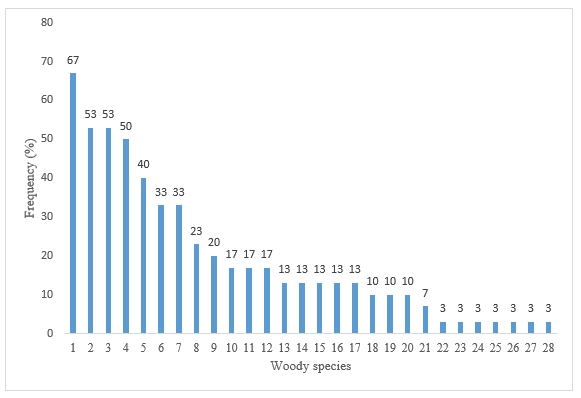
In this study, the structure and farmer preferences of woody species in parkland agroforestry systems in the Amhara Region of Ethiopia's Womberima district, West Gojjam Zone, are examined. A traditional land-use system that is important for preserving biodiversity, improving soil fertility, and sustaining rural livelihoods is parkland agroforestry. For this study, 129 households and 60 parkland agroforestry plots, with 30 plots in the lowland and 30 plots in the midland were taken for the data collection. Within each agro-ecological zone, plots were randomly located in farmers’ fields, ensuring a minimum distance of 100 m between plots to avoid spatial autocorrelation. Woody species inventory was conducted using square plots measuring 50 m × 50 m. A total of 47 woody species identified which is belonging to 28 families with the most abundant being Fabaceae, Moraceae, and Myrtaceae. The lowland parkland agroforestry had a substantially higher species density than the midland, which had a somewhat larger basal area. In terms of frequency, density, and the Importance Value Index (IVI), Croton macrostachyus, Acacia abyssinica, Cordia africana, and Ficus vasta were some of the most ecologically and socially significant species. Farmers’ preferences for woody species were assessed using a preference ranking and scoring method. Soil fertility improvement, Crop compatibility, Provision of fuelwood and timber, Fodder value, Shade provision and Cultural and economic importance were the criteria for preference ranking. According to farmer preference rankings, Acacia abyssinica, Croton macrostachyus, Acacia nilotica, and Cordia africana were the most preferred species because of their multiple uses. The ecological drawbacks of species like Grevillea robusta and Eucalyptus, on the other hand, made them less popular. The study emphasizes that in order to improve sustainability and conservation outcomes, agroforestry development should be in line with farmers’ preferences and local ecological conditions.
References
- Abate, T., Tefera, T., & Belay, A. (2020). Agroecology and its role in enhancing agricultural sustainability in East Africa. Journal of Agroecology, 16(2), 112-123.
- Abebe, S., Yadessa, H., & Tesfaye, S. (2019). Tree species diversity and management practices in traditional agroforestry systems of Ethiopia. Agroforestry Systems, 93(2), 567–579.
- Abebe, S., Yadessa, H., & Tesfaye, S. (2020). "Tree species diversity in Ethiopian agroforestry systems: A review of practices and implications." Agroforestry Systems, 96(4), 429-441.
- Akinnifesi, F. K., Ajayi, O. C., & Sileshi, G. (2010). Agroforestry and climate change in Africa. Earthscan.
- Aklilu Bajigo and Mikrewongel Tadesse. 2015. Woody species diversity of traditional agroforestry practices in Gununo watershed in Wolayitta zone, Ethiopia. Forest Research, Volume 4, Issue 4, Pages 2168–9776.
- Aladi, R., & John, M. (2014). Farmers’ preference and selection criteria for agroforestry species. Journal of Sustainable Forestry, 33(5), 456–471.
- Alemayehu, T., Teferra, B., & Tesfaye, K. (2018). Ecological roles of dominant species in midland agroforestry systems of Ethiopia. Journal of Environmental Management, 230, 44-53.
- Alemu, G., Yadessa, H., & Asfaw, Z. (2022). "Farmer perceptions and preference for tree species in agroforestry systems: A case study in the Ethiopian highlands." Agroforestry Systems, 96(4), 729-744.
- Asfaw, Z., & Ågren, G. I. (2007). Farmers’ local knowledge and topsoil properties of agroforestry practices in Sidama, southern Ethiopia. Agroforestry Systems, 71(1), 35–48.
- Assefa, A., Mekonnen, A., & Getachew, G. (2020). Woody species diversity and farmers’ management practices in agroforestry systems of Ethiopia. Forest Ecology and Management, 462, 117971.
- Azene Bekele (2007). Useful Trees and Shrubs of Ethiopia: Identification, Propagation and Management for Agricultural and Pastoral Communities. Nairobi: World Agroforestry Centre (ICRAF).
- Badege B, Abdu A. Agroforestry and community forestry for rehabilitation of degraded watersheds on the Ethiopian highlands. International Symposium on Contemporary Development Issues in Ethiopia, Addis Ababa, Ethiopia. 2003; 23.
- Bais, S. S., Kamara, A. Y., & Yigeremu, S. (2023). "Coffee-based agroforestry in Ethiopia: A sustainable strategy for smallholder farmers." Environmental Sustainability, 25(2), 205-219.
- Bannister M E, Nair PKR. Agroforestry adoption in Haiti: the importance of household and farm characteristics. Agroforestry systems. 2003; 57: 149-157.
- Bastin, J. F., et al. (2021). "Global patterns of woody vegetation structure and function in relation to climate and land use." Nature Sustainability, 4(6), 404-412.
- Belayneh Lemage and Abayneh Legesse. 2018. Management and socioeconomic determinants of woody species diversity in parkland agroforestry in Tembaro District, Southern Ethiopia. Biodiversity International Journal, Volume 2, Issue 5.
- Bogale G. A. and S. E. Bekele. 2023. Sustainability of agroforestry practices and their resilience to climate change adaptation and mitigation in Sub-Saharan Africa: A review. Ekologia (Bratislava), Volume 42, Issue 2, Pages 179–192.
- Chakraborty, M., Haider, M. Z., & Rahaman, M. M. (2015). Farmers’ perceptions of tree species and agroforestry practices in Bangladesh. Small-scale Forestry, 14(2), 223–238.
- Chauhan S. K. and R. Chauhan. 2011. Short Rotation Forestry Species for Economic and Environmental Benefits: Country Report (India). Presented at the IUFRO Symposium on Short Rotation Forestry, PAU, Ludhiana, India, February 10–12, 2011.
- Cochran W. G. and S. P. Chambers. 1965. The planning of observational studies of human populations. Journal of the Royal Statistical Society. Series A, Volume 128, Issue 2, Pages 234–266.
- Dagar J. C. and V. P. Tewari. 2017. Evolution of agroforestry as a modern science. In: Agroforestry: Anecdotal to Modern Science, Pages 13–90.
- De Foresta, H., & de Lapeyre, M. (2014). Tree diversity and ecological functions of parkland agroforestry systems in West Africa. Agroforestry Systems, 88(2), 279-291.
- Debie E. 2024. Effectiveness of sustainable land management initiatives in the highlands of Ethiopia. Regional Environmental Change, Volume 24, Issue 3, Article 106.
- Degefa S. and M. Markos. 2022. Tree diversity, carbon stock, and factors influencing the adoption of agroforestry systems in Dugda District, Ethiopia. Journal of Agroforestry and Environment, Volume 15, Issue 2, Pages 26–37.
- Derero A. et al. 2021. Farmer-led approaches to increasing tree diversity in fields and farmed landscapes in Ethiopia. Agroforestry Systems, Volume 95, Pages 1309–1326.
- Endale, Y., Derero, A., Argaw, M., & Muthuri, C. (2020). Farmer-managed natural regeneration in Ethiopia: A strategy for restoring degraded landscapes. Land Use Policy, 97, 104739.
- Ewuketu Linger. 2014. Agro-ecosystem and socio-economic role of homegarden agroforestry in Jabithenan District, Northwestern Ethiopia: Implication for climate change adaptation. SpringerPlus, Volume 3, Article 1.
- Fenta, A., Adgo, E., & Tulu, A. (2021). "Agroforestry systems and tree species diversity in Ethiopia." Ecological Applications, 31(3), e02234.
- Gebru, T., Hundera, K., & Tadesse, W. (2019). Woody species diversity and structure in agroforestry systems of northern Ethiopia. Ecology and Evolution, 9(12), 7054–7063.
- Getahun T. et al. 2024. Beyond genetics and environment interaction on quality drivers of Arabica coffee: Implications for Gedeo indigenous agroforestry systems under changing climates. Beverage Plant Research, Volume 4, Issue 1.
- Girma G. 2024. Review on socio-ecological contribution of agroforestry practices in Ethiopia. East African Journal of Forestry and Agroforestry, Volume 7, Issue 1, Pages 268–286.
- Girmay M. et al. 2023. Exploring the past and the present: Examining preservation, management, and resistance practices in the Simien Mountains National Park, Ethiopia. Ethiopian Renaissance Journal of Social Sciences and the Humanities, Volume 10, Issue 2, Pages 73–94.
- Girmay, A., Berhanu, H., & Desta, H. (2021). "The role of Acacia species in Ethiopian agroforestry systems: Growth, management, and environmental benefits." Environmental Management, 66(2), 211-221.
- Gole, T. W., Mulugeta, L., & Hailu, Y. (2019). Agroforestry systems in Ethiopia: An overview of species diversity and ecological contributions. Forest Ecology and Management, 432, 152-160.
- Hailemariam, A., Tesfaye, S., & Mulugeta, L. (2021). Biomass production and carbon sequestration in Ethiopian agroforestry systems: A case study of dominant species. Agroforestry Systems, 95(4), 667-679.
- Hasanuzzaman, M., Nahar, K., & Fujita, M. (2014). Agroforestry systems and environmental sustainability: A review. Environmental Science and Pollution Research, 21(7), 4545–4558.
- Kahinda, J. M., Tadesse, T., & Temesgen, B. (2020). "Evaluating the ecological impacts of Eucalyptus species in agroforestry systems." Environmental Monitoring and Assessment, 192(3), 184.
- Kassa H, Gebrehiwet K, Yamoah C. Balanites aegyptiaca, a potential tree for parkland agroforestry systems with sorghum in Northern Ethiopia. Journal of Soil Science and Environmental Management. 2010; 1: 107-114.
- Kassa, H., Hailu, B., & Mulugeta, L. (2020). The influence of agroecological zones on species composition and diversity in Ethiopian agroforestry systems. Agroecology and Sustainable Food Systems, 44(3), 290-305.
- Kassie, M., et al. (2022). "Comparing tree growth and productivity across agro-ecologies in Ethiopia: Implications for agroforestry systems." Journal of Environmental Management, 290, 112705.
- Kent M. 2011. Vegetation Description and Data Analysis: A Practical Approach. John Wiley & Sons.
- Kent M. 2012. Vegetation Description and Data Analysis: A Practical Approach. Second Edition. John Wiley & Sons.
- Kindt R, Noordin Q, Njui A, Ruigu S. Biodiversity conservation through agroforestry: managing tree species diversity within a network of community-based, nongovernmental, governmental, and research organizations in western Kenya. In the 15th annual conference of the Eastern Africa environmental network on networking for biodiversity. 2005; 27-28
- Kindu, M., Schneider, T., Teketay, D., & Knoke, T. (2016). Drivers of land-use/land-cover changes in Munessa-Shashemene landscape of the Ethiopian highlands. Environmental Monitoring and Assessment, 188, 1–15.
- Mekonnen, A., Assefa, A., & Getachew, G. (2018). Woody species composition and diversity in traditional agroforestry practices of Ethiopia. Agroforestry Systems, 92(3), 589–600.
- Mekonnen, A., Assefa, A., & Getachew, G. (2023). "Ecological and economic importance of Cordia africana in agroforestry systems of Ethiopia." Agriculture, Ecosystems & Environment, 350, 107218.
- Mengistu, T., Tekle, T., & Alemayehu, Y. (2017). Comparative analysis of the role of Croton macrostachyus in agroforestry systems: A case study in northern Ethiopia. Agroforestry Journal, 25(2), 78-88.
- Motuma et al. 2008. Woody species diversity in a changing landscape in the south-central highlands of Ethiopia. Agriculture, Ecosystems & Environment, Volume 128, Pages 52–58.
- Motuma T (2006). Woody species diversity of traditional agroforestry practices in southern Ethiopia. Ethiopian Journal of Natural Resources, 8(1), 1–15.
- Muche M. et al. 2022. Diversity and composition of farm plantation tree/shrub species along altitudinal gradients in northeastern Ethiopia: Implications for conservation. Heliyon, Volume 8, Issue 3.
- Mulugeta G. and M. Admassu. 2014. Woody species diversity and their preferences on farmers’ land holding. Journal of Natural Sciences Research, Volume 4, Issue 9, Pages 96–108.
- Mulugeta S. B. 2023. Drought, vulnerability and adaptation: Risk of food and livelihoods insecurity for pastoralists and agro-pastoralists in Borana Zone, Southern Ethiopia. PhD Dissertation, University of Nairobi.
- Mulugeta, B., et al. (2022). "Agroforestry systems in East Africa: Structural characteristics and species diversity." Ecological Applications, 32(5), e02534.
- Mulugeta, L., Tsegaye, D., & Gole, T. (2019). Species composition and ecological roles of trees in midland agroforestry systems in Ethiopia. Agroforestry Systems, 93(5), 1395-1407.
- Neill G. A. et al. 2001. Strategies for genetic conservation of trees in the Peruvian Amazon. Biodiversity and Conservation, Volume 10, Issue 6, Pages 837–850.
- Nikiema, A. (2005). Agroforestry parkland species diversity and management in Burkina Faso. Agroforestry Systems, 65(2), 131–145.
- Rana D. et al. 2020. Plant species conservation priority index for preparing management strategies: A case study from the Western Himalayas of India. Small-scale Forestry, Volume 19, Issue 4, Pages 461–481.
- Regmi BN, Garforth C. Trees outside forests and rural livelihoods: a study of Chitwan District, Nepal. Agroforestry systems. 2010; 79: 393 407.
- Ronald, H. (2011). Participatory rural appraisal methods for natural resource management. International Journal of Agricultural Extension, 5(2), 45–53.
- Sanginga, N., & Woomer, P. L. (2010). Integrated soil fertility management in tropical farming systems. CRC Press.
- Schroth G. and F. L. Sinclair. 2003. Trees, Crops, and Soil Fertility: Concepts and Research Methods. CABI Publishing.
- Sileshi, G., et al. (2021). "Factors influencing tree size and productivity in agroforestry systems of East Africa." Agroforestry Systems, 95(4), 859-870.
- Singh RP, Singh AK, Kumar V, Kumar P. Quantification and distribution of Agroforestry systems and practices at the Global Level. 2014; 3: 1-6
- Sjögren H. 2015. Agroforestry systems with trees for biomass production in Western Kenya. Unpublished thesis or report.
- Tesfaye, A. (2017). Woody species diversity and farmers’ tree management practices in agroforestry systems of Ethiopia. International Journal of Biodiversity and Conservation, 9(5), 156–165.
- Tesfaye, G., Teketay, D., & Fetene, M. (2015). Woody species diversity and regeneration status in agroforestry systems of Ethiopia. Journal of Forestry Research, 26(2), 359–366.
- Teshome, A., et al. (2023). "Comparative study on tree basal area and species diversity in agroforestry systems of Ethiopia." Agriculture, Ecosystems & Environment, 344, 107125.
- Tessema, Z. K., Abate, T., & Admasu, B. (2023). "Agroforestry practices and tree species preferences: Evidence from the Ethiopian highlands." Journal of Sustainable Agriculture, 45(1), 98-112.
- Tews J, Brose U, Grimm V, Tielbörger K, Wichmann MC, Schwager M, et al. Animal species diversity is driven by habitat heterogeneity/ diversity: the importance of Keystone structure. Journal of Biogeography. 2004; 31: 79-92.
- Tsegaye, D., Gole, T., & Hailu, Y. (2022). The ecological role of understory species in agroecological zones of Ethiopia. Ecology and Development, 31(1), 22-30.
- WDOARD. 2022. Description of Womberima District, West Gojjam Zone, Amhara Regional State of Ethiopia. Annual Report.
- Wondimenh S. 2023. The contribution of traditional agroforestry systems and challenges of adoption by smallholder farmers in Ethiopia: A review. East African Journal of Forestry and Agroforestry, Volume 6, Issue 1, Pages 18–32.
- Wondimenh, T. (2023). Structure and management of parkland agroforestry systems in Ethiopia. Journal of Forestry and Environmental Studies, 12(1), 45–56.
- Wubet, A., Teshome, A., & Wondimu, H. (2022). "Croton macrostachyus in agroforestry systems: An important tree species for timber, medicinal use, and soil fertility." Forest Ecology and Management, 502, 119622.
- Yemataw, Z., Yimer, F., & Hailu, B. (2023). "Rhamnus prinoides: A multi-purpose species for agroforestry systems in Ethiopia." Forests, 14(1), 52.
- Yirga F. et al. 2024. Exploring the contribution of agroforestry practices to income and livelihoods of rural households in the Central Highlands of Ethiopia. Agroforestry Systems, In Press.
- Yirga, H., Asfaw, Z., & Tadesse, W. (2024). Woody species structure and diversity in parkland agroforestry systems of northern Ethiopia. Agroforestry Systems, 98, 1–15.
- Yohannes, K., Aklilu, A., & Getahun, A. (2020). Ecological role of leguminous tree species in agroforestry systems. Agroforestry Systems, 94(1), 91-100.