

Spatial Patterns of Biomass and Carbon Sequestration as Affected by Vegetation and Topography in a Community Forest Selopuro Indonesia
Published 2025-12-30
Keywords
- biomass,
- carbon stock,
- community forests,
- slope,
- vegetation cover
How to Cite
Copyright (c) 2025 Mujiyo Mujiyo, Riska Adityaningrum, Ongko Cahyono, Aktavia Herawati

This work is licensed under a Creative Commons Attribution 4.0 International License.




Abstract
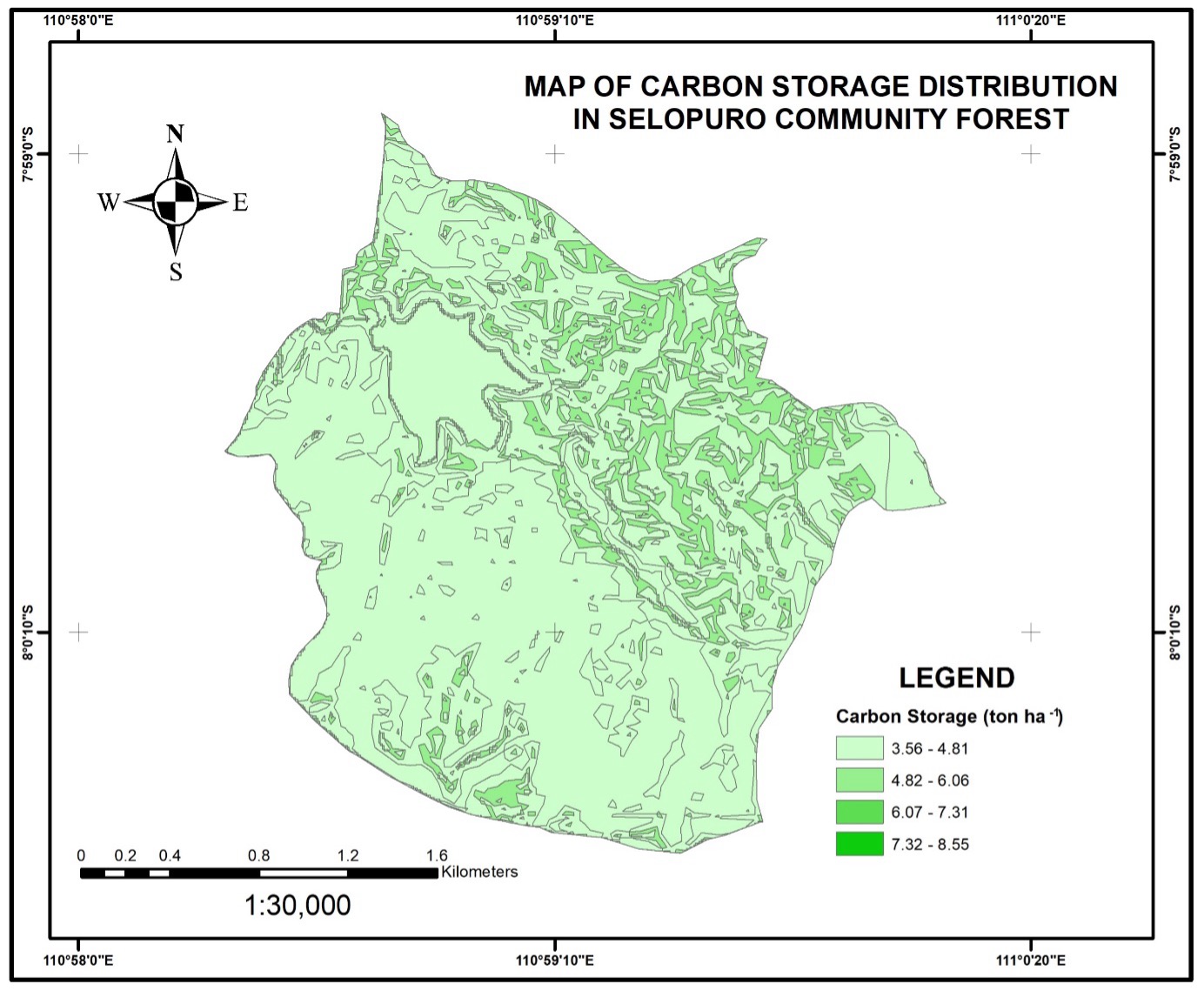
This study aims to estimate biomass and carbon stocks stored based on variations in slope gradient and vegetation cover types in the Community Forest, Selopuro, Indonesia. The study was conducted on 24 sample plots arranged stratified based on a combination of four slope classes (0–8%, 8–15%, 15–30%, >30%) and two vegetation cover types (teak and mixed vegetation). The parameters observed included tree biomass, litter biomass, carbon content, and soil physical-chemical properties. Tree biomass estimation was calculated based on Diameter Breast Height (DBH) measurements and tree height using allometric equations. Data were analyzed using one-way analysis of variance (ANOVA), Tukey's extended test, and Pearson correlation analysis. The results showed that slope and vegetation cover types significantly affected litter biomass and the amount of carbon stored. Plots with mixed vegetation on slope classes 0–8% and 8–15% showed the highest biomass and carbon values. The main factors influencing carbon storage include soil organic C content, canopy length, and soil permeability. These findings emphasize the importance of conservation-based community forest management practices and agroforestry to increase carbon stocks sustainably and support climate change mitigation efforts.
References
- Akter, R., Hasan, M. K., Kabir, K. H., Darr, D., & Roshni, N. A. (2022). Agroforestry systems and their impact on livelihood improvement of tribal farmers in a tropical moist deciduous forest in Bangladesh. Trees, Forests and People, 9(April), 100315. https://doi.org/10.1016/j.tfp.2022.100315 DOI: https://doi.org/10.1016/j.tfp.2022.100315
- Bai, X., Tang, J., Wang, W., Ma, J., Shi, J., & Ren, W. (2023). Organic amendment effects on cropland soil organic carbon and its implications: A global synthesis. Catena, 231(June), 107343. https://doi.org/10.1016/j.catena.2023.107343 DOI: https://doi.org/10.1016/j.catena.2023.107343
- Bertham, Y. H., Utami, K., Putri, E. L., Arifin, Z., & Kamarudin, K. N. (2025). Enhancing soil carbon stocks and soybean yields in coastal areas through the application of biofertilizers. SAINS TANAH – Journal of Soil Science and Agroclimatology, 22(1), 64–74. DOI: https://doi.org/10.20961/stjssa.v22i1.95531
- Bukoski, J. J., Cook-Patton, S. C., Melikov, C., Ban, H., Chen, J. L., Goldman, E. D., ... & Potts, M. D. (2022). Rates and drivers of aboveground carbon accumulation in global monoculture plantation forests. Nature Communications, 13(1), 4206. DOI: https://doi.org/10.1038/s41467-022-31380-7
- Chave, J., Réjou-Méchain, M., Búrquez, A., Chidumayo, E., Colgan, M. S., Delitti, W. B. C., Duque, A., Eid, T., Fearnside, P. M., Goodman, R. C., Henry, M., Martínez-Yrízar, A., Mugasha, W. A., Muller-Landau, H. C., Mencuccini, M., Nelson, B. W., Ngomanda, A., Nogueira, E. M., Ortiz-Malavassi, E., … Vieilledent, G. (2014). Improved allometric models to estimate the aboveground biomass of tropical trees. Global Change Biology, 20(10), 3177–3190. https://doi.org/10.1111/gcb.12629 DOI: https://doi.org/10.1111/gcb.12629
- Daba, D. E., Dullo, B. W., & Soromessa, T. (2022). Effect of forest management on carbon stock of tropical moist afromontane forest. International Journal of Forestry Research, 2022(1), 3691638. DOI: https://doi.org/10.1155/2022/3691638
- Dai, L., Ge, J., Wang, L., Zhang, Q., Liang, T., Bolan, N., Lischeid, G., & Rinklebe, J. (2022). Influence of soil properties, topography, and land cover on soil organic carbon and total nitrogen concentration: A case study in Qinghai-Tibet plateau based on random forest regression and structural equation modeling. Science of the Total Environment, 821, 153440. https://doi.org/10.1016/j.scitotenv.2022.153440 DOI: https://doi.org/10.1016/j.scitotenv.2022.153440
- Diochon, A., & Kellman, L. (2022). Forest structure as a determinant of biomass distribution and carbon retention. Ecological Indicators, 130, 108020.
- Dharmawan, I. W. S., Heriyanto, N. M., et al. (2024). The Dynamics of Vegetation Structure, Composition and Carbon Stock in Peatland Ecosystem of Old Secondary Forest in Riau and South Sumatra Provinces. Land, 13(5), 663. https://doi.org/10.3390/land13050663 DOI: https://doi.org/10.3390/land13050663
- Dharmawan, I. W. S., Heriyanto, N. M., Setyawati, T., Wardani, M., Susilo, A., Garsetiasih, R., Sawitri, R., Denny, Yuskianti, V., Karlina, E., et al. (2023). The Vegetation Composition and Carbon Stock of Old Shrub Typology to Support the Rehabilitation Program in Sumatra and Kalimantan Islands, Indonesia. Sustainability, 15(2), 1389. https://doi.org/10.3390/su15021389 DOI: https://doi.org/10.3390/su15021389
- Fang, Y., Leung, L. R., Koven, C. D., Bisht, G., Detto, M., Cheng, Y., ... & Chambers, J. Q. (2022). Modeling the topographic influence on aboveground biomass using a coupled model of hillslope hydrology and ecosystem dynamics. Geoscientific Model Development, 15(20), 7879-7901. DOI: https://doi.org/10.5194/gmd-15-7879-2022
- FAO. (1990). A statistical manual for forestry research. Rome: Food and Agriculture Organization of the United Nations.
- Frasetya, B., Suriadikusumah, A., Haryanto, R., & Hidayat, C. (2019). A new approach of soil degradation assessment for biomass production in Subang District West Java Province. IOP Conference Series: Earth and Environmental Science, 393(1). https://doi.org/10.1088/1755-1315/393/1/012075 DOI: https://doi.org/10.1088/1755-1315/393/1/012075
- Gunawan, H., Setyawati, T., Atmoko, T., Subarudi, Kwatrina, R. T., Yeny, I., Yuwati, T. W., Effendy, R., Abdullah, L., Mukhlisi, Lastini, T., Arini, D. I. D., Sari, U. K., Sitepu, B. S., Pattiselanno, F., & Kuswanda, W. (2024). A Review of Forest Fragmentation in Indonesia Under the DPSIR Framework for Biodiversity Conservation Strategies. Global Ecology and Conservation, 51(March), e02918. https://doi.org/10.1016/j.gecco.2024.e02918 DOI: https://doi.org/10.1016/j.gecco.2024.e02918
- Hairiah, K., & Rahayu, S. (2007). Pengukuran Karbon Tersimpan Di Berbagai Macam Penggunaan Lahan.
- Herawati, A., Mujiyo, M., Dewi, W. S., Syamsiyah, J., & Romadhon, M. R. (2024). Improving microbial properties in Psamments with mycorrhizal fungi, amendments, and fertilizer. Eurasian Journal of Soil Science, 13(1), 59–69. https://doi.org/10.18393/ejss.1396572 DOI: https://doi.org/10.18393/ejss.1396572
- Herdiansyah, G., Herawati, A., Safira, R., Hardian, T., Istiqomah, N. M., Hasanah, K., & Romadhon, M. R. (2024). Analysis of potential soil degradation on agricultural land based on geographic information systems in Slogohimo District, Wonogiri Regency. In IOP Conference Series: Earth and Environmental Science (Vol. 1314, No. 1, p. 012108). IOP Publishing. https://doi.org/10.1088/1755-1315/1314/1/012108 DOI: https://doi.org/10.1088/1755-1315/1314/1/012108
- Huang, W., Jiang, L., Zhou, J., Kim, H. S., Xiao, J., & Luo, Y. (2025). Reduced Erosion Augments Soil Carbon Storage Under Cover Crops. Global change biology, 31(3), e70133. DOI: https://doi.org/10.1111/gcb.70133
- Hu, Y., Ao, G., Feng, J., Chen, X., & Zhu, B. (2025). The patterns of forest soil particulate and mineral associated organic carbon characteristics with latitude and soil depth across eastern China. Forest Ecosystems, 12(August 2024), 100291. https://doi.org/10.1016/j.fecs.2024.100291 DOI: https://doi.org/10.1016/j.fecs.2024.100291
- Kala, C. P. (2024). Agroforestry in a changing climate: Challenges, opportunities and solutions. Ecological Frontiers, 45(2), 269–276. https://doi.org/10.1016/j.ecofro.2024.11.003 DOI: https://doi.org/10.1016/j.ecofro.2024.11.003
- Kurniawati, A., Aini, S. N., Khodijah, N. S., & Gusta, A. R. (2024). Enhancing Agroecology in Pepper (Piper nigrum L.) Cultivation with Centrosema pubescens Ground Cover: A Study from Central Bangka, Indonesia. Caraka Tani: Journal of Sustainable Agriculture, 39(2), 451–464. http://dx.doi.org/10.20961/carakatani.v39i2.90003 DOI: https://doi.org/10.20961/carakatani.v39i2.90003
- Lal, R. (2021). Soil carbon sequestration to mitigate climate change. Geoderma, 123(2004), 1–22. https://doi.org/10.1016/j.geoderma.2004.01.032 DOI: https://doi.org/10.1016/j.geoderma.2004.01.032
- Lenk, A., Richter, R., Kretz, L., & Wirth, C. (2024). Effects of canopy gaps on microclimate, soil biological activity and their relationship in a European mixed floodplain forest. Science of the Total Environment, 941(February), 173572. https://doi.org/10.1016/j.scitotenv.2024.173572 DOI: https://doi.org/10.1016/j.scitotenv.2024.173572
- Li, Y., Henrion, M., Moore, A., Lambot, S., Opfergelt, S., Vanacker, V., Jonard, F., & Van Oost, K. (2024). Factors Controlling Peat Soil Thickness and Carbon Storage in Temperate Peatlands Based on UAV High-resolution Remote Sensing. Geoderma, 449(August). https://doi.org/10.1016/j.geoderma.2024.117009 DOI: https://doi.org/10.1016/j.geoderma.2024.117009
- Lili, Z., Vivek, Y., Hengchen, Z., Yaya, S., Xiangxiang, H., Xiaoxia, W., ... & Yongxiang, K. (2024). Climate drivers of litterfall biomass dynamics in three types of forest stands on the loess plateau. Ecological Indicators, 163, 112088. https://doi.org/10.1016/j.ecolind.2024.112088 DOI: https://doi.org/10.1016/j.ecolind.2024.112088
- Lin, Q., Wu, Q., Chen, C., Lin, H., Xie, A., Jiang, C., & Xia, X. (2025). Species-Specific Effects of Litter Management on Soil Respiration Dynamics in Urban Green Spaces: Implications for Carbon Cycling and Climate Regulation. Forests, 16(4), 642. DOI: https://doi.org/10.3390/f16040642
- Ma, S., Wang, L. J., Zhao, Y. G., & Jiang, J. (2023). Coupling effects of soil and vegetation from an ecosystem service perspective. Catena, 231, 107354. https://doi.org/10.1016/j.catena.2023.107354 DOI: https://doi.org/10.1016/j.catena.2023.107354
- Mishra, U., Hugelius, G., Shelef, E., Yang, Y., & Strauss, J. (2021). Spatial heterogeneity and environmental predictors of permafrost region soil organic carbon stocks. February. https://doi.org/10.1126/sciadv.aaz5236 DOI: https://doi.org/10.1126/sciadv.aaz5236
- Ngo, K. M., Turner, B. L., Muller-Landau, H. C., Davies, S. J., Larjavaara, M., Nik Hassan, N. F. B., & Lum, S. (2013). Carbon stocks in primary and secondary tropical forests in Singapore. Forest Ecology and Management, 296, 81–89. https://doi.org/10.1016/j.foreco.2013.02.004 DOI: https://doi.org/10.1016/j.foreco.2013.02.004
- Nonglait, M. L., Khundrakpam, N., & Deka, P. (2024). Farmers’ income and the driving forces for the switch from shifting cultivation to settled agriculture in Meghalaya, India. Caraka Tani: Journal of Sustainable Agriculture, 39(1), 65–80. http://dx.doi.org/10.20961/carakatani.v39i1.76129 DOI: https://doi.org/10.20961/carakatani.v39i1.76129
- Plaga, B. N., Bauhus, J., Pretzsch, H., Pereira, M. G., & Forrester, D. I. (2024). Influence of crown and canopy structure on light absorption, light use efficiency, and growth in mixed and pure Pseudotsuga menziesii and Fagus sylvatica forests. European Journal of Forest Research, 143(2), 479-491. DOI: https://doi.org/10.1007/s10342-023-01638-w
- Purwanto, R. H., Maryudi, A., Teguh, Y., Permadi, & Sanjaya. (2012). Potensi Biomassa Dan Simpanan Karbon Jenis Tanaman Berkayu Di Hutan RAKYAT DESA Nglanggeran, Gunungkidul, DIY. Jurnal Ilmu Kehutanan, 6(2). DOI: https://doi.org/10.22146/jik.5778
- Putra, A. D., Ardiansyah, N., Ishaq, R. M., Saputra, D. D., Kurniawan, S., & Hairiah, K. (2025). Benefits of Agroforestry for Maintaining Soil Health: using Microbial Biomass Carbon (MBC) as an indicator. In IOP Conference Series: Earth and Environmental Science (Vol. 1466, No. 1, p. 012002). IOP Publishing. https://doi.org/10.1088/1755-1315/1466/1/012002 DOI: https://doi.org/10.1088/1755-1315/1466/1/012002
- Rahman, A., Fachruzi, I., & Syarbini, M. (2024). Penambahan Fraksi Pasir dan Amelioran terhadap Sifat Fisika dan Kimia Tanah Salin yang Sudah Dilindi. Acta Solum, 3(1), 46–53. https://doi.org/10.20527/actasolum.v3i1.2845 DOI: https://doi.org/10.20527/actasolum.v3i1.2845
- Rijal, S., & Sinutok, S. (2024). Effectiveness of community forest management as an ecosystem-based adaptation strategy in the context of Nepal. Indian Journal of Science and Technology, 17(28), 2880–2888. https://doi.org/10.17485/IJST/v17i28.705 DOI: https://doi.org/10.17485/IJST/v17i28.705
- Romadhon, M. R., & Aziz, A. (2022). Determination of flood susceptibility index using overlay-scoring data method based on geographic information system (gis) in Semarang city, Central Java, Indonesia. AgriHealth: Journal of Agri-food, Nutrition and Public Health, 3(2), 104–123. https://doi.org/10.20961/agrihealth.v3i2.60451 DOI: https://doi.org/10.20961/agrihealth.v3i2.60451
- Sengupta, A., & Thangavel, M. (2023). Analysis of the Effects of Climate Change on Cotton Production in Maharashtra State of India Using Statistical Model and GIS Mapping. Caraka Tani: Journal of Sustainable Agriculture, 38(1), 152–162. http://dx.doi.org/10.20961/carakatani.v38i1.64377 DOI: https://doi.org/10.20961/carakatani.v38i1.64377
- Simmavong, T., Su, Y., Deng, Y., Wang, B., Yao, Z., Wu, J., Sha, L., Cao, M., & Lin, L. (2025). Forest structure predicts aboveground biomass better than community-weighted mean of traits, functional diversity, topography, and soil in a tropical forest across spatial scales. Forest Ecology and Management, 578(November 2024), 122457. https://doi.org/10.1016/j.foreco.2024.122457 DOI: https://doi.org/10.1016/j.foreco.2024.122457
- Stas, S. M. (2014). Above-ground biomass and carbon stocks in a secondary forest compared to adjacent primary forest on limestone in Seram, the Moluccas, Indonesia. CIFOR. DOI: https://doi.org/10.17528/cifor/005258
- Sugiarto, A., Utaya, S., Sumarmi, Bachri, S., & Shrestha, R. P. (2024). Estimation of carbon stocks and CO2 emissions resulting from the forest destruction in West Kalimantan, Indonesia. Environmental Challenges, 17, 101010. https://doi.org/10.1016/j.envc.2024.101010 DOI: https://doi.org/10.1016/j.envc.2024.101010
- Suharno, S., Nugroho, A., & Setyawan, A. (2017). Aboveground biomass and carbon stock in teak-based community forest in Yogyakarta, Indonesia. Journal of Forestry Research, 14(2), 123–134.
- Taillardat, P., Moore, J., Sasmito, S., Evans, C. D., Alfina, T., Lok, S., Bandla, A., Cahya, M., Deshmukh, C. S., Dubey, R. K., Kurnianto, S., Swarup, S., Tarigan, S., Taufik, M., Lupascu, M., & Taylor, D. (2025). Methane and Carbon Dioxide Production and Emission Pathways in the Belowground and Draining Water Bodies of a Tropical Peatland Plantation Forest. https://doi.org/10.1029/2024GL112903 DOI: https://doi.org/10.1029/2024GL112903
- Wang, T., Dong, L., & Liu, Z. (2024). Factors driving carbon accumulation in forest biomass and soil organic carbon across natural forests and planted forests in China. Frontiers in Forests and Global Change, 6, 1333868. DOI: https://doi.org/10.3389/ffgc.2023.1333868
- Warner, E., Cook-Patton, S. C., Lewis, O. T., Brown, N., Koricheva, J., Eisenhauer, N., ... & Hector, A. (2023). Young mixed planted forests store more carbon than monocultures—a meta-analysis. Frontiers in Forests and Global Change, 6, 1226514. DOI: https://doi.org/10.3389/ffgc.2023.1226514
- Wu, Y., Li, X., Zeng, H., Zhong, X., & Kuang, S. (2024). Analysis of Carbon Sink Benefits from Comprehensive Soil and Water Conservation in the Loess Hilly Gently Slope Aeolian Sand Region. Water, 16(23), 3434. DOI: https://doi.org/10.3390/w16233434
- Xiang, Y., Li, Y., Luo, X., Liu, Y., Huang, P., Yao, B., ... & Zhang, W. (2022). Mixed plantations enhance more soil organic carbon stocks than monocultures across China: Implication for optimizing afforestation/reforestation strategies. Science of the Total Environment, 821, 153449. DOI: https://doi.org/10.1016/j.scitotenv.2022.153449
- Xu, S., Eisenhauer, N., Zeng, Z., Mo, X., Ding, Y., Lai, D. Y., & Wang, J. (2024). Drivers of soil organic carbon recovery under forest restoration: a global meta-analysis. Carbon Research, 3(1), 80. DOI: https://doi.org/10.1007/s44246-024-00165-6
- Yu, Z., Wang, K., Li, J., Shangguan, Z., & Deng, L. (2023). Mixed plantations have more soil carbon sequestration benefits than pure plantations in China. Forest Ecology and Management, 529, 120654. DOI: https://doi.org/10.1016/j.foreco.2022.120654
- Zhang, X., Li, X., Ji, X., Zhang, Z., Zhang, H., Zha, T., & Jiang, L. (2021). Elevation and total nitrogen are the critical factors that control the spatial distribution of soil organic carbon content in the shrubland on the Bashang Plateau, China. Catena, 204, 105415. DOI: https://doi.org/10.1016/j.catena.2021.105415
- Zheng, L., Zhou, X., Zhou, X., Huang, S., Zhong, Z., & Xiao, H. (2025). Study on the Spatial Distribution Patterns and Influencing Factors of Soil Organic Carbon Components in Ecological Vegetative Slope Areas. Sustainability, 17(6), 2650. https://doi.org/10.3390/su17062650 DOI: https://doi.org/10.3390/su17062650
- Zhou, H., Liu, W., De Boeck, H. J., Ma, Y., & Zhang, Z. (2025). Improving Total Carbon Storage Estimation Using Multi-Source Remote Sensing. Forests, 16(3), 453. DOI: https://doi.org/10.3390/f16030453
- Zhou, T., Lv, Y., Xie, B., Xu, L., Zhou, Y., Mei, T., ... & Shi, Y. (2023). Topography and soil organic carbon in subtropical forests of China. Forests, 14(5), 1023. DOI: https://doi.org/10.3390/f14051023