

The impact of community-mobilized watershed management interventions on the spatiotemporal erosion patterns and implications: Community Engagement for Erosion Control and Sustainable Watershed Management
Published 2025-12-30
Keywords
- Agroecology,
- Amhara region,
- soil and waters conservation,
- slope class,
- soil type
How to Cite
Copyright (c) 2025 Hailu Kendie Addis, Temesegen Mulualem, Beyene Belay, Simegnew Tamir, Shigdaf Mekuriaw, Tadesse Birehanu, Anteneh Tilahun, Tilaye Teklewold, Almaz Giziew Adugna, Belete Anteneh, Yismaw Wuletaw, Esmelalem Mhiret, Likawent Yeheyis, Hailemariam Kefyalew, Tesfaye Feyisa, Menale Wondie, Asmare Dejen

This work is licensed under a Creative Commons Attribution 4.0 International License.




Abstract
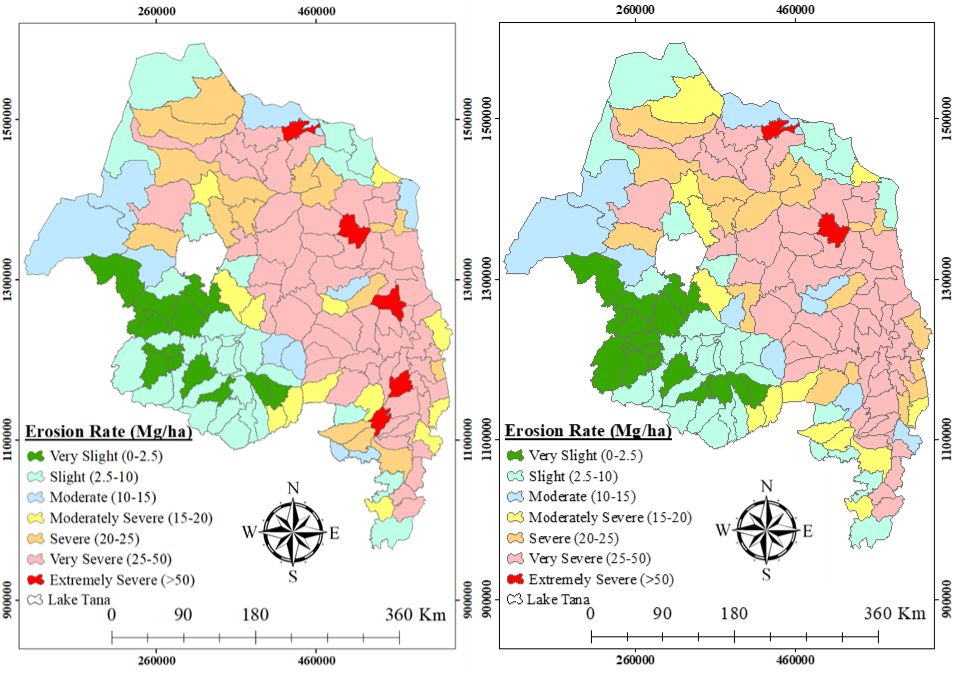
In the Amhara region of Ethiopia, severe soil erosion problems have been a persistent issue due to long-term human-related activities, intense rainfall events, and erosion-sensitive landscapes. The regional government initiated a campaign-based soil and water conservation (SWC) program in response to this pressing issue. A comprehensive soil erosion modeling study was conducted to evaluate the effectiveness of these interventions. The findings show the positive impact of implementing community-based watershed management practices for combating erosion in the region. Specifically, the findings revealed a decline in soil loss from 22.67 Mg ha-1 yr-1 in 2014 to 20.75 Mg ha-1 yr-1 in 2022, indicating a reduction of 1.92 Mg ha-1 yr-1. This decline in soil loss in the region can be directly related to the successful implementation of community-mobilized SWC measures that have been in place since 2011. Despite this progress, it is still alarming to note that a significant 68.61% of the region is classified as high-risk, highlighting the pressing need for immediate action to address soil erosion. Upon examination of the distribution of soil loss across the region, it is evident that cropland, which makes up 39.73% of the total area, is responsible for a substantial 52.04% of the estimated soil loss. Among the 14 agroecology, the warm moist lowlands, tepid sub-moist mid-highlands, and tepid moist mid-highlands cover 48.65% of the total area and contribute a staggering 73.33% of the overall soil loss, underscoring the need for location-specific conservation efforts in these areas to mitigate further degradation.
References
- Abiye, W., Waltner, I., & Kindie, H. (2023). Spatiotemporal dynamics of soil erosion response to land use land cover dynamics and climate variability in Maybar watershed, Awash basin, Ethiopia. Geology, Ecology, and Landscapes, 1-23. DOI: https://doi.org/10.1080/24749508.2023.2256542
- Addis, H. K., Strohmeier, S., Ziadat, F., Melaku, N. D., & Klik, A. (2016). Modeling streamflow and sediment using SWAT in Ethiopian Highlands. International Journal of Agricultural and Biological Engineering, 9(5), 51-66.
- Addis, H. K., Tamir, S., Belay, B., Mekuriaw, S., Birehanu, T., & Wuletaw, Y. (2024). Community-mobilized soil and water conservation and farmers' preferences for mitigating land degradation. Environmental Research Communications. DOI: https://doi.org/10.1088/2515-7620/ad9c1e
- Adgo, E., Teshome, A., & Mati, B. (2013). Impacts of long-term soil and water conservation on agricultural productivity: The case of Anjenie watershed, Ethiopia. Agricultural Water Management, 117, 55-61. DOI: https://doi.org/10.1016/j.agwat.2012.10.026
- Agidew, A. M. A., & Singh, K. N. (2018). Factors affecting farmers’ participation in watershed management programs in the Northeastern highlands of Ethiopia: A case study in the Teleyayen sub-watershed. Ecological Processes, 7(1), 1–15. https://doi.org/10.1186/s13717-018-0128-6 DOI: https://doi.org/10.1186/s13717-018-0128-6
- Alemayehu, A. A., Muluneh, A., Moges, A., & Kendie, H. (2020). Estimation of sediment yield and effectiveness of level stone bunds to reduce sediment loss in the Gumara-Maksegnit watershed, Nile Basin, Ethiopia. Journal of Soils and Sediments, 20, 3756-3768. DOI: https://doi.org/10.1007/s11368-020-02715-y
- Alexandridis, T. K., Sotiropoulou, A. M., Bilas, G., Karapetsas, N., & Silleos, N. G. (2015). The effects of seasonality in estimating the C‐factor of soil erosion studies. Land Degradation & Development, 26(6), 596-603. DOI: https://doi.org/10.1002/ldr.2223
- Almagro, A., Thomé, T. C., Colman, C. B., Pereira, R. B., Junior, J. M., Rodrigues, D. B. B., & Oliveira, P. T. S. (2019). Improving cover and management factor (C-factor) estimation using remote sensing approaches for tropical regions. International Soil and Water Conservation Research, 7(4), 325-334. DOI: https://doi.org/10.1016/j.iswcr.2019.08.005
- Altieri, M. A., & Nicholls, C. I. (2012). Agroecology scaling up for food sovereignty and resiliency. Sustainable Agriculture Reviews: Volume 11, 1-29. DOI: https://doi.org/10.1007/978-94-007-5449-2_1
- Angima, S. D., Stott, D. E., O’neill, M. K., Ong, C. K., & Weesies, G. A. (2003). Soil erosion prediction using RUSLE for central Kenyan highland conditions. Agriculture, ecosystems & environment, 97(1-3), 295-308. DOI: https://doi.org/10.1016/S0167-8809(03)00011-2
- Anley, M. A., & Minale, A. S. (2024). Modeling the impact of land use land cover change on the estimation of soil loss and sediment export using InVEST model at the Rib watershed of Upper Blue Nile Basin, Ethiopia. Remote Sensing Applications: Society and Environment, 101177. DOI: https://doi.org/10.1016/j.rsase.2024.101177
- Aquino, R. F., Silva, M. L. N., Freitas, D. A. F. D., Curi, N., & Avanzi, J. C. (2013). Soil losses from typic Cambisols and Red Latosol as related to three erosive rainfall patterns. Revista Brasileira de Ciência do Solo, 37, 213-220. DOI: https://doi.org/10.1590/S0100-06832013000100022
- ARBoFED (Amhara Region Bureau of Finance and Economic Development) (2022). Annual report. Bahir Dar, Ethiopia: Bureau of Finance and Economic Development (BoFED).
- Arekhi, S., Niazi, Y., & Kalteh, A. M. (2012). Soil erosion and sediment yield modeling using RS and GIS techniques: a case study, Iran. Arabian Journal of Geosciences, 5(2), 285. DOI: https://doi.org/10.1007/s12517-010-0220-4
- Arega, E., Deribew, K. T., Moisa, M. B., & Gemeda, D. O. (2024). Assessment of soil erosion and prioritization of conservation and restoration measures using RUSLE and Geospatial techniques: the case of upper Bilate watershed. Geomatics, Natural Hazards and Risk, 15(1), 2336016. DOI: https://doi.org/10.1080/19475705.2024.2336016
- Argaw, M., & Yohannes, H. (2024). Impact of land use/land cover changes on surface water and soil-sediment export in the urbanized Akaki River catchment, Awash Basin, Ethiopia. Journal of Hydrology: Regional Studies, 52, 101677. DOI: https://doi.org/10.1016/j.ejrh.2024.101677
- Arnold, J. G., Srinivasan, R., Muttiah, R. S., & Williams, J. R. (1998). Large area hydrologic modeling and assessment part I: model development 1. JAWRA Journal of the American Water Resources Association, 34(1), 73-89. DOI: https://doi.org/10.1111/j.1752-1688.1998.tb05961.x
- Ayalew, G., & Selassie, Y. G. (2015). Soil loss estimation for soil conservation planning using geographic information system in Guang watershed, Blue Nile basin. J Environ Earth Sci, 5(1), 126-134.
- Bayle, D., & Muluye, K. (2023). Review on successful soil conservation methods in Ethiopia. Cogent Food & Agriculture, 9(2), 2274171. DOI: https://doi.org/10.1080/23311932.2023.2274171
- Behera, M., Sena, D. R., Mandal, U., Kashyap, P. S., & Dash, S. S. (2020). Integrated GIS-based RUSLE approach for quantification of potential soil erosion under future climate change scenarios. Environmental Monitoring and Assessment, 192(11), 733. DOI: https://doi.org/10.1007/s10661-020-08688-2
- Berihun, M. L., Tsunekawa, A., Haregeweyn, N., Meshesha, D. T., Adgo, E., Tsubo, M., ... & Yibeltal, M. (2019). Exploring land use/land cover changes, drivers and their implications in contrasting agro-ecological environments of Ethiopia. Land use policy, 87, 104052. DOI: https://doi.org/10.1016/j.landusepol.2019.104052
- Betru, T., Tolera, M., Sahle, K., & Kassa, H. (2019). Trends and drivers of land use/land cover change in Western Ethiopia. Applied Geography, 104, 83-93. DOI: https://doi.org/10.1016/j.apgeog.2019.02.007
- Blanco-Canqui, H., Stone, L. R., & Stahlman, P. W. (2010). Soil response to long‐term cropping systems on an Argiustoll in the central Great Plains. Soil Science Society of America Journal, 74(2), 602-611. DOI: https://doi.org/10.2136/sssaj2009.0214
- BoA (Bureau of Agriculture) (2023). Amhara National Regional State Bureau of Agriculture, Natural resource 2023 Annual report: Wereda level. Bahir Dar, Ethiopia
- Borrelli, P., Robinson, D. A., Fleischer, L. R., Lugato, E., Ballabio, C., Alewell, C., ... & Panagos, P. (2017). An assessment of the global impact of 21st century land use change on soil erosion. Nature communications, 8(1), 1-13. DOI: https://doi.org/10.1038/s41467-017-02142-7
- Borrelli, P., Robinson, D. A., Panagos, P., Lugato, E., Yang, J. E., Alewell, C., ... & Ballabio, C. (2020). Land use and climate change impacts on global soil erosion by water (2015-2070). Proceedings of the National Academy of Sciences, 117(36), 21994-22001. DOI: https://doi.org/10.1073/pnas.2001403117
- Brady, N. C., & Weil, R. R. (2008). The nature and properties of soils (Vol. 13, pp. 662-710). Upper Saddle River, NJ: Prentice Hall.
- Brooks, K. N., & Eckman, K. (1998). Global perspective of watershed management. Land Stewardship in the 21stCentury: The Contributions of Watershed Management, 11-20.
- Carlson, T. N., & Ripley, D. A. (1997). On the relation between NDVI, fractional vegetation cover, and leaf area index. Remote sensing of Environment, 62(3), 241-252. DOI: https://doi.org/10.1016/S0034-4257(97)00104-1
- CEDEP (Consultants for Economic Development and Environmental Protection) (1999). Regional Agricultural Master Plan: Main report. CEDEP, Bahir Dar, Ethiopia. 155 pp.
- Chowdary, V. M., Ramakrishnan, D., Srivastava, Y. K., Chandran, V., & Jeyaram, A. (2009). Integrated water resource development plan for sustainable management of Mayurakshi watershed, India using remote sensing and GIS. Water resources management, 23(8), 1581-1602. DOI: https://doi.org/10.1007/s11269-008-9342-9
- Cooper, P. J., Dimes, J., Rao, K. P. C., Shapiro, B., Shiferaw, B., & Twomlow, S. (2008). Coping better with current climatic variability in the rain-fed farming systems of sub-Saharan Africa: An essential first step in adapting to future climate change?. Agriculture, ecosystems & environment, 126(1-2), 24-35. DOI: https://doi.org/10.1016/j.agee.2008.01.007
- CoSAERAR (Commission for Sustainable Agriculture and Environmental Rehabilitation for Amhara Region) (1999). CoSAERAR brochure. CoSAERAR, Bahir Dar, Ethiopia. 12 pp.
- De Graaff, J., Amsalu, A., Bodnar, F., Kessler, A., Posthumus, H., & Tenge, A. (2008). Factors influencing adoption and continued use of long-term soil and water conservation measures in five developing countries. Applied Geography, 28(4), 271-280. DOI: https://doi.org/10.1016/j.apgeog.2008.05.001
- De Graaff, J., Aklilu, A., Ouessar, M., Asins-Velis, S., & Kessler, A. (2013). The development of soil and water conservation policies and practices in five selected countries from 1960 to 2010. Land Use Policy, 32, 165-174. DOI: https://doi.org/10.1016/j.landusepol.2012.10.018
- Demirel, H., Ozcinar, C., & Anbarjafari, G. (2009). Satellite image contrast enhancement using discrete wavelet transform and singular value decomposition. IEEE Geoscience and remote sensing letters, 7(2), 333-337. DOI: https://doi.org/10.1109/LGRS.2009.2034873
- Desta, L., Kassie, M., Benin, S., & Pender, J. (2000). Land degradation and strategies for sustainable development in the Ethiopian highlands, Amhara Region, Socio-economics and Policy Research Working Paper 32. International Livestock Research Institute, Nairobi, Kenya.
- Desta, L., Carucci, V., Wendem-Agenehu, A., & Abebe, Y. (2005). Community based participatory watershed development: A guideline. Addis Ababa, Ethiopia: Ministry of Agriculture and Rural Development (MoARD).
- Diao, X., Taffesse, A. S., Yu, B., & Pratt, A. N. (2010, November). Economic importance of agriculture for sustainable development and poverty reduction: The case study of Ethiopia. In Global forum on agriculture (pp. 29-30). Policies for Agricultural Development, Poverty Reduction and Food Security, November 29-30, 2010, Organisation for Economic Co-operation and Development (OECD) Headquarters, Paris, France.
- Di Stefano, C., Nicosia, A., Pampalone, V., & Ferro, V. (2023). Soil loss tolerance in the context of the European Green Deal. Heliyon, 9(1). DOI: https://doi.org/10.1016/j.heliyon.2023.e12869
- Diro, S., Tesfaye, A., & Erko, B. (2022). Determinants of adoption of climate-smart agricultural technologies and practices in the coffee-based farming system of Ethiopia. Agriculture & Food Security, 11(1), 1-14. DOI: https://doi.org/10.1186/s40066-022-00385-2
- Ebabu, K., Tsunekawa, A., Haregeweyn, N., Adgo, E., Meshesha, D. T., Aklog, D., ... & Yibeltal, M. (2020). Exploring the variability of soil properties as influenced by land use and management practices: A case study in the Upper Blue Nile basin, Ethiopia. Soil and Tillage Research, 200, 104614. DOI: https://doi.org/10.1016/j.still.2020.104614
- El-Shikha, D. M., Waller, P., Hunsaker, D., Clarke, T., & Barnes, E. (2007). Ground-based remote sensing for assessing water and nitrogen status of broccoli. Agricultural water management, 92(3), 183-193. DOI: https://doi.org/10.1016/j.agwat.2007.05.020
- Endalew, T., & Biru, D. (2022). Soil erosion risk and sediment yield assessment with Revised Universal Soil Loss Equation and GIS: The case of Nesha watershed, Southwestern Ethiopia. Results in Geophysical Sciences, 12, 100049. DOI: https://doi.org/10.1016/j.ringps.2022.100049
- FAO. (1984). (Food and agriculture organization/United Nations development programme), methodology used in the development of soil loss rate map of the Ethiopian highlands. Field document 5 (Rome: FAO). https://doi.org/10.1016/j.iswcr.2019.01.003
- FAO. (2006). Guidelines for Soil Description, 4th ed.; Food and Agriculture Organization of the United Nations: Rome, Italy, ISBN 978-92-5-105521-2.
- FAO. (2014). Adapting to climate change through land and water management in Eastern Africa. Results of Pilot Projects in Ethiopia, Kenya and Tanzania.
- Fayas, C. M., Abeysingha, N. S., Nirmanee, K. G. S., Samaratunga, D., & Mallawatantri, A. (2019). Soil loss estimation using rusle model to prioritize erosion control in KELANI river basin in Sri Lanka. International Soil and Water Conservation Research, 7(2), 130-137. DOI: https://doi.org/10.1016/j.iswcr.2019.01.003
- Feng, Q., Zhao, W., Ding, J., Fang, X., & Zhang, X. (2018). Estimation of the cover and management factor based on stratified coverage and remote sensing indices: A case study in the Loess Plateau of China. Journal of soils and sediments, 18, 775-790. DOI: https://doi.org/10.1007/s11368-017-1783-4
- Fenta, A. A., Yasuda, H., Shimizu, K., & Haregeweyn, N. (2017). Response of streamflow to climate variability and changes in human activities in the semiarid highlands of northern Ethiopia. Regional Environmental Change, 17, 1229-1240. DOI: https://doi.org/10.1007/s10113-017-1103-y
- Fenta, A. A., Tsunekawa, A., Haregeweyn, N., Poesen, J., Tsubo, M., Borrelli, P., ... & Kurosaki, Y. (2020). Land susceptibility to water and wind erosion risks in the East Africa region. Science of the Total Environment, 703, 135016. DOI: https://doi.org/10.1016/j.scitotenv.2019.135016
- Fenta, A. A., Tsunekawa, A., Haregeweyn, N., Tsubo, M., Yasuda, H., Kawai, T., ... & Sultan, D. (2021). Agroecology-based soil erosion assessment for better conservation planning in Ethiopian river basins. Environmental research, 195, 110786. DOI: https://doi.org/10.1016/j.envres.2021.110786
- Fischer, G., Nachtergaele, F., Prieler, S., Van Velthuizen, H. T., Verelst, L., & Wiberg, D. (2008). Global agro-ecological zones assessment for agriculture (GAEZ 2008). IIASA, Laxenburg, Austria and FAO, Rome, Italy, 10.
- Flanagan, D. C., Ascough, J. C., Nearing, M. A., & Laflen, J. M. (2001). The water erosion prediction project (WEPP) model. Landscape erosion and evolution modeling, 145-199. DOI: https://doi.org/10.1007/978-1-4615-0575-4_7
- Galindo, V., Giraldo, C., Lavelle, P., Armbrecht, I., & Fonte, S. J. (2022). Land use conversion to agriculture impacts biodiversity, erosion control, and key soil properties in an Andean watershed. Ecosphere, 13(3), e3979. DOI: https://doi.org/10.1002/ecs2.3979
- Ganasri, B. P., & Ramesh, H. (2016). Assessment of soil erosion by RUSLE model using remote sensing and GIS-A case study of Nethravathi Basin. Geoscience Frontiers, 7(6), 953-961. https://doi.org/10.1016/j.gsf.2015.10.007. DOI: https://doi.org/10.1016/j.gsf.2015.10.007
- Gebregziabher, G., Abera, D. A., Gebresamuel, G., Giordano, M., & Langan, S. (2016). An assessment of integrated watershed management in Ethiopia (Vol. 170). International Water Management Institute (IWMI). DOI: https://doi.org/10.5337/2016.214
- Gebremeskel, G., Gebremicael, T. G., & Girmay, A. (2018). Economic and environmental rehabilitation through soil and water conservation, the case of Tigray in northern Ethiopia. Journal of Arid Environments, 151, 113-124. DOI: https://doi.org/10.1016/j.jaridenv.2017.12.002
- Gessesse, A. A., & Melesse, A. M. (2019). Temporal relationships between time series CHIRPS-rainfall estimation and eMODIS-NDVI satellite images in Amhara Region, Ethiopia. In Extreme hydrology and climate variability (pp. 81-92). Elsevier. DOI: https://doi.org/10.1016/B978-0-12-815998-9.00008-7
- Getu, L. A., Nagy, A., & Addis, H. K. (2022). Soil loss estimation and severity mapping using the RUSLE model and GIS in Megech watershed, Ethiopia. Environmental Challenges, 8, 100560. DOI: https://doi.org/10.1016/j.envc.2022.100560
- Girmay, G., Moges, A., & Muluneh, A. (2020). Estimation of soil loss rate using the USLE model for Agewmariayam Watershed, northern Ethiopia. Agriculture & Food Security, 9, 1-12. DOI: https://doi.org/10.1186/s40066-020-00262-w
- Gupta, H., Kaur, L., Asra, M., Avtar, R., & Reddy, C. S. (2021). MODIS NDVI multi-temporal analysis confirms farmer perceptions on seasonality variations affecting apple orchards in Kinnaur, Himachal Pradesh. Agriculture, 11(8), 724. DOI: https://doi.org/10.3390/agriculture11080724
- Haregeweyn, N., Berhe, A., Tsunekawa, A., Tsubo, M., & Meshesha, D. T. (2012). Integrated watershed management as an effective approach to curb land degradation: a case study of the Enabered watershed in northern Ethiopia. Environmental management, 50, 1219-1233. DOI: https://doi.org/10.1007/s00267-012-9952-0
- Haregeweyn, N., Tsunekawa, A., Poesen, J., Tsubo, M., Meshesha, D. T., Fenta, A. A., ... & Adgo, E. (2017). Comprehensive assessment of soil erosion risk for better land use planning in river basins: Case study of the Upper Blue Nile River. Science of the Total Environment, 574, 95-108. DOI: https://doi.org/10.1016/j.scitotenv.2016.09.019
- Heyder, S. M., Beza, S. A., & Demissie, S. T. (2023). Optimization of land management measures for soil erosion risk using GIS in agricultural landscape of western Hararghe highlands, Ethiopia. Scientific African, 21, e01853. DOI: https://doi.org/10.1016/j.sciaf.2023.e01853
- Hurni, K., Zeleke, G., Kassie, M., Tegegne, B., Kassawmar, T., Teferi, E., ... & Hurni, H. (2015). Soil degradation and sustainable land management (SLM) in the rainfed agricultural areas of Ethiopia: an assessment of the economic implications. Report for the economics of land degradation initiative, 62.
- Jetten, V., Govers, G., & Hessel, R. (2003). Erosion models: quality of spatial predictions. Hydrological processes, 17(5), 887-900. DOI: https://doi.org/10.1002/hyp.1168
- Jourgholami, M., Karami, S., Tavankar, F., Lo Monaco, A., & Picchio, R. (2020). Effects of slope gradient on runoff and sediment yield on machine-induced compacted soil in temperate forests. Forests, 12(1), 49. DOI: https://doi.org/10.3390/f12010049
- Kaffas, K., Papaioannou, G., Varlas, G., Al Sayah, M. J., Papadopoulos, A., Dimitriou, E., ... & Righetti, M. (2022). Forecasting soil erosion and sediment yields during flash floods: The disastrous case of Mandra, Greece, 2017. Earth Surface Processes and Landforms, 47(7), 1744-1760. DOI: https://doi.org/10.1002/esp.5344
- Kassawmar, T., Zeleke, G., Bantider, A., Gessesse, G. D., & Abraha, L. (2018). A synoptic land change assessment of Ethiopia's Rainfed Agricultural Area for evidence-based agricultural ecosystem management. Heliyon, 4(11). DOI: https://doi.org/10.1016/j.heliyon.2018.e00914
- Kayode, J. S., Olufemi, S. D., Bola, A., Samuel, A. A., Obinna, S. C. (2025). Geospatial analysis of soil erosion and implications for sustainable development goals in tropical ecological zones. Discov Environ, 3, 14 (2025). https://doi.org/10.1007/s44274-025-00198-7 DOI: https://doi.org/10.1007/s44274-025-00198-7
- Kebede, B., Tsunekawa, A., Haregeweyn, N., Adgo, E., Ebabu, K., Meshesha, D. T., ... & Fenta, A. A. (2021). Determining C-and P-factors of RUSLE for different land uses and management practices across agro-ecologies: case studies from the Upper Blue Nile basin, Ethiopia. Physical Geography, 42(2), 160-182. DOI: https://doi.org/10.1080/02723646.2020.1762831
- Kefale Munye, G. S., Belayneh, A., & Ayalew, M. (2024). Identifying Soil Erosion Hotspot Areas Using GIS and MCDA Techniques: Case. Land and Water Degradation in Ethiopia: Climate and Land Use Change Implications, 111. DOI: https://doi.org/10.1007/978-3-031-60251-1_7
- Kim, H., Kwak, H. S., & Yoo, J. S. (2008). Improved clustering algorithm for change detection in remote sensing. International journal of digital content technology and its applications, 2(2), 55-59.
- Kinyanjui, M. J. (2011). NDVI‐based vegetation monitoring in Mau forest complex, Kenya. African Journal of Ecology, 49(2), 165-174. DOI: https://doi.org/10.1111/j.1365-2028.2010.01251.x
- Kumar, G., Kurothe, R. S., Viswakarma, A. K., Mandal, D., Sena, D. R., Mandal, U., ... & Dinesh, D. (2023). Assessment of soil vulnerability to erosion in different land surface configurations and management practices under semi-arid monsoon climate. Soil and Tillage Research, 230, 105698. DOI: https://doi.org/10.1016/j.still.2023.105698
- Lacombe, G., Cappelaere, B., & Leduc, C. (2008). Hydrological impact of water and soil conservation works in the Merguellil catchment of central Tunisia. Journal of Hydrology, 359(3-4), 210-224. DOI: https://doi.org/10.1016/j.jhydrol.2008.07.001
- Lal, R., & Stewart, B. A. (1992). Need for land restoration. Soil Restoration: Soil Restoration Volume 17, 1-11. DOI: https://doi.org/10.1007/978-1-4612-2820-2_1
- Lal, R. (2001). Soil degradation by erosion. Land degradation & development, 12(6), 519-539. DOI: https://doi.org/10.1002/ldr.472
- Lan, Y. Zhang, H. Lacey, R. Hoffmann, W. C. & Wu, W. (2009). Development of an integration sensor and instrumentation system for measuring crop conditions. Agricultural Engineering International: CIGR Journal, 11, pp.11-15.
- Lemma, H., Admasu, T., Dessie, M., Fentie, D., Deckers, J., Frankl, A., ... & Nyssen, J. (2018). Revisiting lake sediment budgets: How the calculation of lake lifetime is strongly data and method dependent. Earth Surface Processes and Landforms, 43(3), 593-607. DOI: https://doi.org/10.1002/esp.4256
- Li, Y., Ni, J., Yang, Q., & Li, R. (2006). Human impacts on soil erosion identified using land-use changes: a case study from the Loess Plateau, China. Physical geography, 27(2), 109-126. DOI: https://doi.org/10.2747/0272-3646.27.2.109
- Liu, B. Y., Nearing, M. A., Shi, P. J., & Jia, Z. W. (2000). Slope length effects on soil loss for steep slopes. Soil Science Society of America Journal, 64(5), 1759-1763. DOI: https://doi.org/10.2136/sssaj2000.6451759x
- Liu, K., Tang, G., Jiang, L., Zhu, A. X., Yang, J., & Song, X. (2015). Regional-scale calculation of the LS factor using parallel processing. Computers & Geosciences, 78, 110-122. DOI: https://doi.org/10.1016/j.cageo.2015.02.001
- Luvai, A., Obiero, J., & Omuto, C. (2022). Soil loss assessment using the revised universal soil loss equation (RUSLE) model. Applied and Environmental Soil Science, 2022(1), 2122554. DOI: https://doi.org/10.1155/2022/2122554
- Mahapatra, S. K., Reddy, G. O., Nagdev, R., Yadav, R. P., Singh, S. K., & Sharda, V. N. (2018). Assessment of soil erosion in the fragile Himalayan ecosystem of Uttarakhand, India using USLE and GIS for sustainable productivity. Current Science, 115(1), 108-121. https://doi.org/10.18520/cs/v115/i1/108-121 DOI: https://doi.org/10.18520/cs/v115/i1/108-121
- Malleswara Rao, B. N., Umamahesh, N. V., & Reddy, G. T. (2005). GIS based soil erosion modelling for conservation planning of watersheds. ISH Journal of Hydraulic Engineering, 11(3), 11-23. https://doi.org/10.1080/09715010.2005.10514 DOI: https://doi.org/10.1080/09715010.2005.10514797
- Masha, M., Yirgu, T., & Debele, M. (2021). Impacts of land cover and greenness change on soil loss and erosion risk in damota area districts, southern Ethiopia. Applied and Environmental Soil Science, 2021, 1-14. DOI: https://doi.org/10.1155/2021/9148138
- Maximus, J. K. (2025). Assessing watershed vulnerability to erosion and sedimentation: Integrating DEM and LULC data in Guyana's diverse landscapes. HydroResearch, 8, 178-193. DOI: https://doi.org/10.1016/j.hydres.2024.11.002
- McCool, D. K., Foster, G. R., & Weesies, G. A. (1997). Slope length and steepness factors (LS). In Predicting soil erosion by water: A guide to conservation planning with the revised universal soil loss equation (RUSLE) (Vol. 703). Washington, DC, USA: US Department of Agriculture.
- Mekonnen, E., Kebede, A., Asfaw, S., & Feyissa, S. (2023). Optimizing soil erosion estimates of RUSLE model by analyzing land use/cover dynamics in upper Awash River Basin, Central Ethiopia. Geomatics, Natural Hazards and Risk, 14(1), 2257363. DOI: https://doi.org/10.1080/19475705.2023.2257363
- Melaku, B. S., Sefereh, E. Y., Emunu, M. H., & Wassie, D. Y. (2024). Application of communication strategies in the diffusion of agricultural innovations and technologies: the case of Amhara Regional Agricultural Research Institute, Ethiopia. Cogent Social Sciences, 10(1), 2306704. DOI: https://doi.org/10.1080/23311886.2024.2306704
- MoFED (Ministry of Finance and Economic Development) (2010). Growth and transformation plan 2010/11-2014/15. Volume I: Main text. Addis Ababa, Ethiopia: Ministry of Finance and Economic Development (MoFED), Federal Democratic Republic of Ethiopia.
- Moges, D. M., & Bhat, H. G. (2018). An insight into land use and land cover changes and their impacts in Rib watershed, north‐western highland Ethiopia. Land degradation & development, 29(10), 3317-3330. DOI: https://doi.org/10.1002/ldr.3091
- Molla, T., & Sisheber, B. (2017). Estimating soil erosion risk and evaluating erosion control measures for soil conservation planning at Koga watershed in the highlands of Ethiopia. Solid Earth, 8(1), 13-25. DOI: https://doi.org/10.5194/se-8-13-2017
- Morgan, R. P. C., Quinton, J. N., Smith, R. E., Govers, G., Poesen, J. W. A., Chisci, G., & Torri, D. (1998). The EUROSEM model. In Modelling Soil Erosion by Water (pp. 389-398). Springer Berlin Heidelberg. DOI: https://doi.org/10.1007/978-3-642-58913-3_29
- Morgan, R. P. C. (2009). Soil erosion and conservation. John Wiley & Sons.
- Musafiri, C. M., Kiboi, M., Macharia, J., Ng'etich, O. K., Kosgei, D. K., Mulianga, B., ... & Ngetich, F. K. (2022). Adoption of climate-smart agricultural practices among smallholder farmers in Western Kenya: do socioeconomic, institutional, and biophysical factors matter?. Heliyon, 8(1). DOI: https://doi.org/10.1016/j.heliyon.2021.e08677
- Mwanake, H., Mehdi-Schulz, B., Schulz, K., Kitaka, N., Olang, L. O., Lederer, J., & Herrnegger, M. (2023). Agricultural Practices and Soil and Water Conservation in the Transboundary Region of Kenya and Uganda: Farmers’ Perspectives of Current Soil Erosion. Agriculture, 13(7), 1434. DOI: https://doi.org/10.3390/agriculture13071434
- Mwanga, E. W., Shaibu, A. G., & Issaka, Z. (2024). Influence of long-term land use and land cover (LULC) changes on soil loss, sediment export, and deposition in the ungauged Bontanga watershed. H2Open Journal, 7(1), 93-113. DOI: https://doi.org/10.2166/h2oj.2024.088
- Nachtergaele, F., van Velthuizen, H., Verelst, L., Wiberg, D., Henry, M., Chiozza, F., ... & Tramberend, S. (2023). Harmonized World Soil Database version 2.0. Food and Agriculture Organization of the United Nations.
- Nigussie, A. B., Ayeled, G. T., Endalew, A., Miheretu, B. A., Amognehegn, A. E., Adamu, A. Y., & Karuppannan, S. (2025). Integrating Google Earth Engine and GIS for RUSLE-based soil erosion and sediment yield assessment in Borkena Watershed, Ethiopia. J. Sediment. Environ. (2025). https://doi.org/10.1007/s43217-025-00218-9 DOI: https://doi.org/10.1007/s43217-025-00218-9
- Nigussie, Z., Tsunekawa, A., Haregeweyn, N., Adgo, E., Nohmi, M., Tsubo, M., ... & Abele, S. (2017). Farmers' perception about soil erosion in Ethiopia. Land degradation & development, 28(2), 401-411. DOI: https://doi.org/10.1002/ldr.2647
- Nut, N., Mihara, M., Jeong, J., Ngo, B., Sigua, G., Prasad, P. V., & Reyes, M. R. (2021). Land use and land cover changes and its impact on soil erosion in Stung Sangkae catchment of Cambodia. Sustainability, 13(16), 9276. DOI: https://doi.org/10.3390/su13169276
- Nyesheja, E. M., Chen, X., El-Tantawi, A. M., Karamage, F., Mupenzi, C., & Nsengiyumva, J. B. (2019). Soil erosion assessment using RUSLE model in the Congo Nile Ridge region of Rwanda. Physical Geography, 40(4), 339-360. DOI: https://doi.org/10.1080/02723646.2018.1541706
- Panagos, P., Borrelli, P., Meusburger, K., Alewell, C., Lugato, E., & Montanarella, L. (2015a). Estimating the soil erosion cover-management factor at the European scale. Land use policy, 48, 38-50. DOI: https://doi.org/10.1016/j.landusepol.2015.05.021
- Panagos, P., Borrelli, P., Meusburger, K., Yu, B., Klik, A., Jae Lim, K., ... & Ballabio, C. (2017). Global rainfall erosivity assessment based on high-temporal resolution rainfall records. Scientific reports, 7(1), 1-12. DOI: https://doi.org/10.1038/s41598-017-04282-8
- Patt, A., Suarez, P., & Gwata, C. (2005). Effects of seasonal climate forecasts and participatory workshops among subsistence farmers in Zimbabwe. Proceedings of the National Academy of Sciences, 102(35), 12623-12628. DOI: https://doi.org/10.1073/pnas.0506125102
- Pechanec, V., Mráz, A., Benc, A., & Cudlín, P. (2018). Analysis of spatiotemporal variability of C-factor derived from remote sensing data. Journal of Applied Remote Sensing, 12(1), 016022-016022. DOI: https://doi.org/10.1117/1.JRS.12.016022
- Pimentel, D., & Burgess, M. (2013). Soil erosion threatens food production. Agriculture, 3(3), 443-463. DOI: https://doi.org/10.3390/agriculture3030443
- Regassa, A., Assen, M., Ali, A., & Gessesse, B. (2023). Major soil types. In The Soils of Ethiopia (pp. 77-110). Cham: Springer International Publishing. DOI: https://doi.org/10.1007/978-3-031-17012-6_6
- Renard, K. G., & Freimund, J. R. (1994). Using monthly precipitation data to estimate the R-factor in the revised USLE. Journal of hydrology, 157(1-4), 287-306. DOI: https://doi.org/10.1016/0022-1694(94)90110-4
- Renard, K. G. (1997). Predicting soil erosion by water: a guide to conservation planning with the Revised Universal Soil Loss Equation (RUSLE). US Department of Agriculture, Agricultural Research Service.
- Saravanan, S., Jegankumar, R., Selvaraj, A., Jennifer, J. J., & Parthasarathy, K. S. S. (2019). Utility of landsat data for assessing mangrove degradation in Muthupet Lagoon, South India. In Coastal zone management (pp. 471-484). Elsevier. DOI: https://doi.org/10.1016/B978-0-12-814350-6.00020-3
- Sardari, M. R., Bazrafshan, O., Panagopoulos, T., & Sardooi, E. R. (2019). Modeling the impact of climate change and land use change scenarios on soil erosion at the Minab Dam Watershed. Sustainability, 11(12), 3353. DOI: https://doi.org/10.3390/su11123353
- Sartori, M., Philippidis, G., Ferrari, E., Borrelli, P., Lugato, E., Montanarella, L., & Panagos, P. (2019). A linkage between the biophysical and the economic: Assessing the global market impacts of soil erosion. Land use policy, 86, 299-312. DOI: https://doi.org/10.1016/j.landusepol.2019.05.014
- Sartori, M., Ferrari, E., M'Barek, R., Philippidis, G., Boysen-Urban, K., Borrelli, P., ... & Panagos, P. (2024). Remaining Loyal to Our Soil: A Prospective Integrated Assessment of Soil Erosion on Global Food Security. Ecological Economics, 108103. DOI: https://doi.org/10.1016/j.ecolecon.2023.108103
- Schmidt, S., Alewell, C., & Meusburger, K. (2018). Mapping spatio-temporal dynamics of the cover and management factor (C-factor) for grasslands in Switzerland. Remote Sensing of Environment, 211, 89-104. DOI: https://doi.org/10.1016/j.rse.2018.04.008
- Schmidt, S., Tresch, S., & Meusburger, K. (2019). Modification of the RUSLE slope length and steepness factor (LS-factor) based on rainfall experiments at steep alpine grasslands. MethodsX, 6, 219-229. DOI: https://doi.org/10.1016/j.mex.2019.01.004
- Selassie, G. Y., Anemut, F., & Addisu, S. (2015). The effects of land use types, management practices and slope classes on selected soil physico-chemical properties in Zikre watershed, North Western Ethiopia. Environmental Systems Research, 4(1), 7. doi: 10.1186/s40068-015-0027-0 DOI: https://doi.org/10.1186/s40068-015-0027-0
- Sharpley, A. N., & Williams, J. R. (Eds.). (1990). EPIC-erosion/productivity impact calculator: 1. Model documentation.
- Shi, Z. H., Cai, C. F., Ding, S. W., Wang, T. W., & Chow, T. L. (2004). Soil conservation planning at the small watershed level using RUSLE with GIS: a case study in the Three Gorge Area of China. Catena, 55(1), 33-48. DOI: https://doi.org/10.1016/S0341-8162(03)00088-2
- Shiferaw, A. (2012). Estimating soil loss rates for soil conservation planning in the Borena Woreda of South Wollo Highlands, Ethiopia. Journal of Sustainable Development in Africa, 13(3), 87-106.
- Shulstad, R. N., & May, R. D. (1980). Conversion of noncropland to cropland: the prospects, alternatives, and implications. American Journal of Agricultural Economics, 62(5), 1077-1083. DOI: https://doi.org/10.2307/1240319
- Sikka, A. K., & Sharda, V. N. (2002, May). Land and water care through participatory watershed management in India: An overview. In Proceedings of 12th ISCO Conference, Beijing, China (Vol. 26731).
- Siraw, Z., Bewket, W., & Adnew, M. (2018). Effects of Community-Based Watershed Development on Soil Properties in the Northwestern Highlands of Ethiopia. Malaysian Journal of Soil Science, 22. DOI: https://doi.org/10.1080/15715124.2018.1505733
- Stone, R. P., & Hilborn, D. (2012). Universal soil loss equation (USLE) factsheet. Ministry of Agriculture, Food and Rural Affairs order, (12-051).
- Taddese, G. (2001). Land degradation: a challenge to Ethiopia. Environmental management, 27, 815-824. DOI: https://doi.org/10.1007/s002670010190
- Tamene, L., & Le, Q. B. (2015). Estimating soil erosion in sub-Saharan Africa based on landscape similarity mapping and using the revised universal soil loss equation (RUSLE). Nutrient cycling in agroecosystems, 102, 17-31. DOI: https://doi.org/10.1007/s10705-015-9674-9
- Tamene, L., Abera, W., Demissie, B., Desta, G., Woldearegay, K., & Mekonnen, K. (2022). Soil erosion assessment in Ethiopia: A review. Journal of Soil and Water Conservation, 77(2), 144-157. DOI: https://doi.org/10.2489/jswc.2022.00002
- Taye, G., Poesen, J., Wesemael, B. V., Vanmaercke, M., Teka, D., Deckers, J., ... & Haregeweyn, N. (2013). Effects of land use, slope gradient, and soil and water conservation structures on runoff and soil loss in semi-arid Northern Ethiopia. Physical Geography, 34(3), 236-259. DOI: https://doi.org/10.1080/02723646.2013.832098
- Tesfaye, G., Assefa, A., & Kidane, D. (2017). Runoff, sediment load and land use/cover change relationship: the case of Maybar sub-watershed, South Wollo, Ethiopia. International journal of river basin management, 15(1), 89-101. DOI: https://doi.org/10.1080/15715124.2016.1239625
- Tesfaye, S., Taye, G., Birhane, E., & van der Zee, S. E. (2021). Spatiotemporal variability of ecosystem water use efficiency in northern Ethiopia during 1982–2014. Journal of Hydrology, 603, 126863. DOI: https://doi.org/10.1016/j.jhydrol.2021.126863
- Tessema, Y. M., Jasińska, J., Yadeta, L. T., Świtoniak, M., Puchałka, R., & Gebregeorgis, E. G. (2020). Soil loss estimation for conservation planning in the welmel watershed of the Genale Dawa Basin, Ethiopia. Agronomy, 10(6), 777. DOI: https://doi.org/10.3390/agronomy10060777
- Tian, P., Zhu, Z., Yue, Q., He, Y., Zhang, Z., Hao, F., ... & Liu, M. (2021). Soil erosion assessment by RUSLE with improved P factor and its validation: Case study on mountainous and hilly areas of Hubei Province, China. International Soil and Water Conservation Research, 9(3), 433-444. DOI: https://doi.org/10.1016/j.iswcr.2021.04.007
- Tian, Y., Jiang, G., Wu, S., Zhou, D., Zhou, T., Tian, Y., & Chen, T. (2023). Cropland-grassland use conversions in the agro-pastoral areas of the Tibetan Plateau: Spatiotemporal pattern and driving mechanisms. Ecological Indicators, 146, 109819. DOI: https://doi.org/10.1016/j.ecolind.2022.109819
- Tiffen, M., & Mortimore, M. (1992). Environment, population growth and productivity in Kenya: a case study of Machakos District. Development Policy Review, 10(4), 359-387. DOI: https://doi.org/10.1111/j.1467-7679.1992.tb00020.x
- Tittonell, P., Piñeiro, G., Garibaldi, L. A., Dogliotti, S., Olff, H., and Jobbagy, E. G. (2020). Agroecology in large scale farming—A research agenda. Front. Sustain. Food Syst. 214, 584605. doi:10.3389/fsufs.2020.584605 DOI: https://doi.org/10.3389/fsufs.2020.584605
- Tiwari, A. K., Risse, L. M., & Nearing, M. A. (2000). Evaluation of WEPP and its comparison with USLE and RUSLE. Transactions of the ASAE, 43(5), 1129-1135. DOI: https://doi.org/10.13031/2013.3005
- Tsendbazar, N., Herold, M., Lesiv, M., & Fritz, S. (2018). Copernicus Global Lan d Operations: Validation Report of Moderate Dynamic Land Cover, Collection 100 M. Version, 1, 68.
- Tucker, C. J. (1979). Red and photographic infrared linear combinations for monitoring vegetation. Remote sensing of Environment, 8(2), 127-150. DOI: https://doi.org/10.1016/0034-4257(79)90013-0
- USGS. EarthExplorer. Available online: https://earthexplorer.usgs.gov/ (accessed on 20 June 2022).
- Vanmaercke, M., Panagos, P., Vanwalleghem, T., Hayas, A., Foerster, S., Borrelli, P., ... & Poesen, J. (2021). Measuring, modelling and managing gully erosion at large scales: A state of the art. Earth-Science Reviews, 218, 103637. DOI: https://doi.org/10.1016/j.earscirev.2021.103637
- Wang, X., Song, K., Wang, Z., Li, S., Shang, Y., & Liu, G. (2024). Effects of land conversion to cropland on soil organic carbon in montane soils of Northeast China from 1985 to 2020. Catena, 235, 107691. DOI: https://doi.org/10.1016/j.catena.2023.107691
- Wang, Z., & Su, Y. (2020). Assessment of soil erosion in the Qinba Mountains of the southern Shaanxi Province in China using the RUSLE model. Sustainability, 12(5), 1733. DOI: https://doi.org/10.3390/su12051733
- Wani, S. P., Singh, H. P., Sreedevi, T. K., Pathak, P., Rego, T. J., Shiferaw, B., & Iyer, S. R. (2003). Farmer-participatory integrated watershed management: Adarsha watershed, Kothapally India. Case 7.
- Wardlow, B. D., Egbert, S. L., & Kastens, J. H. (2007). Analysis of time-series MODIS 250 m vegetation index data for crop classification in the US Central Great Plains. Remote sensing of environment, 108(3), 290-310. DOI: https://doi.org/10.1016/j.rse.2006.11.021
- Wei J.B., Xiao D.N., Zeng H., Fu Y.K. (2008): Spatial variability of soil properties in relation to land use and topography in a typical small watershed of the black soil region, northeastern China. Environmental Geology, 53: 1663–1672. DOI: https://doi.org/10.1007/s00254-007-0773-z
- Welde, K., & Gebremariam, B. (2017). Effect of land use land cover dynamics on hydrological response of watershed: Case study of Tekeze Dam watershed, northern Ethiopia. International Soil and Water Conservation Research, 5(1), 1-16. DOI: https://doi.org/10.1016/j.iswcr.2017.03.002
- Mera, G. A. (2018). Drought and its impacts in Ethiopia. Weather and climate extremes, 22, 24-35. DOI: https://doi.org/10.1016/j.wace.2018.10.002
- Wezel, A., Bellon, S., Doré, T., Francis, C., Vallod, D., & David, C. (2009). Agroecology as a science, a movement and a practice. A review. Agronomy for sustainable development, 29, 503-515. DOI: https://doi.org/10.1051/agro/2009004
- Wischmeier, W. H., & Smith, D. D. (1978). Predicting rainfall erosion losses: a guide to conservation planning (No. 537). Department of Agriculture, Science and Education Administration.
- Woldemariam, A. D., Ddumba, S. D., & Addis, H. K. (2024). Modeling Sediment Yield with Current and Projected Climatic Scenarios in Andit Tid Watershed, Central Highland of Ethiopia. Journal of Agriculture and Environment for International Development (JAEID), 118(2), 83-118. DOI: https://doi.org/10.36253/jaeid-16073
- Yamaguchi, T., Kishida, K., Nunohiro, E., Park, J. G., Mackin, K. J., Hara, K., ... & Harada, I. (2010). Artificial neural networks paddy-field classifier using spatiotemporal remote sensing data. Artificial life and robotics, 15, 221-224. DOI: https://doi.org/10.1007/s10015-010-0797-4
- Yang, Y., Zhu, J., Zhao, C., Liu, S., & Tong, X. (2011). The spatial continuity study of NDVI based on Kriging and BPNN algorithm. Mathematical and Computer Modelling, 54(3-4), 1138-1144. DOI: https://doi.org/10.1016/j.mcm.2010.11.046
- Zanaga, D., Van De Kerchove, R., Daems, D., De Keersmaecker, W., Brockmann, C., Kirches, G., ... & Arino, O. (2022). ESA WorldCover 10 m 2021 v200. https://doi.org/10.5281/zenodo.7254221
- Zhang, W., Hu, G., Dang, Y., Weindorf, D. C., & Sheng, J. (2016). Afforestation and the impacts on soil and water conservation at decadal and regional scales in Northwest China. Journal of Arid Environments, 130, 98-104. DOI: https://doi.org/10.1016/j.jaridenv.2016.03.003
- Zhang, X., Lark, T. J., Clark, C. M., Yuan, Y., & LeDuc, S. D. (2021). Grassland-to-cropland conversion increased soil, nutrient, and carbon losses in the US Midwest between 2008 and 2016. Environmental Research Letters, 16(5), 054018. DOI: https://doi.org/10.1088/1748-9326/abecbe
- Zhao, G., Mu, X., Wen, Z., Wang, F., & Gao, P. (2013). Soil erosion, conservation, and eco‐environment changes in the Loess Plateau of China. Land Degradation & Development, 24(5), 499-510. DOI: https://doi.org/10.1002/ldr.2246
- Zhao, J., Feng, X., Deng, L., Yang, Y., Zhao, Z., Zhao, P., ... & Fu, B. (2020). Quantifying the effects of vegetation restorations on the soil erosion export and nutrient loss on the Loess Plateau. Frontiers in Plant Science, 11, 573126. DOI: https://doi.org/10.3389/fpls.2020.573126