

Published 2025-12-30
Keywords
- Typology,
- Crop systems,
- Cajanus cajan,
- determinants,
- Benin
How to Cite
Copyright (c) 2025 Ibidon Firmin Akpo, Filikibirou Tassou Zakari, Zachée Houessingbe, Afouda Jacob Yabi

This work is licensed under a Creative Commons Attribution 4.0 International License.




Abstract
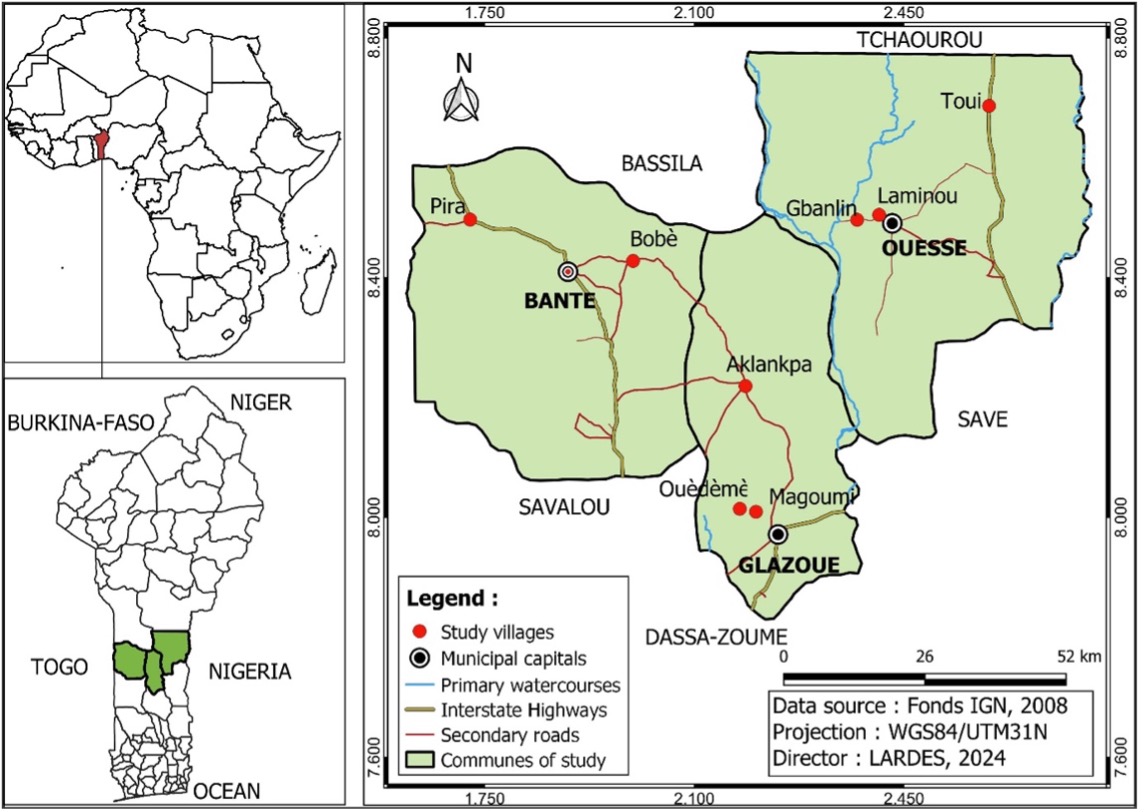
Pigeon pea farms are heterogeneous, applying varied cropping systems. In this context, the study of the typology of farms taking into account the cropping systems they adopt is of practical importance for the implementation of targeted and effective technological interventions. The objective of this research is to identify and characterize the pigeon pea cropping systems practiced in Central Benin. A field survey was conducted among 240 pigeon pea producers randomly selected in the communes of Bantè, Glazoué and Ouèssè. Principal Component Analysis (PCA), Chi-square test of independence, analysis of variance (ANOVA) and multinomial logit regression were used to analyze the collected data. Three types of cropping systems were identified. The first system, adopted by 31.25% of farmers, is characterized by pure stand cultivation, the use of herbicides and a reduced frequency of manual weeding. The second system, chosen by 47.08% of participants, is characterized by mixed cultivation with maize, legumes (soybean, peanut), or other crops (cassava, yam, market garden crops and sometimes in cashew plantations), without the use of herbicides but with a moderate frequency of manual weeding. The third system, adopted by 21.67% of farmers, is characterized by mixed cultivation with maize, the use of herbicides and a limited frequency of manual weeding. These systems have varying levels of economic performance and appear to be specific to each municipality. Factors such as available agricultural area, Mahi ethnicity, and location within the Glazoué and Ouèssè communes significantly influence the choice of these systems. The results advocate for promoting pure stand systems and improved varieties to optimize yields across all cultivation systems.
References
- Abdulhafedh, A. (2017). Incorporating the Multinomial Logistic Regression in Vehicle Crash Severity Modeling: A Detailed Overview. Journal of Transportation Technologies, 07(03), 279‑303. https://doi.org/10.4236/jtts.2017.73019 DOI: https://doi.org/10.4236/jtts.2017.73019
- Adjobo, O., Yabi, J. A., & Gouwakinnou, J. Y. (2020). Typologie des exploitations agricoles productrices d’anacarde au Nord et au Centre du Bénin, Glazoué, Tchaourou et Djougou. Afrique Science, 16(5), 303‑316. https://www.afriquescience.net/PDF/16/5/25.pdf
- Akpatcho, H. L., Crinot, G., Sinha, M., Adegbola, P. Y., & Yabi, J. A. (2022). Analyse de l’evolution de la typologie des exploitations cotonnieres engagees dans la transition agroecologique au Benin et pratiques agroecologiques. Agronomie Africaine, 34(3), 479‑491. https://www.ajol.info/index.php/aga/article/view/240000
- Alla, W. H., Shalaby, E. M., Dawood, R. A., & Zohry, A. A. (2015). Effect of cowpea (Vigna sinensis L.) with maize (Zea mays L.) intercropping on yield and its components. International Journal of Agricultural and Biosystems Engineering, 8(11), 1258‑1264. https://doi.org/10.5281/zenodo.1326836
- Alshurideh, M., Al Kurdi, B., Abu Hussien, A., & Alshaar, H. (2017). Determining the main factors affecting consumers’ acceptance of ethical advertising: A review of the Jordanian market. Journal of Marketing Communications, 23(5), 513‑532. https://doi.org/10.1080/13527266.2017.1322126 DOI: https://doi.org/10.1080/13527266.2017.1322126
- Alvarez, S., Paas, W., Descheemaeker, K., Tittonell, P. A., & Groot, J. C. (2014). Typology construction, a way of dealing with farm diversity: General guidelines for Humidtropics (p. 1‑38) [Report for the CGIAR Program on Integrated Systems for the Humid Tropics]. Netherlands: Wageningen University and Research Centre. Accessed at the address website: https://cgspace.cgiar.org/server/api/core/bitstreams/5ff1127f-f160-4eac-b07e-c59096853216/content
- Ameh, M., & Lee, S. H. (2022). Determinants of loan acquisition and utilization among smallholder rice producers in Lagos state, Nigeria. Sustainability, 14(7), 3900. https://doi.org/10.3390/su14073900 DOI: https://doi.org/10.3390/su14073900
- Andersen, E., Elbersen, B., Godeschalk, F., & Verhoog, D. (2007). Farm management indicators and farm typologies as a basis for assessments in a changing policy environment. Journal of environmental management, 82(3), 353‑362. https://doi.org/10.1016/j.jenvman.2006.04.021 DOI: https://doi.org/10.1016/j.jenvman.2006.04.021
- Asiwe, J. N. A., & Madimabe, K. S. (2020). Performance and economic prospect of pigeonpea varieties in pigeonpea-maize strip intercropping in Limpopo Province. International Journal of Agriculture & Biology, 25(1), 20‑26. https://doi.org/10.17957/IJAB/15.1633 DOI: https://doi.org/10.17957/IJAB/15.1633
- Ayedegue, L. U., Issaka, K., & Yabi, J. A. (2020). Typologie Et Déterminants Des Stratégies D’adaptation Aux Changements Climatiques En Riziculture Au Nord Et Centre Du Bénin. European Scientific Journal, ESJ, 16(6). https://doi.org/10.19044/esj.2020.v16n6p206 DOI: https://doi.org/10.19044/esj.2020.v16n6p206
- Ayenan, M. A. T., Ofori, K., Ahoton, L. E., & Danquah, A. (2017). Pigeonpea [(Cajanus cajan (L.) Millsp.)] production system, farmers’ preferred traits and implications for variety development and introduction in Benin. Agriculture & Food Security, 6(1), 1‑11. https://doi.org/10.1186/s40066-017-0129-1 DOI: https://doi.org/10.1186/s40066-017-0129-1
- Azonkpin, S., Chougourou, D. C., Agbangba, E. C., Santos, C. C. J., Soumanou, M. M., & Vodouhe, S. D. (2018). Typologie des systèmes de culture de coton biologique au Bénin. International Journal of Biological and Chemical Sciences, 12(4), 1688‑1704. https://doi.org/10.4314/ijbcs.v12i4.14 DOI: https://doi.org/10.4314/ijbcs.v12i4.14
- Bandara, B. E. S., De Silva, D. A. M., Maduwanthi, B. C. H., & Warunasinghe, W. (2016). Impact of food labeling information on consumer purchasing decision: With special reference to faculty of Agricultural Sciences. Procedia Food Science, 6, 309‑313. https://doi.org/10.1016/j.profoo.2016.02.061 DOI: https://doi.org/10.1016/j.profoo.2016.02.061
- Bazie, Y. G., Le Cotty, T., D’hôtel, É. M., Ouattara, D. O., & Sanou, A. (2020). Pourquoi une relation positive entre taille des exploitations et productivité au Burkina Faso ? Économie rurale, 371(1), 37‑58. https://doi.org/10.4000/economierurale.7592 DOI: https://doi.org/10.4000/economierurale.7592
- Bélières, J.-F., Rasolofo, P., Rivolala, B., Ratovoarinony, R., Ratsaramiarina, O., Rabevohitra, B. N., & David-Benz, H. (2017). Elaboration de typologies d’exploitations agricoles au niveau infranational à Madagascar : Lac Alaotra et région du Menabe (p. 57). Antananarivo: Programme waw Madagascar (World agricultures watch / Protocole FAO/CIRAD). Accessed at the address website: https://agritrop.cirad.fr/586885/1/2017_D09_TypoWAW_ROR_Menabe_Alaotra_VF.pdf
- Biswas, B., Mallick, B., Roy, A., & Sultana, Z. (2021). Impact of agriculture extension services on technical efficiency of rural paddy farmers in southwest Bangladesh. Environmental Challenges, 5(100261). https://doi.org/10.1016/j.envc.2021.100261 DOI: https://doi.org/10.1016/j.envc.2021.100261
- Budiastutik, I., & Nugraheni, S. A. (2018). Determinant of stunting in Indonesia: A review article. International Journal of Healthcare Research, 1(1), 43‑49. http://download.garuda.kemdikbud.go.id/article.php?article=3059694&val=27909&title=Determinant%20of%20Stunting%20in%20Indonesia%20A%20Review%20Article
- Chanda Venkata, S. K., Nadigatla Veera Prabha Rama, G. R., Saxena, R. K., Saxena, K., Upadhyaya, H. D., Siambi, M., … Sharma, M. (2019). Pigeonpea improvement: An amalgam of breeding and genomic research. Plant Breeding, 138(4), 445‑454. https://doi.org/10.1111/pbr.12656 DOI: https://doi.org/10.1111/pbr.12656
- Chou, H.-L., & Chou, C. (2019). A quantitative analysis of factors related to Taiwan teenagers’ smartphone addiction tendency using a random sample of parent-child dyads. Computers in Human Behavior, 99, 335‑344. https://doi.org/10.1016/j.chb.2019.05.032 DOI: https://doi.org/10.1016/j.chb.2019.05.032
- Cochet, H., & Devienne, S. (2006). Fonctionnement et performances économiques des systèmes de production agricole : Une démarche à l’échelle régionale. Cahiers agricultures, 15(6), 578‑583. https://doi.org/10.1684/agr.2006.0028 DOI: https://doi.org/10.1684/agr.2006.0028
- Collier, D., LaPorte, J., & Seawright, J. (2012). Putting Typologies to Work: Concept Formation, Measurement, and Analytic Rigor. Political Research Quarterly, 65(1), 217‑232. https://doi.org/10.1177/1065912912437162 DOI: https://doi.org/10.1177/1065912912437162
- Dansi, A., Vodouhè, R., Azokpota, P., Yedomonhan, H., Assogba, P., Adjatin, A., … Akpagana, K. (2012). Diversity of the neglected and underutilized crop species of importance in Benin. The scientific world journal, 2012(932947), 1‑19. https://doi.org/10.1100/2012/932947 DOI: https://doi.org/10.1100/2012/932947
- DGCS-ODD. (2019). Spatialisation des cibles prioritaires des ODD au Bénin : Monographie des départements du Zou et des Collines (p. 280) [Monographie]. République du Bénin: Direction Générale de la Coordination et du Suivi des Objectifs de Développement Durable. Accessed at the address website: https://docplayer.fr/210627693-Spatialisation-des-cibles-prioritaires-des-odd-au-benin-monographie-des-departements-du-zou-et-des-collines.html
- Diop, S., Ndiaye, M. M., Diallo, I., & Sene, B. (2022). Analyse des effets des facteurs d’intensification sur les types d’exploitations agricoles du mil sanio au Sénégal. Revue Marocaine des Sciences Agronomiques et Vétérinaires, 10(3), 517‑523. https://www.agrimaroc.org/index.php/Actes_IAVH2/article/view/1268
- Egbe, O. M., & Vange, T. (2008). Yield and agronomic characteristics of 30 pigeon pea genotypes at Otobi in Southern Guinea Savanna of Nigeria. Life Science Journal, 5(2), 70-80.
- Emefiene, M. E., Joshua, V. I., Nwadike, C., Yaroson, A. Y., & Zwalnan, N. D. E. (2014). Profitability analysis of Pigean pea (Cajanus cajan) production in Riyom LGA of Plateau State. International Letters of Natural Sciences, 13(2), 73-88. https://doi.org/10.18052/www.scipress.com/ILNS.18.73 DOI: https://doi.org/10.56431/p-ogjgt1
- Far, S. T., & Rezaei-Moghaddam, K. (2018). Impacts of the precision agricultural technologies in Iran : An analysis experts’ perception & their determinants. Information Processing in Agriculture, 5(1), 173‑184. https://doi.org/10.1016/j.inpa.2017.09.001 DOI: https://doi.org/10.1016/j.inpa.2017.09.001
- Fossou, R. K., Ziegler, D., Zeze, A., Barja, F., & Perret, X. (2016). Two major clades of bradyrhizobia dominate symbiotic interactions with pigeonpea in fields of Côte d’Ivoire. Frontiers in microbiology, 7, 1793. https://doi.org/10.3389/fmicb.2016.01793 DOI: https://doi.org/10.3389/fmicb.2016.01793
- Freguin-Gresh, S., & Razafimahefa, L. (2016). Comparer des situations agricoles pour mieux concevoir des interventions de développement. In Atelier de méthodologie. Comparatisme et interdisciplinarité (Meuriot Véronique (ed.), Lacquement Guillaume (ed.), p. 71‑84). Montpellier: Working Paper n°2– Séance du 2 juin 2016. Accessed at the address https://agritrop.cirad.fr/582827
- Goswami, R., Chatterjee, S., & Prasad, B. (2014). Farm types and their economic characterization in complex agro-ecosystems for informed extension intervention: Study from coastal West Bengal, India. Agricultural and Food Economics, 2(5), 5. https://doi.org/10.1186/s40100-014-0005-2 DOI: https://doi.org/10.1186/s40100-014-0005-2
- Granja, C., Janssen, W., & Johansen, M. A. (2018). Factors determining the success and failure of eHealth interventions: Systematic review of the literature. Journal of medical Internet research, 20(5), e10235. https://doi.org/10.2196/10235 DOI: https://doi.org/10.2196/10235
- Greene, W. H. (2012). Econometric analysis. 7e éd. Rev. Et augm. New york university. New York: Prentice Hall. 1189p.
- Guarín, A., Rivera, M., Pinto-Correia, T., Guiomar, N., Šūmane, S., & Moreno-Pérez, O. M. (2020). A new typology of small farms in Europe. Global Food Security, 26, 100389. https://doi.org/10.1016/j.gfs.2020.100389 DOI: https://doi.org/10.1016/j.gfs.2020.100389
- Gwata, E. T., & Shimelis, H. (2013). Evaluation of pigeonpea germplasm for important agronomic traits in Southern Africa. In Crop Production (26th ed., Goyal A, Asif M (éd.), p. 1-15. https://doi.org/10.5772/56094). London: IntechOpen. Accessed at the address https://www.intechopen.com/chapters/43880
- Hammond, J., Rosenblum, N., Breseman, D., Gorman, L., Manners, R., van Wijk, M. T., … Schut, M. (2020). Towards actionable farm typologies: Scaling adoption of agricultural inputs in Rwanda. Agricultural Systems, 183, 102857. https://doi.org/10.1016/j.agsy.2020.102857 DOI: https://doi.org/10.1016/j.agsy.2020.102857
- Hardev, C. (2016). Performance of farmers’ pigeon pea [Cajanus cajan L. Millsp.] varieties: Opportunities for sustained productivity and dissemination of varieties. International Journal of Agriculture Sciences, 8(61), 3471-3474.
- Hauggaard-Nielsen, H., & Jensen, E. S. (2001). Evaluating pea and barley cultivars for complementarity in intercropping at different levels of soil N availability. Field Crops Research, 72(3), 185‑196. https://doi.org/10.1016/S0378-4290(01)00176-9 DOI: https://doi.org/10.1016/S0378-4290(01)00176-9
- INSAE. (2016). Cahier des villages et quartiers de ville du département des Collines (RGPH-4, 2013) (p. 1‑30). Cotonou, Bénin.: Institut National de la Statistique et de l’Analyse Economique. Accessed at the address website: https://instad.bj/images/docs/insae-statistiques/enquetes-recensements/RGPH/1.RGPH_4/resultats%20finaux/Cahiers%20villages/Cahier%20des%20villages%20et%20quartiers%20de%20ville%20des%20Collines.pdf
- Issaka K, Akpo IF, Zakari FT, Houessingbe Z, Ollabode N, Yabi AJ. 2024. Performance économique et financière des systèmes de culture du Cajanus cajan au Bénin en Afrique de l’Ouest. European Scientific Journal, ESJ, 20(22): 66–100. https://doi.org/10.19044/esj.2024.v20n22p66 DOI: https://doi.org/10.19044/esj.2024.v20n22p66
- Jain, A. R., Nallaswamy, D., Ariga, P., & Ganapathy, D. M. (2018). Determination of correlation of width of Maxillary Anterior Teeth using Extraoral and Intraoral Factors in Indian Population: A systematic review. World J Dent, 9(1), 68‑75. DOI: https://doi.org/10.5005/jp-journals-10015-1509
- Kermah, M., Franke, A. C., Adjei-Nsiah, S., Ahiabor, B. D., Abaidoo, R. C., & Giller, K. E. (2017). Maize-grain legume intercropping for enhanced resource use efficiency and crop productivity in the Guinea savanna of northern Ghana. Field crops research, 213(2017), 38‑50. https://doi.org/10.1016/j.fcr.2017.07.008 DOI: https://doi.org/10.1016/j.fcr.2017.07.008
- Kinhoégbè, G., Djèdatin, G., Loko, L. E. Y., Favi, A. G., Adomou, A., Agbangla, C., & Dansi, A. (2020). On-farm management and participatory evaluation of pigeonpea (Cajanus cajan [L.] Millspaugh) diversity across the agro-ecological zones of the Republic of Benin. Journal of ethnobiology and ethnomedicine, 16(1), 1‑21. https://doi.org/10.1186/s13002-020-00378-0 DOI: https://doi.org/10.1186/s13002-020-00378-0
- Kinhoégbè, G., Djèdatin, G., Saxena, R. K., Chitikineni, A., Bajaj, P., Molla, J., … Varshney, R. K. (2022). Genetic diversity and population structure of pigeonpea (Cajanus cajan [L.] Millspaugh) landraces grown in Benin revealed by Genotyping-By-Sequencing. Plos One, 17(7), e0271565. https://doi.org/10.1371/journal.pone.0271565 DOI: https://doi.org/10.1371/journal.pone.0271565
- Koné, S., & Fok, M. (2021). Typologie pour l’action des exploitations des zones cotonnières de Côte d’Ivoire. Cahiers Agricultures, 30, 13. https://doi.org/10.1051/cagri/2020051 DOI: https://doi.org/10.1051/cagri/2020051
- Kuentz-Simonet, V., Lyser, S., Candau, J., Deuffic, P., Chavent, M., & Saracco, J. (2013). Une approche par classification de variables pour la typologie d’observations : Le cas d’une enquête agriculture et environnement. Journal de la Société Française de Statistique, 154(2), 37‑63. http://www.numdam.org/item/JSFS_2013__154_2_37_0/
- Kwak, S. G., & Kim, J. H. (2017). Central limit theorem: The cornerstone of modern statistics. Korean journal of anesthesiology, 70(2), 144‑156. https://doi.org/10.4097/kjae.2017.70.2.144 DOI: https://doi.org/10.4097/kjae.2017.70.2.144
- Long, J. S., & Freese, J. (2006). Regression models for categorical dependent variables using Stata (2e éd., Vol. 7). Stata press.
- Lowder, S. K., Skoet, J., & Raney, T. (2016). The Number, Size, and Distribution of Farms, Smallholder Farms, and Family Farms Worldwide. World Development, 87, 16‑29. https://doi.org/10.1016/j.worlddev.2015.10.041 DOI: https://doi.org/10.1016/j.worlddev.2015.10.041
- Madani, N., Maleki, M., & Soltani-Mohammadi, S. (2022). Geostatistical modeling of heterogeneous geo-clusters in a copper deposit integrated with multinomial logistic regression: An exercise on resource estimation. Ore Geology Reviews, 150, 105132. https://doi.org/10.1016/j.oregeorev.2022.105132 DOI: https://doi.org/10.1016/j.oregeorev.2022.105132
- MAEP-DPP. (2020). Annuaire statistique agricoles années 2017 à 2019. (p. 1‑441). Bénin: Direction de la Programmation et de la Prospective du Ministère de l’Agriculture de l’Elevage et de la Pêche. Accessed at the address website: https://elearning.agriculture.gouv.bj/bibliotheque/upload/Annuaire%20statistique%20agricole%202017-2019%20B%C3%A9nin.pdf
- Makena, N. S., Ngare, L., & Kago, E. W. (2022). Profitability Analysis of Pigeonpea Production Among Smallholder Farmers in Machakos County, Kenya. East African Agricultural and Forestry Journal, 88(2), 115‑122. https://kalro.org/www.eaafj.or.ke/index.php/path/article/download/586/637
- Manyasa, E. O., Silim, S. N., & Christiansen, J. L. (2009). Variability patterns in Ugandan pigeonpea landraces. Journal of SAT Agricultural Research, 7, 1-9. http://oar.icrisat.org/id/eprint/2024
- Mazoyer, M., & Roudart, L. (1997). Pourquoi une théorie des systèmes agraires? Cahiers Agricultures, 6(6), 591‑595. https://revues.cirad.fr/index.php/cahiers-agricultures/article/view/30057
- Mergeai, G., Kimani, P., Mwang’ombe, A., Olubayo, F., Smith, C., Audi, P., … Le Roi, A. (2001). Survey of pigeonpea production systems, utilization and marketing in semi-arid lands of Kenya. Biotechnology, Agronomy, Society and Environment, 5(3), 145-153. https://popups.uliege.be/1780-4507/index.php?id=14793
- Musafiri, C. M., Macharia, J. M., Ng’etich, O. K., Kiboi, M. N., Okeyo, J., Shisanya, C. A., … Ngetich, F. K. (2020). Farming systems’ typologies analysis to inform agricultural greenhouse gas emissions potential from smallholder rain-fed farms in Kenya. Scientific African, 8, e00458. https://doi.org/10.1016/j.sciaf.2020.e00458 DOI: https://doi.org/10.1016/j.sciaf.2020.e00458
- Mwabila, M. L., Kalambayi, A. R. M., Vumilia, R. K., Murhula, J. C., Kadima, P. K., Bindusa, C. M., … Kizika, C. Z. (2023). Typologie des Exploitations Agricoles Familiales et Technologie de Rouissage de Manioc : Cas des Exploitations de la Commune de Maluku, en République Démocratique du Congo. European Scientific Journal, ESJ, 19(11), 85. https://doi.org/10.19044/esj.2023.v19n11p85 DOI: https://doi.org/10.19044/esj.2023.v19n11p85
- Namuyiga, D. B., Stellmacher, T., Borgemeister, C., & Groot, J. C. J. (2022). A Typology and Preferences for Pigeon Pea in Smallholder Mixed Farming Systems in Uganda. Agriculture, 12(8), 1186. https://doi.org/10.3390/agriculture12081186 DOI: https://doi.org/10.3390/agriculture12081186
- Njira, K. O. W., Nalivata, P. C., Kanyama-Phiri, G. Y., & Lowole, M. W. (2012). Biological nitrogen fixation in sole and doubled-up legume cropping systems on the sandy soils of Kasungu, Central Malawi. Journal of Soil Science and Environmental Management, 3(9), 224‑230. https://academicjournals.org/journal/JSSEM/article-full-text-pdf/2E511F210545.pdf
- Rached, Z., Chebil, A., & Khaldi, R. (2018). Effet de la taille sur l’efficacité technique des exploitations céréalières en Tunisie : Cas de la Région Subhumide. New Medit, 4(4), 82‑89. https://doi.org/10.30682/nm1804g DOI: https://doi.org/10.30682/nm1804g
- Sultana, M., Ahmed, J. U., & Shiratake, Y. (2020). Sustainable conditions of agriculture cooperative with a case study of dairy cooperative of Sirajgonj District in Bangladesh. Journal of Co-operative Organization and Management, 8(1), 100105. https://doi.org/10.1016/j.jcom.2019.100105 DOI: https://doi.org/10.1016/j.jcom.2019.100105
- Yang, S.-E., Vo, T.-L. T., Chen, C.-L., Yang, N.-C., Chen, C.-I., & Song, T.-Y. (2020). Nutritional Composition, Bioactive Compounds and Functional Evaluation of Various Parts of Cajanus cajan (L.) Millsp. Agriculture, 10(11), 558. https://doi.org/10.3390/agriculture10110558 DOI: https://doi.org/10.3390/agriculture10110558
- Zavinon, F., Adoukonou-Sagbadja, H., Keilwagen, J., Lehnert, H., Ordon, F., & Perovic, D. (2020). Genetic diversity and population structure in Beninese pigeon pea [Cajanus cajan (L.) Huth] landraces collection revealed by SSR and genome wide SNP markers. Genetic Resources and Crop Evolution, 67, 191‑208. https://doi.org/10.1007/s10722-019-00864-9 DOI: https://doi.org/10.1007/s10722-019-00864-9
- Zongo, K. F., Hien, E., Drevon, J.-J., Blavet, D., Masse, D., & Clermont-Dauphin, C. (2016). Typologie et logique socio-économique des systèmes de culture associant céréales et légumineuses dans les agro-écosystèmes soudano-sahéliens du Burkina Faso. International Journal of Biological and Chemical Sciences, 10(1), 290‑312. https://doi.org/10.4314/ijbcs.v10i1 DOI: https://doi.org/10.4314/ijbcs.v10i1.23